


















Lesson 30 of 48 · Growth, Hormones and Reproduction
Chapter 6 overview: Growth, hormones and reproduction
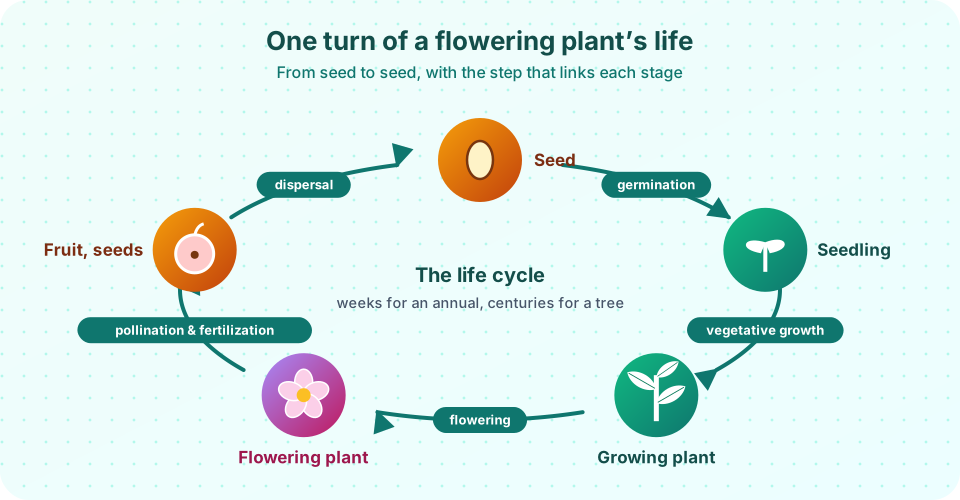
Preview chapter 6 of Botany: the life cycle of a flowering plant, the five main plant hormones, light signals, flowers, pollination, fertilization, seeds and germination.
A plant cannot walk toward light, flee a grazer or choose a mate. It has to solve every one of those problems by growing, and it has to time its growth well. A seed must wait through winter and germinate only when spring comes. A shoot must bend toward a window, a root must turn down into the soil, a tree must flower only after enough warm days have passed. The control system behind all of this is built from hormones, light receptors and a flexible body plan that keeps producing new tissue throughout life. Chapter 6 shows how it works and how plants reproduce.
What you will learn
- How the life cycle of a flowering plant is organized.
- What kinds of signals steer growth, and which lessons cover them.
- Words you will meet: meristem, hormone, tropism, photoperiod, pollination, dormancy.
Key terms
Meristem: a region of undifferentiated cells that keeps dividing and creates new tissues.
Hormone: a chemical messenger active in very small amounts, made in one place and acting in another (or in the same cell).
Tropism: directional growth in response to a stimulus such as light or gravity.
Photoperiod: the length of day (or night) that a plant uses as a cue.
Dormancy: a resting state in which growth is paused until conditions are right.
Plants grow at their tips and keep growing
Animals build a body plan once and then just enlarge it. Plants keep making new organs for their whole lives, because they keep meristems. Apical meristems at the tips of shoots and roots add length (primary growth). Lateral meristems, the vascular cambium and cork cambium, add width to woody stems (secondary growth). A cell produced by a meristem first divides, then elongates, then specializes, and every step is regulated.
This open design shapes how plants respond to the world. A shaded shoot elongates toward light. A pruned shoot wakes up side buds. A drought makes roots grow deeper. Instead of reacting with muscles, plants change how and where they grow. Hormones are the main messengers that coordinate this; light receptors and the plant's internal clock tell the hormones when to act.
Two kinds of growth plans
- Annuals such as wheat and sunflower go from seed to seed in one season and die.
- Biennials such as carrots grow leaves the first year and flower in the second.
- Perennials such as grasses, shrubs and trees live for many years and flower repeatedly.
The plan decides when a plant spends its energy on growth and when on reproduction. A flowering plant changes from making leaves to making flowers by turning its apical meristem into a floral meristem, a switch controlled by day length, temperature and age.
How plants steer growth
Signals combine into one decision
How plants reproduce
Seeds let plants travel in time and space
What each lesson covers
- Plant hormones introduces auxin, gibberellins, cytokinins, abscisic acid and ethylene: the experiments that found them, what they do and how they combine.
- Light signals and tropisms explains phototropism, gravitropism, phytochrome, photoperiodism and flowering.
- Flowers, pollination and seeds covers flower anatomy, pollination, double fertilization, fruits, dispersal and germination.
- Chapter 6 review recaps the chapter and checks your understanding.
A note on lab and field work
The discoveries in this chapter come from clever experiments: Darwin's grass seedlings in the 1880s, Went's agar blocks in 1928, the day-length trials of Garner and Allard in 1920, and the red-light studies of Borthwick and colleagues in the 1950s. This course describes what those experiments found; it never invents measurements. When you do your own plant experiments, record only what you actually observe.
Common misconceptions
"Plants do not respond to their surroundings." They respond constantly, but by growing differently, so the change is slow enough to miss.
"A hormone has one job." Each plant hormone has many effects, and the same hormone can have opposite effects in different tissues or at different concentrations.
Summary
- Plants keep meristems and grow throughout life, so growth decisions replace movement.
- Hormones, light, gravity and temperature are combined to time germination, shoot and root growth and flowering.
- Flowering plants reproduce with flowers, pollination, double fertilization, fruits and seeds.
- The next three lessons cover hormones, light signals and the reproductive cycle in detail.
Next: Plant hormones
Track your progress
Create a free account to tick off lessons and pick up where you left off on any device.
of Botany and Plant Science lessons completed