


















Lesson 46 of 48 · Projects and Practice
Glossary of plant science terms
A glossary of more than 55 key terms from the botany chapters on transport, growth, diversity, ecology and biotechnology, with flashcards for self-testing.
Plant science has a large vocabulary, but most of it is built from a small set of ideas and a few Greek and Latin roots. This glossary collects the terms you met in chapters 5 to 8, arranged alphabetically so you can find them fast, followed by flashcards for self-testing. Each entry is a short definition, with a pointer to the lesson that explains it in depth.
What you will learn
- The meaning of the key terms in chapters 5 to 8.
- Word roots that help you decode new terms.
- How to test yourself with flashcards.
Key terms
Glossary: an alphabetical list of terms with short definitions.
Root word: a Greek or Latin part that carries meaning, such as photo- (light) or -tropism (turning).
Active recall: testing yourself instead of rereading, which improves memory.
Word roots worth knowing
| Root | Meaning | Example |
|---|---|---|
| photo- | light | photoperiod, photosynthesis |
| -tropism | turning toward or away | phototropism, gravitropism |
| hydro- | water | hydroponics, hydrotropism |
| xylo- | wood | xylem |
| phloe- | bark | phloem |
| gymno- | naked | gymnosperm |
| angio- | vessel, enclosed | angiosperm |
| poly- | many | polyploid |
| mono- / di- | one / two | monocot, dicot |
| gamete- | marriage partner | gametophyte |
| -phyte | plant | bryophyte, sporophyte |
Glossary A to P
Abscisic acid (ABA): a hormone that closes stomata and maintains seed dormancy. See plant hormones.
Angiosperm: a flowering plant whose seeds develop inside an ovary. See seed plants.
Apical dominance: suppression of side buds by auxin from the growing tip.
Aquaporin: a membrane channel protein that lets water cross quickly.
Auxin: the hormone (mainly IAA) that elongates cells and organizes growth.
Biome: a large region defined by climate and dominant vegetation. See plant ecology.
Callus: undifferentiated cells grown in tissue culture.
Carpel: the female part of a flower: stigma, style and ovary.
Casparian strip: a waxy band in the root endodermis that forces ions through cell membranes.
Cavitation: breaking of the water column in the xylem, leaving an air bubble.
Cohesion-tension theory: the explanation of water rising in xylem by evaporation-driven tension and water's cohesion.
Cotyledon: a seed leaf of the embryo.
Cuticle: the waxy waterproof layer covering leaves and stems.
Cytokinin: a hormone promoting cell division and delaying leaf aging.
Domestication syndrome: traits shared by crops, such as non-shattering seed heads. See agriculture and crops.
Dormancy: a resting state in seeds or buds.
Double fertilization: fusion of one sperm with the egg and another with the central cell in flowering plants. See flowers, pollination and seeds.
Endosperm: triploid nutritive tissue of a flowering-plant seed.
Essential element: an element a plant cannot complete its life cycle without; there are 17.
Ethylene: a gaseous hormone that ripens fruit and ages tissue.
Florigen: the mobile flowering signal, the FT protein.
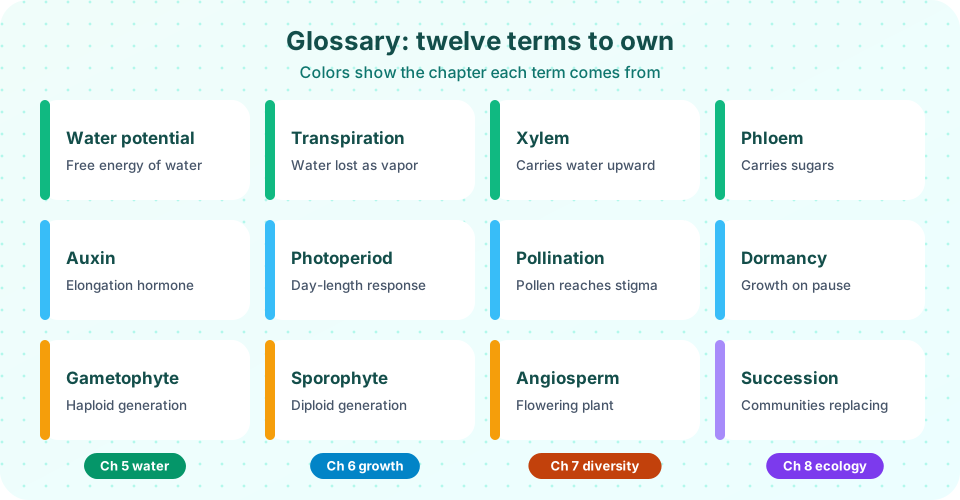
Gametophyte: the haploid, gamete-producing generation of a plant.
Gibberellin: a hormone that stretches stems and breaks seed dormancy.
Guard cells: the paired cells that open and close a stoma.
Gymnosperm: a seed plant with naked seeds, such as a pine.
Heterospory: production of two kinds of spores, small male and large female.
Imbibition: uptake of water by a dry seed.
Liebig's law of the minimum: growth is limited by the scarcest essential resource.
Meristem: a region of dividing cells that makes new tissue.
Mycorrhiza: a partnership between a fungus and plant roots.
Net primary productivity (NPP): plant dry matter added per year after respiration.
Nitrogenase: the bacterial enzyme that reduces nitrogen gas to ammonia.
Osmosis: net movement of water across a membrane toward lower water potential.
Ovule: the structure that becomes a seed after fertilization.
Phloem: living tissue that carries sugars from sources to sinks.
Photoperiodism: response to the length of day and night.
Phylogeny: the evolutionary family tree of a group.
Phytochrome: a red and far-red receptor with Pr and Pfr forms. See light signals and tropisms.
Plasmolysis: shrinkage of the cell membrane away from the wall in a strong solution.
Pollination: transfer of pollen from an anther to a stigma.
Polyploid: having more than two sets of chromosomes.
Pressure flow: the model in which osmotic pressure pushes sap through phloem.
Glossary S to Z
Seed: a protected embryo with a food supply and a seed coat.
Sink and source: a tissue that imports sugar, and one that exports it.
Solute potential (Ψs): the effect of dissolved solutes on water potential; always zero or negative.
Sporophyte: the diploid, spore-producing generation of a plant.
Stoma: a pore in the leaf epidermis bounded by two guard cells. See transpiration and stomata.
Succession: gradual replacement of one community by another after a disturbance.
T-DNA: the segment of the Agrobacterium Ti plasmid transferred into plant cells.
Totipotency: the ability of one cell to regenerate a whole plant.
Tracheid and vessel element: water-conducting cells of the xylem.
Transgenic plant: a plant carrying a gene from another species.
Transpiration: loss of water vapor from a plant, mainly through stomata.
Tropism: directional growth in response to a stimulus.
Turgor: the pressure of cell contents against the wall (positive pressure potential).
Vascular tissue: xylem and phloem.
Vernalization: a cold period that allows flowering.
Water potential (Ψ): the free energy of water, in MPa; water moves toward lower values. See water potential and osmosis.
Xylem: dead, lignified tissue that carries water and minerals upward.
Zygote: the diploid cell formed when a sperm fuses with an egg.
Try it
First, flashcards. Click a card to flip it, then use the buttons to move on or shuffle. The definitions are shortened versions of the glossary.
Second, a small matching quiz in code. It prints a term and four possible definitions, then checks your answer with a fixed seed so the output is repeatable. Edit the answers list to try it.
Press Run (or Ctrl + Enter) to see the result here.
Program input · what you'd type while the program runs
Type the answers before you press Run, one per line. Each time the program reads a line (with input()), it gets the next line from this box.
Check your understanding
Quick check · 4 questions
of 4 answered You scored / 4 · perfect!
-
1. Which pair is correctly matched?
The sporophyte is diploid and produces spores by meiosis; the gametophyte is haploid. -
2. What does the root -tropism mean?
Phototropism and gravitropism are turning responses to light and gravity. -
3. Which term describes the Pr and Pfr receptor that senses red and far-red light?
Phytochrome switches between Pr (absorbs red) and Pfr (absorbs far-red). -
4. Which term describes a plant cell membrane pulling away from its wall in a strong solution?
Plasmolysis is the loss of turgor to the point where the membrane detaches from the wall.
Summary
- The vocabulary of botany rests on a few ideas: water potential, transport tissues, hormones and light, generations, ecology and biotechnology.
- Greek and Latin roots such as photo-, -tropism and gymno- help you decode new terms.
- Test yourself with flashcards and matching exercises instead of rereading.
- The glossary links back to the lesson that explains each idea in depth.
Next: Botany cheat sheet
Track your progress
Create a free account to tick off lessons and pick up where you left off on any device.
of Botany and Plant Science lessons completed