


















Lesson 44 of 48 · Ecology, Agriculture and Biotechnology
Chapter 8 review: Ecology, agriculture and biotechnology
Review chapter 8 of Botany: biomes and productivity, succession, domestication and the Green Revolution, tissue culture, GM crops and CRISPR, with ten questions.
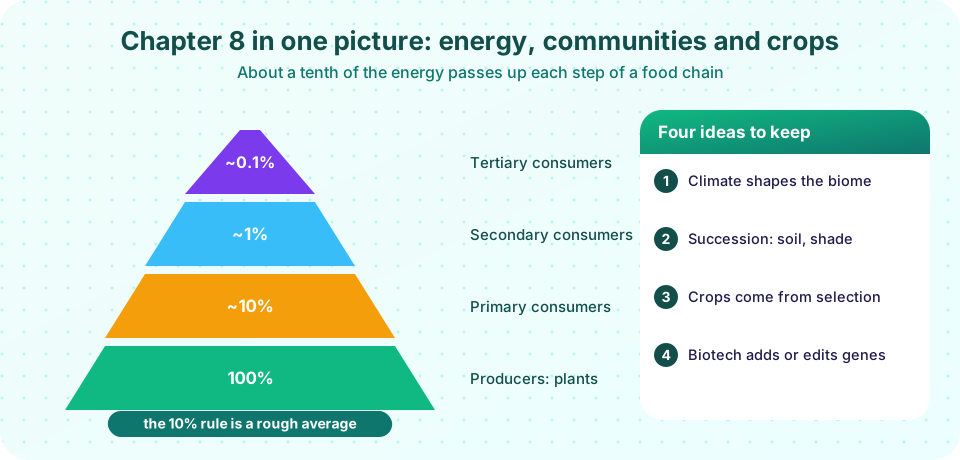
This chapter moved from individual plants to the world they build and the world we build from them. You saw how climate decides biomes, how communities change after disturbance, how people turned wild grasses into crops, and how biotechnology adds new ways of changing plants. The review links these into one story and tests whether you can apply it.
What you will learn
- How the four lessons form one picture of plants, ecosystems and farming.
- Key facts and formulas to remember.
- How well you can answer mixed questions.
Key terms
NPP: net primary productivity, the dry matter plants add per year after respiration.
Succession: gradual replacement of communities, primary (bare ground) or secondary (soil remains).
Domestication syndrome: the shared traits of crops, including non-shattering heads and bigger seeds.
Totipotency: the ability of a plant cell to regenerate a whole plant.
CRISPR-Cas9: a guide-RNA-directed DNA-cutting system used for genome editing.
The chapter in one paragraph
Plants capture solar energy, and only about a tenth of the energy at each step passes up the food chain, so plants form the broad base of every ecosystem. Climate, mainly temperature and precipitation, decides the biome and sets NPP, as in the Miami model. After disturbance, succession rebuilds the community from pioneers to forest. People domesticated crops by selecting for traits such as non-shattering seed heads, then used polyploidy, hybrids and the Green Revolution's semi-dwarf varieties to raise yields, at environmental and social costs that sustainable practices try to reduce. Tissue culture regenerates plants from cells; Agrobacterium and gene guns create transgenic plants; CRISPR edits a plant's own genes. Whether a technology is good depends on the trait, the crop, the evidence and who benefits.
Recap table
| Lesson | Key ideas | Numbers and names |
|---|---|---|
| Plant ecology and biomes | Limiting factors, biomes, interactions, succession, conservation | NPP_T = 3000 / (1 + exp(1.315 − 0.119 T)); NPP_P = 3000 (1 − exp(−0.000664 P)); Connell and Slatyer 1977 |
| Agriculture and crops | Domestication, centers of origin, polyploidy, Green Revolution | Bread wheat 2n = 42; Borlaug; IR8 (1966); Vavilov |
| Plant biotechnology | Tissue culture, Agrobacterium, GM crops, CRISPR | Skoog and Miller; MS medium (1962); NGG PAM; Doudna and Charpentier 2012 |
Worked review problems
Problem 1. A grassland produces 4,000 kJ of energy per square meter in plant tissue. Using the 10% rule, how much reaches secondary consumers?
Primary consumers receive about 10% of 4,000 kJ = 400 kJ. Secondary consumers receive about 10% of that, about 40 kJ per square meter. The rule is a rough average and the actual efficiency varies from about 5% to 20%.
Problem 2. A breeder needs a plant that is recessive at three independent genes. How likely is a given F₂ plant to have that genotype, and why does the work grow so fast?
Each gene gives 1/4, so three genes give (1/4)³ = 1/64. Every extra gene multiplies the number of plants needed by about four.
Problem 3. A cut stem segment on medium with high cytokinin and low auxin forms shoots. How would you induce roots?
Switch the ratio: a medium with a high auxin-to-cytokinin ratio promotes root formation, as Skoog and Miller found.
Common misconceptions
"The 10% rule is an exact law." It is a rough average; real transfer efficiencies range from a few percent to about 20%, depending on the organisms and the ecosystem.
"A GM crop is always dangerous, or always harmless." Each trait and crop is judged on its evidence; blanket statements in either direction miss the point.
"Succession ends in a permanent forest." It depends on the climate and disturbances, and many communities keep changing.
Check your understanding
Quick check · 10 questions
of 10 answered You scored / 10 · perfect!
-
1. About what fraction of energy passes from one trophic level to the next, as a rough average?
Most energy is lost as heat in respiration, so about 10% is stored in the next level. -
2. Which biome has permafrost, mosses, lichens and dwarf shrubs?
Tundra has a very cold climate with a short growing season. -
3. Secondary succession differs from primary succession because it
Soil and seed banks make secondary succession faster. -
4. Which is NOT a domestication syndrome trait?
Crops have non-shattering seed heads; shattering is the wild trait. -
5. What made semi-dwarf wheat and rice valuable in the Green Revolution?
Short, stiff stems stood up under heavy grain heads, so farmers could add nitrogen. -
6. Bread wheat has 42 chromosomes and is described as
Hexaploid wheat has six sets of seven chromosomes (2n = 42). -
7. Which hormone ratio in a culture medium promotes roots?
A high auxin-to-cytokinin ratio gives roots; the reverse gives shoots. -
8. What does the PAM sequence do for Cas9?
Cas9 needs an NGG PAM adjacent to the 20-nt target. -
9. In the Miami model, a site's NPP is
Whichever factor is more limiting sets NPP. -
10. Why is genetic uniformity in a crop risky?
Uniform genotypes share the same vulnerabilities.
Summary
- Energy flows up with about 10% passed on at each step, making plants the base of the food web.
- Climate sets biomes and NPP; succession rebuilds communities after disturbance.
- Domestication, polyploidy, hybrids and the Green Revolution produced today's crops; sustainability balances yield and environment.
- Tissue culture, transgenics and CRISPR extend breeding; judge each case on trait, evidence and benefit.
- Chapter 9 puts it all to work with a lab project, a glossary, a cheat sheet and a path for further study.
Track your progress
Create a free account to tick off lessons and pick up where you left off on any device.
of Botany and Plant Science lessons completed