


















Lesson 40 of 48 · Ecology, Agriculture and Biotechnology
Chapter 8 overview: Ecology, agriculture and biotechnology
Preview chapter 8 of Botany: how climate shapes biomes, how plant communities change over time, how crops were domesticated, and how biotechnology reshapes plants.
Plants are the base of nearly every food web on land. They feed animals, make the air we breathe, hold soil in place and store carbon. People have also reshaped them for ten thousand years, turning a few wild grasses into the crops that feed the world, and in the last fifty years we have learned to move single genes between species. Chapter 8 widens the lens from the individual plant to the community, the farm and the laboratory.
What you will learn
- How climate maps onto the major biomes.
- How plant communities change after a disturbance.
- How crops came from wild plants, and how modern breeding and genetic tools build on that history.
- What each lesson of this chapter covers.
Key terms
Biome: a large region defined by its climate and dominant vegetation.
Succession: the gradual replacement of one community by another after a disturbance.
Domestication: genetic change in a species through human selection, resulting in dependence on people.
Net primary productivity (NPP): the amount of organic matter plants produce per unit area per year, after their own respiration.
Transgenic plant: a plant carrying a gene from another species.
Plants and the planet
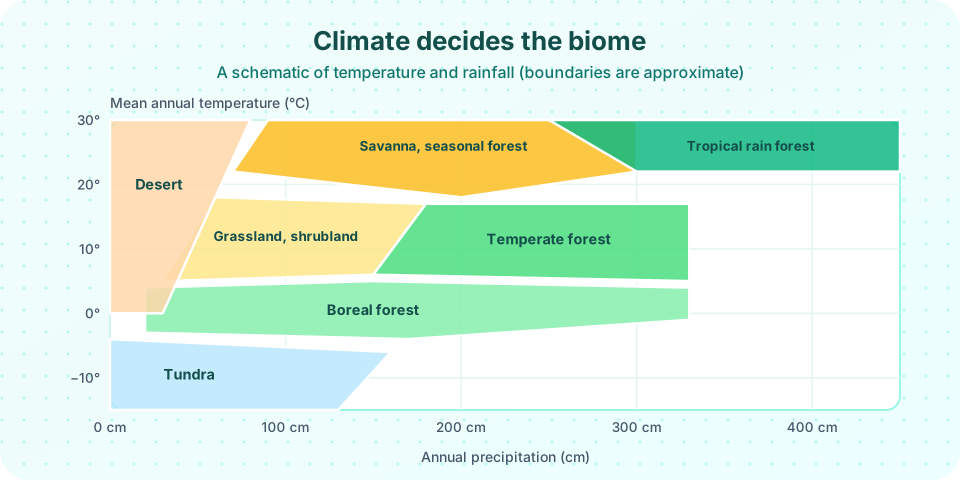
Plants are not a small part of life on Earth. A widely cited 2018 estimate by Yinon Bar-On and colleagues put the total living carbon on Earth at about 550 gigatons, with plants accounting for around 450 gigatons, roughly 80%. On land they fix on the order of 55 to 60 gigatons of carbon a year by photosynthesis. The way that production is distributed depends on climate: a tropical rain forest produces far more per hectare than a desert or tundra, and the mix of plant forms that dominates (trees, grasses, shrubs, mosses) changes with temperature and rainfall.
From wild plants to the farm
About 12,000 years ago, in several parts of the world, people began planting and saving seed. Over generations, their choices changed plants: seeds became larger, stayed on the plant instead of shattering, and sprouted more evenly. Agriculture made towns, cities and written records possible. Today three grasses (wheat, rice and maize) provide roughly 40% to 50% of the calories humans eat (estimates vary with the year and the method), and a handful of crops carry the load of feeding eight billion people. Plant breeding increased yields enormously in the 20th century, and now new tools such as genome editing aim at diseases, droughts and nutrition.
Ecology
Plants build ecosystems
Agriculture
Farming is applied botany
Biotechnology
New tools, old goals
What each lesson covers
- Plant ecology and biomes covers limiting factors, biomes, competition and partnerships, succession, and conservation, with a productivity model.
- Agriculture and crops covers domestication, the Green Revolution, breeding, polyploidy and sustainable farming, with calculators for growing degree days and breeding population size.
- Plant biotechnology covers tissue culture, Agrobacterium, gene guns, GM crops, CRISPR and the debates around them.
- Chapter 8 review recaps and quizzes.
Evidence and balance
Several topics in this chapter, such as GM crops, fertilizers and conservation, involve debates among scientists, farmers, businesses and the public. The lessons present what experiments and regulators have found, separate well-supported conclusions from open questions, and note where views differ. When a number is an estimate, the text says so.
Common misconceptions
"Plants are passive scenery in an ecosystem." They compete, cooperate, defend themselves and change soil, water and climate around them.
"Domestication is just agriculture with fancier plants." It is a genetic change in the plant that makes it depend on people; many domesticated crops cannot survive without help.
Summary
- Climate, mainly temperature and precipitation, sets the biome and its productivity.
- Plant communities change through succession after disturbance.
- Domestication and breeding transformed a few wild plants into global crops.
- Biotechnology adds tissue culture, transgenics and gene editing to the breeder's toolkit.
Next: Plant ecology and biomes
Track your progress
Create a free account to tick off lessons and pick up where you left off on any device.
of Botany and Plant Science lessons completed