


















Lesson 32 of 48 · Growth, Hormones and Reproduction
Light signals and tropisms
How plants sense light and gravity: phototropism and auxin, gravitropism, the phytochrome red and far-red switch, photoperiodism and flowering, with day-length calculations.
A houseplant on a windowsill leans toward the glass. A seed buried by a gardener sends its root down and its shoot up, even in complete darkness. Poinsettias flower at Christmas, spinach bolts in the long days of early summer, and chrysanthemums bloom in autumn. In every case the plant is reading its environment and turning the information into growth. Plants carry several families of light receptors and a gravity sensor, and they use hormones, mainly auxin, to turn signals into bending. This lesson explains the sensors, the bending, and the way plants measure the length of a night.
What you will learn
- How phototropism and gravitropism work, and the role of auxin.
- What phytochrome and cryptochrome do and how the red and far-red switch works.
- How photoperiodism controls flowering, and why "short-day" really means "long-night".
- How to compute day length for a place and date.
Key terms
Tropism: growth toward or away from a stimulus (positive or negative).
Phototropin and cryptochrome: blue-light receptors; phototropins drive bending and stomatal opening.
Phytochrome: a red/far-red receptor that exists in an inactive form (Pr) and an active form (Pfr).
Photoperiodism: a response to the relative lengths of day and night.
Florigen: a mobile flowering signal, now identified as the FT protein, made in leaves and carried in the phloem.
Phototropism: bending toward blue light
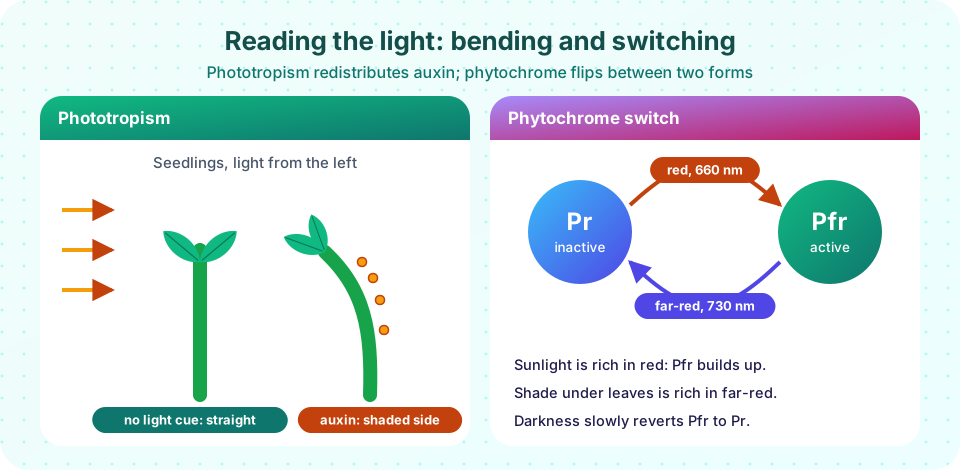
When light hits a shoot from one side, the shoot bends toward it. This is positive phototropism. It is a growth response, not a movement of cells, and it follows a simple rule:
- Blue light receptors called phototropins, concentrated near the shoot tip, detect the light direction.
- Auxin is redistributed toward the shaded side of the stem. This idea was developed by Nikolai Cholodny and Frits Went in the 1920s and is called the Cholodny-Went model.
- Cells on the shaded side elongate more, and the stem curves toward the light.
Roots usually show weak or negative phototropism, which helps them grow into soil. The effect works best for blue light in the 400 to 500 nm range. Pale seedlings grown in the dark are drawn to even a small light leak, which is why seedlings on a windowsill turn so quickly.
Gravitropism: knowing which way is down
A seedling germinating in the dark has no light to guide it, but its root still turns downward (positive gravitropism) and its shoot turns upward (negative gravitropism).
The sensors are statoliths: dense starch-filled organelles called amyloplasts that sit in specialized cells (columella cells in the root cap, and cells around the vascular tissue in shoots). When the plant is tilted, the statoliths sink to the new low side of the cell. This triggers a redistribution of auxin, again carried by PIN proteins.
Here is the neat twist: the same auxin gradient has opposite effects on roots and shoots. In a horizontal shoot, more auxin builds on the lower side, which speeds growth there and the shoot curves up. In a horizontal root, more auxin on the lower side slows growth there, because roots are much more sensitive to auxin, and the root curves down. You saw the underlying dose-response difference in plant hormones.
Other directional responses include thigmotropism (growth in response to touch, as in a pea tendril wrapping a wire) and hydrotropism (roots turning toward moisture).
Phytochrome: a switch that reads the color of light
Sunlight is a mix of colors, and leaves absorb red and blue strongly but let far-red light (about 730 nm) pass or reflect. Light that has gone through a leaf, or reflected from one, is therefore enriched in far-red. A plant can use this to detect shade from neighbors.
The receptor behind this is phytochrome, discovered in the 1950s by Harry Borthwick, Sterling Hendricks and colleagues at the US Department of Agriculture, and isolated by Warren Butler and coworkers in 1959. It exists in two interconvertible forms:
- Pr absorbs red light (about 660 nm). When it does, it converts to Pfr.
- Pfr absorbs far-red light (about 730 nm) and converts back to Pr. In darkness, Pfr also slowly reverts to Pr or breaks down.
Pfr is the active form: it moves into the nucleus and changes gene expression. So the ratio of Pfr to total phytochrome reports the ratio of red to far-red light. Borthwick and Hendricks found this by testing lettuce seed. Lettuce seeds germinate after a flash of red light, but a flash of far-red light right afterward cancels the effect. You can alternate the flashes for as long as you like, and the seed obeys the last one it received. Phytochrome therefore controls germination, seedling de-etiolation (the switch from pale, elongated dark growth to green, compact light growth), flowering and shade avoidance, in which plants under a canopy stretch their stems to reach light.
Cryptochromes, another family of blue-light receptors, regulate seedling growth and set the internal circadian clock, together with phytochromes. The clock gives plants a way to measure time of day and season.
Photoperiodism and flowering
Many plants flower at a particular time of year. In the 1910s and 1920s Wightman Garner and Henry Allard at the US Department of Agriculture studied a tobacco variety, 'Maryland Mammoth', that grew very tall but did not flower until winter. They realized it needed shorter days. They then named three kinds of response.
| Type | Flowering is triggered by | Examples |
|---|---|---|
| Short-day plants (SDP) | Nights longer than a critical length | Chrysanthemum, poinsettia, soybean, cocklebur |
| Long-day plants (LDP) | Nights shorter than a critical length | Spinach, lettuce, wheat, Arabidopsis |
| Day-neutral plants | Age or other cues, not day length | Tomato, cucumber, many tropical plants |
It is the night that counts
In the late 1930s, Karl Hamner and James Bonner worked with cocklebur, a short-day plant. They found that a single brief flash of light in the middle of a long night prevented flowering, but interrupting the day with darkness had no effect. So the plant is measuring the uninterrupted night length: "short-day plants" are really long-night plants, and "long-day plants" are short-night plants. A red flash given in the night counts as light, and a far-red flash right after cancels it, tying phytochrome to the effect. Growers use this: they cover chrysanthemums with black cloth to create long nights for early flowers, or flash lights in the night to keep plants vegetative.
The signal is made in the leaves
If you cover one leaf of a short-day plant and give the rest of the plant long days, the plant still flowers: the covered leaf's long night is enough. The leaf sends a mobile signal to the shoot apex. This hypothetical signal was named florigen by the Russian physiologist Mikhail Chailakhyan in 1936. Decades later, between 2005 and 2007, several teams showed that florigen is the FT protein, made in leaf phloem companion cells and carried through the phloem to the meristem, where it triggers a floral program. The circadian clock, via a protein called CONSTANS, decides when FT is made.
Some plants also need a period of cold, called vernalization, before flowering. Winter wheat sown in autumn and flowering after winter is the best-known example. This ensures flowering does not happen in a warm spell in autumn.
Common misconceptions
"Plants bend toward light because they are attracted to it." The bending is differential growth: auxin builds up on the shaded side, and cells there elongate faster.
"Short-day plants need short days." They need long uninterrupted nights. A short day with a lit night would not do.
"Plants only see visible light." Phytochrome senses red and far-red at the edge of visible light; plants also have receptors for blue, ultraviolet-B and green light.
Try it
First, compute the length of the day for several latitudes through the year. The formula uses the sun's declination (how far north or south of the equator the sun is overhead): declination = −23.44° × cos(360°/365 × (N + 10)), where N is the day of the year, and day length = (24/π) × arccos(−tan(latitude) × tan(declination)). It is a standard astronomical approximation that ignores atmospheric refraction.
Press Run (or Ctrl + Enter) to see the result here.
Program input · what you'd type while the program runs
Type the answers before you press Run, one per line. Each time the program reads a line (with input()), it gets the next line from this box.
Second, an interactive flowering-response explorer. It is a simplified model of the rules above (critical night lengths are typical illustrations, since each species has its own), not a prediction for a real plant.
Check your understanding
Quick check · 6 questions
of 6 answered You scored / 6 · perfect!
-
1. In phototropism, where does auxin accumulate in a stem lit from one side?
Auxin moves to the shaded side; cells there elongate more, so the stem curves toward the light. -
2. What are statoliths?
Dense starch-filled amyloplasts sink to the low side of the cell and trigger auxin redistribution. -
3. Which light form of phytochrome is active?
Red light (about 660 nm) converts inactive Pr to active Pfr; far-red (about 730 nm) converts it back. -
4. A short-day plant is exposed to a long night interrupted by a brief flash of light. What happens?
Short-day plants measure uninterrupted night length; a flash splits the night and prevents flowering. -
5. What is florigen, as currently understood?
Florigen was hypothesized in 1936 and identified as FT protein in 2005 to 2007. -
6. Under a dense leaf canopy, the light is rich in far-red. What does a plant typically do?
A low Pfr ratio signals shading and triggers stem elongation.
Summary
- Phototropism and gravitropism are growth responses made by moving auxin; the same gradient bends shoots and roots in opposite directions because they respond differently to auxin.
- Statoliths in specialized cells sense gravity; phototropins sense blue light direction.
- Phytochrome flips between Pr (absorbs red) and Pfr (active, absorbs far-red), so it reads the red to far-red ratio and signals shade, germination and de-etiolation.
- Plants measure the uninterrupted night length, and short-day plants are really long-night plants.
- Leaves make the flowering signal (FT protein, florigen) and send it through the phloem; some plants also need vernalization.
Track your progress
Create a free account to tick off lessons and pick up where you left off on any device.
of Botany and Plant Science lessons completed