


















Lesson 34 of 48 · Growth, Hormones and Reproduction
Chapter 6 review: Growth, hormones and reproduction
Review chapter 6 of Botany: five plant hormones, light signals and photoperiodism, flowers, pollination, double fertilization, seeds and germination, with ten questions.
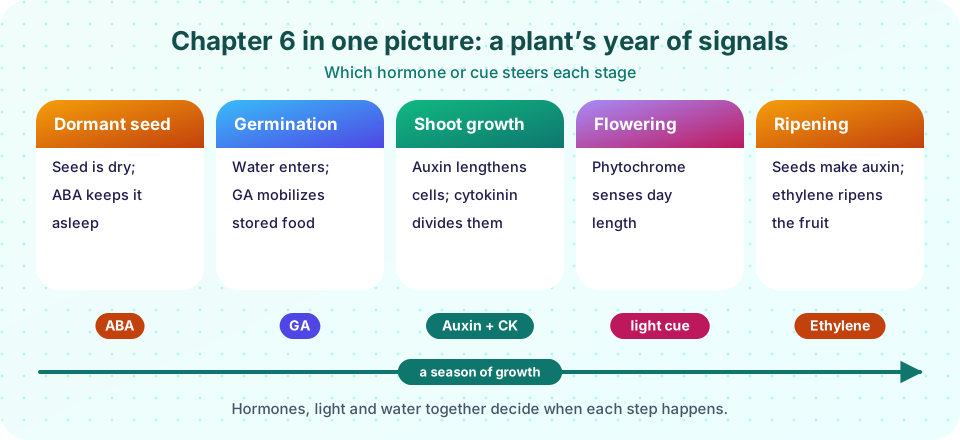
This chapter followed a plant through a whole year of decisions. A dormant seed waits, then germinates when water, warmth and hormones allow. The seedling bends toward light, grows tall or bushy depending on its hormone balance, measures the night to decide when to flower, and finally pollination and double fertilization produce the next generation of seeds. Use this review to see the pieces as one story and to test whether you can use them.
What you will learn
- How hormones, light and flowers link into a single life-cycle story.
- Key facts and experiments to remember.
- How to apply them in mixed questions.
Key terms
Auxin / gibberellin / cytokinin / ABA / ethylene: the five classic plant hormones.
Phytochrome: red and far-red receptor with inactive Pr and active Pfr forms.
Photoperiodism: response to day and night length; plants measure uninterrupted night.
Double fertilization: sperm 1 makes the zygote (2n), sperm 2 makes endosperm (3n).
Dormancy: a resting state, often governed by ABA versus gibberellin.
The chapter in one paragraph
A seed stays dormant while ABA is high and wakes when water, temperature and gibberellin tip the balance, mobilizing food stores. The seedling reads light with phytochrome, cryptochrome and phototropins, and gravity with starch-filled statoliths; both signals are turned into growth by auxin, which also keeps side buds suppressed. Cytokinin from roots promotes division and bushy growth. Leaves measure the length of the night and send florigen (FT protein) through the phloem to switch the shoot apex to flowers. Flowers receive pollen, the pollen tube delivers two sperm, and double fertilization makes a zygote and endosperm. The ovule becomes a seed and the ovary becomes a fruit, whose ethylene-driven ripening and dispersal start the cycle again.
Recap table
| Lesson | Main ideas | Facts worth remembering |
|---|---|---|
| Plant hormones | Five hormones, balance over single effects | Went 1928 agar blocks; Skoog and Miller: high auxin gives roots, high cytokinin gives shoots; ABA versus GA for dormancy; ethylene is an autocatalytic gas |
| Light signals and tropisms | Bending is differential growth; phytochrome is a switch | Pr absorbs 660 nm and becomes Pfr; Pfr absorbs 730 nm; short-day plants measure long nights; florigen is the FT protein |
| Flowers, pollination and seeds | Flower parts; pollination versus fertilization | Zygote 2n; endosperm 3n; ovule gives seed, ovary gives fruit; imbibition starts germination |
Worked review problems
Problem 1. A grower wants a spring-flowering chrysanthemum (a short-day plant) to bloom in summer. What can she do?
She must give long nights. She can cover the plants with black cloth in the evening and uncover them in the morning so that each night lasts longer than the plant's critical night length. Light at night would do the opposite.
Problem 2. At 40° N on 21 June the day length is about 14.8 hours. A long-day plant has a critical day length of 14 hours. Will it flower?
Yes. The longest night is about 24 − 14.8 = 9.2 hours, which is shorter than the plant's critical night length of 10 hours, so the long-day plant receives its flowering signal.
Problem 3. A tissue culture contains callus. The scientist wants shoots. Which hormone ratio should she use?
A higher cytokinin-to-auxin ratio drives shoot formation, according to the Skoog and Miller experiments. A higher auxin-to-cytokinin ratio gives roots.
Common misconceptions
"Plants flower when days are long enough." What matters is the uninterrupted night; a long-day plant is really a short-night plant.
"Pollination makes seeds." Pollination only delivers pollen. Seeds form after the pollen tube grows and fertilization takes place.
"Auxin makes shoots grow, so more auxin always makes them grow more." High concentrations inhibit growth, and roots are inhibited at lower concentrations than shoots.
Check your understanding
Quick check · 10 questions
of 10 answered You scored / 10 · perfect!
-
1. Which pair of hormones mainly decides whether a seed stays dormant or germinates?
ABA maintains dormancy and gibberellin promotes germination. -
2. A horizontal root bends down because
Roots are inhibited by the auxin that builds up on their lower side, so the upper side grows faster and the root curves down. -
3. What converts inactive Pr to active Pfr?
Red light converts Pr to Pfr; far-red light converts Pfr back to Pr. -
4. A short-day plant is grown on a 16-hour light and 8-hour dark cycle. What happens?
Short-day plants need long uninterrupted nights; an 8-hour night is too short. -
5. Which tissue is triploid in a flowering plant seed?
The central cell has two nuclei and fuses with one sperm to make 3n endosperm. -
6. The ovary of a flower becomes
The ovule becomes the seed and the ovary becomes the fruit. -
7. Which hormone is a gas that ripens climacteric fruit?
Ethylene is a simple gas that triggers and spreads ripening. -
8. Pinching the tip of a shoot causes branching because
Apical dominance is maintained by auxin from the tip; removing the tip releases side buds. -
9. Where is the florigen signal (FT protein) made and how does it travel?
FT is made in leaves in response to day length and moves through the phloem to the shoot apex. -
10. Which event comes first after a pollen grain lands on a compatible stigma?
The pollen tube grows down the style before fertilization can occur.
Summary
- Hormones, light, gravity and temperature combine to time germination, growth and flowering.
- Auxin redistribution explains phototropism and gravitropism; phytochrome reads red and far-red light; plants measure night length.
- Flowers make pollen and ovules; pollination is delivery, fertilization is fusion; double fertilization yields zygote and endosperm.
- Seeds and fruits spread the next generation, and dormancy and germination are regulated by ABA and gibberellin.
- Chapter 7 asks where this machinery came from, by touring the groups of the plant kingdom and their evolution.
Track your progress
Create a free account to tick off lessons and pick up where you left off on any device.
of Botany and Plant Science lessons completed