


















Lesson 1 of 48 · Getting Started
Course map: how to study botany
See the whole botany course at a glance: who it is for, what you need first, how to study it, and what each of the nine chapters covers.
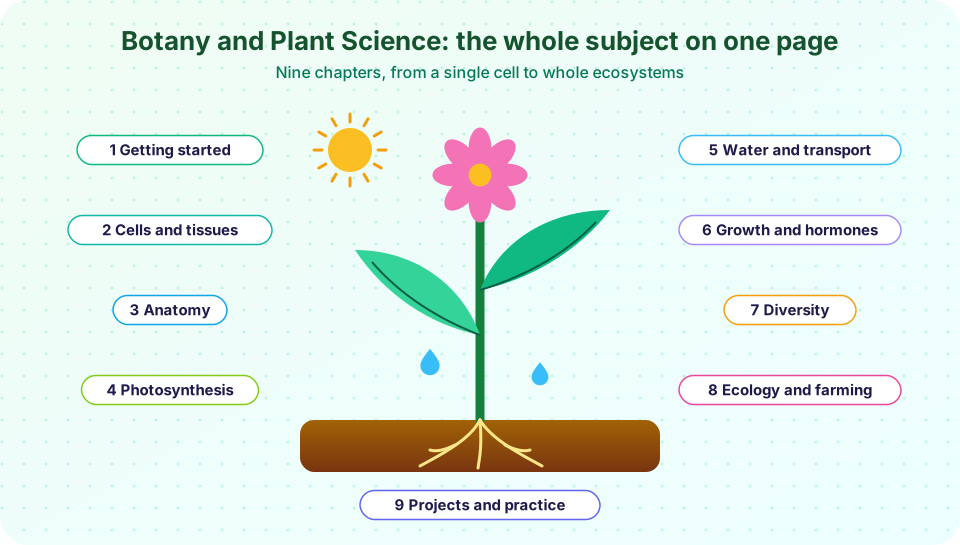
Plants make the food you eat, most of the oxygen you breathe and the paper, wood and cotton around you. Botany is the science that explains how they do it. This course takes you from a single plant cell to forests, farms and genetic engineering, in nine chapters, with pictures, simulations and quizzes along the way.
What you will learn
- Who this course is written for and what you should know first.
- How the nine chapters fit together, from cells to ecosystems.
- A study routine that works for plant science, including a rough time plan.
- Which tools you will use: diagrams, Python simulations and short quizzes.
Who this course is for
The course is written for learners aged about 11 to 18 and for adults who want to refresh or start the subject. It follows the common core of international school courses (Cambridge IGCSE and A Level biology, the IB, and US AP biology), so it is a good companion to any of them. It uses SI units throughout: meters, grams, liters, degrees Celsius.
You do not need to know any botany. You do need to be comfortable with simple arithmetic, reading a graph, and the idea that a cell is the smallest unit of life. If cells are new to you, Chapter 2 starts from the beginning. The cells and genetics course covers the animal and general side in more depth, and the ecology and evolution course goes further with the ideas in Chapters 7 and 8.
Educational information. This course explains how plants work. It is not a guide to identifying or eating wild plants, and it gives no medical advice. Many plants are poisonous; never eat a plant unless an expert has identified it.
Key terms
- Botany: the scientific study of plants, from molecules to ecosystems.
- Photosynthesis: making sugar from carbon dioxide and water using light energy.
- Tissue: a group of similar cells that do one job together.
- Species: a group of organisms that can interbreed and share a recognizable set of traits.
- Hypothesis: a testable explanation that you can try to prove wrong with an experiment.
The nine chapters
Foundations
- Getting started
- Cells and tissues
- Anatomy
How a plant lives
- Photosynthesis
- Water and transport
- Growth and hormones
The big picture
- Diversity
- Ecology and farming
- Projects
- Chapter 1, Getting started, defines a plant, shows how botanists test ideas and explains why every plant has a two-part Latin name. You are here now.
- Chapter 2, Plant cells and tissues, opens the cell: wall, chloroplast, vacuole, and the tissues they build.
- Chapter 3, Anatomy and morphology, follows the plant body from root tip to flower and fruit.
- Chapter 4, Photosynthesis and plant metabolism, explains the light reactions, the Calvin cycle, C4 and CAM plants and respiration.
- Chapter 5, Water, nutrients and transport, shows how water climbs 100 meters up a tree with no pump.
- Chapter 6, Growth, hormones and reproduction, covers auxin, light responses, flowering, seeds and fruit.
- Chapter 7, Plant diversity and evolution, walks through mosses, ferns, conifers and flowering plants.
- Chapter 8, Ecology, agriculture and biotechnology, connects plants to ecosystems, crops and genetic engineering.
- Chapter 9, Projects and practice, gives you case studies, practice sets and a glossary.
How to study this course
Plant science rewards a few simple habits.
- Look at a real plant while you read. A potted herb, a tree outside the window or a vegetable from the kitchen is enough. Chapter 3 is far easier when you can cut an onion or a celery stalk and see the structures yourself. Cutting up a supermarket vegetable is safe lab work; just use a blunt knife and ask an adult if you are young.
- Read the picture before the text. Every lesson has an illustration near the top that shows the main idea. Study it for a minute, then read the lesson to see what you missed.
- Run the code. The Try it boxes run real Python in your browser. Change a number and predict what happens before you press Run. Predicting first is how experts learn from simulations.
- Answer the quiz from memory. Close the lesson, answer the questions, then check. Retrieval is much stronger than rereading.
- Space it out. Two or three short sessions a week beat one marathon.
A realistic plan: each lesson takes 25 to 40 minutes, including the activities. With about 20 lessons per half of the course you can finish the whole subject in a school term of 12 to 16 weeks at 3 hours per week. The calculator below does the arithmetic for your own schedule.
Try it
Press Run (or Ctrl + Enter) to see the console output here.
No output.
Press Run (or Ctrl + Enter) to see the result here.
Program input · what you'd type while the program runs
Type the answers before you press Run, one per line. Each time the program reads a line (with input()), it gets the next line from this box.
Check your understanding
Quick check · 4 questions
of 4 answered You scored / 4 · perfect!
-
1. Which tool in this course lets you test an idea by changing numbers and watching the result?
The code boxes run real Python in your browser, so you can change a value and see a simulated result. -
2. Chapter 4 is about...
Chapter 4 explains how plants turn light into sugar and how they release energy by respiration. -
3. Why should you try the quiz questions from memory before checking?
Retrieval practice is one of the best-supported study methods. -
4. A good rule for wild plants is...
Many harmless-looking plants are poisonous, and color is no guide.
Summary
- Botany is the science of plants, from molecules to ecosystems.
- The course has nine chapters: foundations, how a plant lives, then the big picture and projects.
- Study with a real plant nearby, read each illustration first, run and change the code, and test yourself from memory.
- Plan about 25 to 40 minutes per lesson and a few short sessions each week.
Next: What is a plant?
Track your progress
Create a free account to tick off lessons and pick up where you left off on any device.
of Botany and Plant Science lessons completed