


















Lesson 4 of 48 · Getting Started
Naming and classifying plants
Learn why every plant has a two-part Latin name, how taxonomic ranks from kingdom to species work, and how DNA has reshaped the plant family tree.
A plant that you call a "daisy" may be a different plant to a friend in another country, and in another language it has another name again. Botanists solved this with one internationally agreed name for each species, written in a form of Latin. That name works the same in Nairobi, Nagoya and Nottingham. This lesson explains how the system works, how plants are grouped into ranks, and how DNA evidence has changed the groups.
What you will learn
- Why common names are unreliable and scientific names are not.
- How to write a binomial name correctly.
- The main taxonomic ranks and what the endings tell you.
- What a type specimen and a herbarium do for naming.
- How DNA changed plant classification, and what APG means.
Key terms
- Binomial nomenclature: naming a species with two words, genus then species epithet.
- Taxon (plural taxa): any named group of organisms at any rank.
- Taxonomy: the science of describing, naming and classifying organisms.
- Phylogeny: the evolutionary history and relationships of a group, drawn as a tree.
- Clade: a group containing an ancestor and all of its descendants.
The problem with common names
Common names are friendly, but they fail in three ways.
- One name, many plants. In the United Kingdom "bluebell" usually means Hyacinthoides non-scripta. In Scotland the same word is used for Campanula rotundifolia. Both are different plants in different families.
- One plant, many names. The plant called "corn" in the United States is "maize" in most of the world, and "corn" in Britain traditionally meant wheat or barley.
- No name at all. Most of the roughly 350,000 known plant species have no common name in any language.
A scientific name removes these problems because there is one accepted name per species, and the rules for choosing it are written down.
How binomials work
The Swedish naturalist Carl Linnaeus popularized two-word names in his book Species Plantarum (1753), which botanists treat as the starting point of modern plant naming. Before him, plants had long descriptive phrases. Linnaeus kept a short two-word tag for everyday use.
A binomial has two parts:
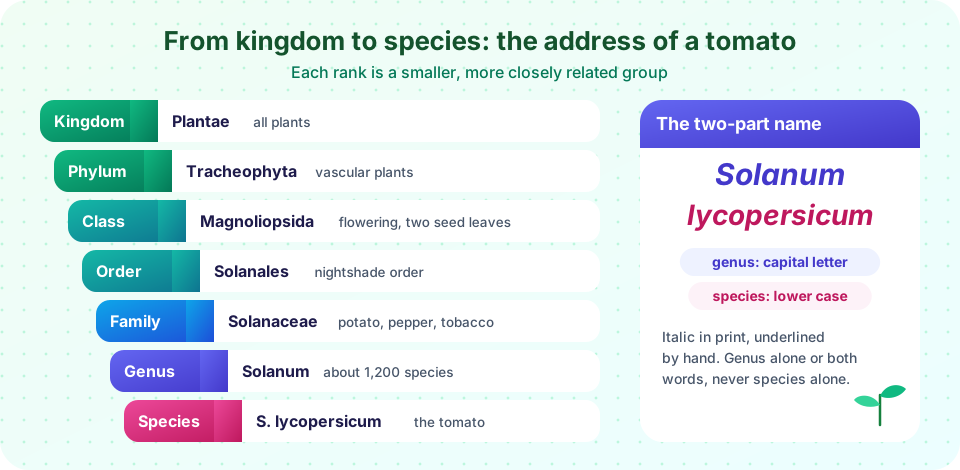
- The genus (plural genera) comes first and begins with a capital letter: Solanum.
- The species epithet comes second and starts with a lower-case letter: lycopersicum.
Together they make the species name: Solanum lycopersicum, the tomato. Never use the epithet alone: lycopersicum by itself means nothing, because many genera have species with the same epithet (for example, officinalis appears hundreds of times).
Formatting rules matter:
- Write the name in italics in print, or underline it when handwriting.
- After the first full use you may abbreviate the genus to its initial: S. lycopersicum.
- A formal name may be followed by the authority, the person who described it, such as Solanum lycopersicum L., where L. stands for Linnaeus.
- A hybrid has a multiplication sign: Mentha × piperita (peppermint).
- A cultivar (cultivated variety) goes in single quotes and is not italic: Malus domestica 'Granny Smith'.
Species names often tell a story. Rosa canina is "dog rose", Quercus robur is "strong oak", Digitalis purpurea has purple flowers, and Bellis perennis lives for many years (perennis). Learning a few Latin words makes names less intimidating.
The ranks
Linnaeus also grouped species into a nested hierarchy. Each rank is more inclusive than the one below:
| Rank | Tomato | Ending in plants |
|---|---|---|
| Kingdom | Plantae | none |
| Phylum (division) | Tracheophyta | -phyta |
| Class | Magnoliopsida | -opsida |
| Order | Solanales | -ales |
| Family | Solanaceae | -aceae |
| Genus | Solanum | none |
| Species | Solanum lycopersicum | none |
The endings are a very useful clue. If you see a word ending in -aceae, it is a plant family: Rosaceae (roses, apples, strawberries), Fabaceae (peas and beans), Poaceae (grasses, including wheat, rice and maize), Asteraceae (daisies and sunflowers). Knowing a family tells you things about a plant you have never met: members of Solanaceae often contain alkaloids and many are toxic, which is why tomato leaves are not eaten even though the fruit is.
A mnemonic for the ranks: King Philip Came Over For Good Soup. Make up your own funnier one; you will remember it better.
Who decides? Codes, type specimens and herbaria
Names follow the International Code of Nomenclature for algae, fungi, and plants (ICN), revised every six years at an international congress. Its core rules are simple:
- The oldest valid name has priority.
- A name must be published with a description, and it is tied to a type specimen: one real preserved plant that serves as the permanent reference for the name. If scientists later argue about which plants a name covers, they go back to the type.
- Type specimens are kept in herbaria, such as the ones at Kew in London, the Muséum national d'Histoire naturelle in Paris and the Missouri Botanical Garden. Over 3,000 herbaria exist worldwide.
When a botanist decides that two names refer to the same species, the later name becomes a synonym. That is why a name in an old book may not match the name in a modern flora.
Classification and DNA
For centuries, botanists classified plants by structure: flower parts, leaf shapes, seed types. This works well but can mislead, because unrelated plants can evolve similar bodies in similar habitats (a process called convergent evolution). The cacti of the Americas and the euphorbs of Africa both have thick, spiny, water-storing stems, but they belong to different families.
DNA sequencing changed everything. Comparing gene sequences gives an independent view of relationships. The Angiosperm Phylogeny Group (APG) is an international team that reclassified flowering plants using DNA; its most recent system, APG IV, appeared in 2016. APG has moved some genera between families and showed that the old groups "dicots" and "monocots" need updating: the monocots are one natural clade, but the dicots are not. Most "dicots" form a group called the eudicots, and a small set of early-branching lineages sits outside.
The practical lesson is that classification is a hypothesis. It improves when new data arrive. Textbooks, and this course, mention the traditional names alongside the modern ones.
Common misconceptions
- "The species name is the second word." The species name is both words together. The second word is only the epithet.
- "A higher rank means a better or more advanced group." Ranks only describe how inclusive a group is. A moss is not "lower" in any useful biological sense: mosses have survived for hundreds of millions of years.
- "A plant has one correct name forever." Names change when new research shows two species are the same, or that a genus must be split. The plant itself stays the same.
Try it
Press Run (or Ctrl + Enter) to see the result here.
Program input · what you'd type while the program runs
Type the answers before you press Run, one per line. Each time the program reads a line (with input()), it gets the next line from this box.
Press Run (or Ctrl + Enter) to see the console output here.
No output.
Check your understanding
Quick check · 5 questions
of 5 answered You scored / 5 · perfect!
-
1. Which is the correct way to write a scientific name?
The genus has a capital letter and the epithet is lower case; both are italic in print. -
2. A word ending in -aceae is the name of a...
Plant family names end in -aceae, such as Rosaceae. -
3. Why is a common name like 'bluebell' unreliable?
One common name can refer to unrelated species in different regions. -
4. What does a type specimen do?
The type anchors the name so that later disputes can be resolved by examining it. -
5. Why did DNA evidence change plant classification?
Structure can mislead because of convergent evolution; DNA gives an independent test of relationships.
Summary
- Common names are ambiguous; a scientific name is one agreed name per species under the ICN.
- A binomial is Genus species, in italics, with a capital for the genus only.
- The main ranks are kingdom, phylum, class, order, family, genus and species; family names end in -aceae.
- Type specimens in herbaria anchor names to physical plants.
- DNA data (APG IV for flowering plants) keep reshaping the groupings, so classification is a hypothesis that improves.
Next: Chapter 1 review
Track your progress
Create a free account to tick off lessons and pick up where you left off on any device.
of Botany and Plant Science lessons completed