


















Lesson 45 of 48 · Projects and Practice
Project: transpiration with a potometer
Plan, run and analyze a potometer experiment on transpiration: variables, method, calculations, statistics, evaluation, plus a practice set with worked answers.
This project turns chapter 5 into something you can do with a leafy shoot, a piece of clear tubing and a ruler. A potometer measures how fast a cut shoot takes up water, which is a good stand-in for how fast it loses water by transpiration. You will design a fair test, collect data, convert distances to volumes and rates, use basic statistics to decide whether a difference is real, and then evaluate your method. The lesson describes the experiment and shows the analysis with invented practice numbers, clearly labeled. It never reports results as if they had been measured. When you run the experiment, your own data will replace them.
What you will learn
- How to design a fair test with one independent variable and controlled conditions.
- How a potometer works and how to convert bubble distance to volume and rate.
- How to summarize replicates with mean, standard deviation and a significance test.
- How to evaluate the limits of the method and suggest improvements.
Key terms
Independent variable: the factor you change on purpose (for example, moving air from a fan).
Dependent variable: the quantity you measure (distance moved by the bubble in a set time).
Control variables: everything else kept the same (shoot size, light, temperature, time).
Replicate: a repeat of the same treatment, needed to see how much results vary.
Standard error of the mean (SEM): the standard deviation divided by the square root of the number of replicates.
Aim and hypothesis
Aim: To investigate how one environmental factor affects the rate of water uptake of a leafy shoot.
Choose one factor: moving air (a fan), light intensity, temperature, humidity (a clear plastic bag over the leaves) or leaf area (removing some leaves). From chapter 5 you can predict the direction. Moving air removes the humid boundary layer around the leaf, steepening the water-vapor gradient, so a hypothesis could be: "Shoots in moving air take up water faster than shoots in still air." A good hypothesis says which way the change should go and why.
Background: what the potometer measures
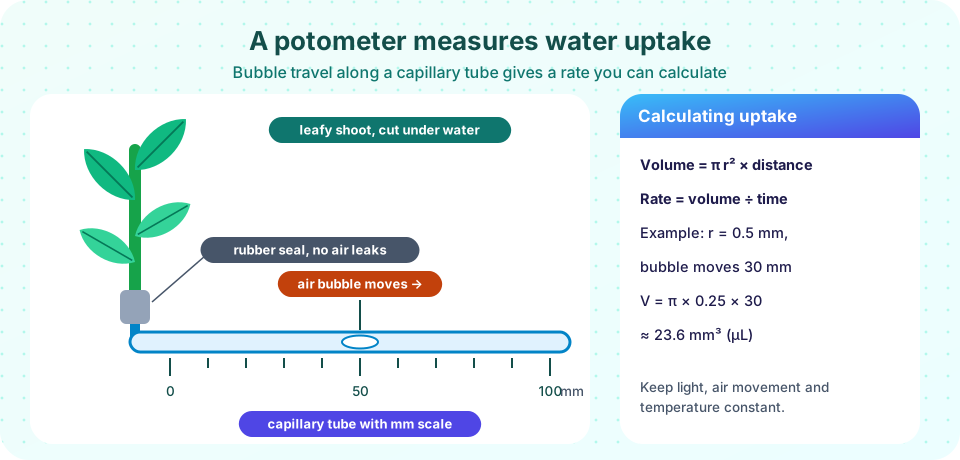
Water leaves the leaf by transpiration and is replaced from the xylem by cohesion-tension (see xylem and phloem transport). A shoot connected to a water-filled capillary tube therefore pulls an air bubble along it. The distance the bubble moves in a given time shows the volume of water taken up. This is an approximation of transpiration: a little of the water is used in photosynthesis or stays in the tissues, but over short times most uptake equals loss, so it is a good comparative measure.
Apparatus
- A leafy shoot (for example from a privet, ivy, sunflower or similar plant) about 30 cm long.
- A potometer: a capillary tube with a scale in millimeters, rubber tubing, and a water reservoir (a beaker or a syringe on a side arm).
- Petroleum jelly or waterproof sealant for joints.
- A sharp knife or secateurs, a bowl of water, a stopwatch, a ruler and a thermometer.
- Tools for your variable: a desk fan, a lamp, or a plastic bag.
Method
- Fill the apparatus with water under the surface of a bowl, so there is no air in the tubes.
- Cut the shoot underwater, at a slant, with a sharp blade. Cutting in air lets bubbles enter the xylem and block it (embolism).
- Insert the cut end into the tubing while everything is still underwater and make the joints watertight with petroleum jelly. Dry the leaves gently.
- Introduce one air bubble into the capillary by lifting the end out of the water for a moment, and then put it back in the water.
- Wait about 10 minutes to let the shoot settle (acclimatize) in its conditions.
- Record the starting position of the bubble on the scale (mm), start the stopwatch, and record the position again every minute for 10 minutes.
- Reset the bubble by opening the reservoir tap or by squeezing the syringe, to bring it back to the start of the scale.
- Repeat at least three to five times per condition (replicates), and change only the independent variable between conditions.
Safety. Use cutting tools carefully, with the blade moving away from you. Keep water and electrical equipment (fans, lamps) apart and dry the table. Wash your hands after handling plants, and follow your school or lab rules.
Variables
| Variable | In this example |
|---|---|
| Independent | Moving air (fan) or still air |
| Dependent | Bubble distance in 10 minutes (mm), converted to a rate |
| Controlled | Same shoot or similar shoots, leaf area, light, temperature, tube radius, time, and a 10 minute settling period |
Calculations
The capillary is a cylinder. If its inner radius is r (mm) and the bubble moves d (mm), the volume of water taken up is
V = π × r² × d (mm³, and 1 mm³ = 1 μL)
and the rate is V / t. If the shoots have different leaf areas, divide by area to compare fairly: rate per cm² of leaf. Measure leaf area by tracing leaves on squared paper or by photographing them next to a ruler.
Analyzing the data
Below, practice numbers stand in for your results: bubble distances in 10 minutes, five replicates per condition. They are invented for demonstration. The code converts them to rates, computes the mean and standard deviation (SD), the standard error (SEM), and Welch's t-test, which compares two means without assuming equal variance.
Press Run (or Ctrl + Enter) to see the result here.
Program input · what you'd type while the program runs
Type the answers before you press Run, one per line. Each time the program reads a line (with input()), it gets the next line from this box.
A plot helps readers see both the means and the individual points, and the error bars show the spread.
Press Run (or Ctrl + Enter) to see the result here.
Program input · what you'd type while the program runs
Type the answers before you press Run, one per line. Each time the program reads a line (with input()), it gets the next line from this box.
Evaluating the experiment
A good evaluation does more than list errors. It asks how serious each problem is and what would fix it.
- Uptake is not exactly transpiration. Some water goes into photosynthesis and growth, and leaf water content may change. Conclusion: use the method to compare conditions, not to measure absolute water loss.
- Air bubbles in the xylem can block flow. Cut underwater and discard shoots that do not take up water.
- Leaks make the bubble move for the wrong reason. Check each joint and use the same shoot for repeats.
- Different shoots vary in leaf area and stomatal behavior. Divide by leaf area, use shoots of similar size and, if possible, test both conditions on the same shoot in turn.
- Stomata take time to adjust, so give the shoot time to settle in each condition.
- Uncontrolled factors such as the lamp warming the leaves need a heat shield or a measured temperature.
- Few replicates make the result uncertain; more replicates narrow the spread of the mean.
Practice set
Try these before looking at the answers beneath.
- The capillary radius is 0.5 mm and the bubble moves 36 mm in 12 minutes. What volume was taken up, and what is the rate?
- The shoot in question 1 has 40 cm² of leaf area. What is the rate per cm² of leaf?
- With a fan, the bubble moves 54 mm in 12 minutes. What is the new rate and by what percentage did it change?
- At 22 °C and 40% relative humidity, what is the VPD, and what is the transpiration rate for gs = 0.15 mol m⁻² s⁻¹ (P = 101.3 kPa)?
- A cell has Ψs = −0.9 MPa and Ψp = +0.3 MPa and is placed in 0.15 M sucrose at 20 °C. Which way does water move?
- A 25 kg bag of 15-5-10 fertilizer is used to supply 90 kg N per hectare to a 0.5 ha field. How many bags are needed?
Press Run (or Ctrl + Enter) to see the result here.
Program input · what you'd type while the program runs
Type the answers before you press Run, one per line. Each time the program reads a line (with input()), it gets the next line from this box.
Common misconceptions
"A bigger p-value means a bigger effect." The p-value shows how surprising the data would be if there were no real difference. It does not measure the size of the effect.
"One run is enough if it looks right." Plants vary, so without replicates you cannot know whether a difference is real.
"The potometer measures photosynthesis." It measures water uptake, a proxy for transpiration.
Check your understanding
Quick check · 5 questions
of 5 answered You scored / 5 · perfect!
-
1. Why must the shoot be cut underwater?
Cutting in air lets bubbles enter the water-conducting cells, which breaks the water column. -
2. A capillary has radius 0.4 mm and the bubble moves 25 mm. What is the volume taken up? (V = pi r^2 d)
pi x 0.16 x 25 = 12.6 mm3. -
3. Which is a control variable in a test of fan versus still air?
Temperature and light are kept constant, while the fan is the independent variable and distance is the dependent variable. -
4. Why divide the rate by leaf area?
Uptake scales with leaf area, so per-area rates allow fair comparisons. -
5. A potometer measures
Uptake follows loss over short periods, so it serves as a comparative measure of transpiration.
Summary
- A potometer converts bubble distance into water uptake, using
V = π r² dandrate = V / t. - A fair test changes one independent variable and controls the rest, with replicates.
- Mean, SD, SEM and a Welch t-test summarize and compare replicate data; plots should show individual points and error bars.
- Evaluate the method: uptake is only an approximation of transpiration, and leaks, embolisms and plant variability are sources of error.
- The practice numbers here are invented; use your own measurements when you run the experiment.
Track your progress
Create a free account to tick off lessons and pick up where you left off on any device.
of Botany and Plant Science lessons completed