


















Lesson 29 of 48 · Water, Nutrients and Transport
Chapter 5 review: Water, nutrients and transport
Review chapter 5 of Botany: water potential, transpiration, xylem and phloem, mineral nutrition. Includes a one-picture summary, a recap table and ten questions.
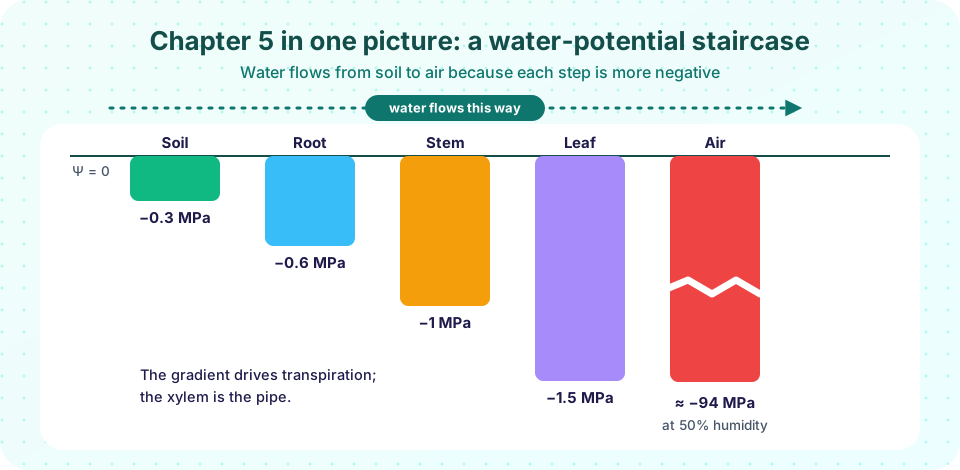
You have now followed water from damp soil, through root hairs and the xylem, out of a leaf and into the air, and followed sugar from leaves to roots and fruit. This review pulls the chapter into one picture, one table and one set of questions. If a row in the table feels unclear, jump back to that lesson with the link.
What you will learn
- How the four lessons form one explanation of plant transport.
- Which formulas and numbers are worth remembering.
- How well you can apply them in questions that mix topics.
Key terms
Water potential (Ψ): free energy of water in MPa; water moves toward lower Ψ.
Turgor (Ψp): pressure of cell contents on the wall.
Transpiration: evaporative loss of water, mainly through stomata.
Cohesion-tension: water is pulled up the xylem by tension created at the leaf and transmitted by cohesion.
Pressure flow: sap moves through the phloem from high-pressure sources to low-pressure sinks.
The chapter in one paragraph
Dissolved solutes and pressure set a cell's water potential, Ψ = Ψs + Ψp, and water moves toward lower Ψ. Soil sits at a few tenths of a megapascal below zero, the root a little lower, the leaf lower still, and dry air far lower, at about −94 MPa at 20 °C and 50% humidity. That staircase draws water through the plant. Leaves lose most of it as vapor through stomata, which guard cells open for CO₂ and close under ABA and water stress. The pull is carried by the xylem as tension, with each conduit a dead, lignified tube. Phloem carries sugars in living sieve tubes by pressure flow, from sources to sinks. Roots also gather the 17 essential elements, helped by mycorrhizal fungi and nitrogen-fixing bacteria, and a plant's symptoms hint at which one it lacks.
Recap table
| Lesson | Big idea | Number or equation to remember |
|---|---|---|
| Water potential and osmosis | Water moves toward lower Ψ; turgor comes from wall pressure | Ψ = Ψs + Ψp; Ψs = −i C R T, R = 0.008314 L·MPa/(mol·K) |
| Transpiration and stomata | Evaporation drives flow; stomata trade water for CO₂ | E = gs × VPD / P; es = 0.6108 exp(17.27 T/(T+237.3)) kPa |
| Xylem and phloem transport | Cohesion-tension pulls water; pressure flow pushes sugar | Gravity cost 0.01 MPa per m; trees top out near 120 to 130 m |
| Mineral nutrition and soil | 17 essential elements; mobility decides where symptoms show | N-P-K label = % N, P₂O₅, K₂O |
Worked review problems
Problem 1. A cell has Ψs = −1.0 MPa and Ψp = +0.6 MPa. It is placed in an open beaker of 0.1 M sucrose at 20 °C (Ψ ≈ −0.24 MPa). Which way does water move?
The cell's Ψ is −0.4 MPa. The solution's Ψ is −0.24 MPa, which is higher (less negative). Water moves from the solution into the cell, and the cell becomes more turgid.
Problem 2. At 30 °C and 60% relative humidity, what is the VPD, and how does it compare with air at the same humidity at 20 °C?
At 30 °C, es ≈ 4.24 kPa, so VPD = 4.24 × 0.4 ≈ 1.70 kPa. At 20 °C, es ≈ 2.34 kPa, so VPD ≈ 0.94 kPa. The warm air dries leaves about 1.8 times faster.
Problem 3. Young leaves of a tomato plant have pale veins that stay green, while old leaves look normal. What does that suggest?
Symptoms in young leaves with green veins point to an immobile nutrient such as iron, a classic cause of interveinal chlorosis in young leaves (check the soil pH too).
Common misconceptions
"Higher solute concentration means higher water potential." It is the other way round: more solute lowers Ψs and so lowers Ψ.
"Phloem is passive like xylem." Phloem loading uses energy, and sieve tubes are living. Only the xylem conduit is a passive tube.
"A plant with green leaves has enough of every nutrient." Some deficiencies are hidden; only soil and tissue tests are certain.
Check your understanding
Quick check · 10 questions
of 10 answered You scored / 10 · perfect!
-
1. A cell with Psi_s = -0.7 MPa and Psi_p = +0.2 MPa is next to a cell with Psi_s = -0.9 MPa and Psi_p = +0.1 MPa. Which way does water move?
First cell Psi = -0.5 MPa; second = -0.8 MPa. Water moves toward the lower value, the second cell. -
2. Which pair describes xylem and phloem correctly?
Xylem conduits are dead and operate under tension; phloem sieve tubes are alive and operate under positive pressure. -
3. What happens to transpiration when relative humidity rises at constant temperature?
VPD = es x (1 - RH), so a higher RH means a smaller deficit and slower transpiration. -
4. Which of these is NOT a cause of plasmolysis in a plant cell?
In pure water a plant cell becomes turgid, not plasmolyzed. -
5. Which nutrient deficiency shows up first in older leaves?
Nitrogen is mobile and is moved to new growth, so old leaves yellow first. -
6. Roughly how much hydrostatic pressure per meter of height must the xylem overcome because of gravity?
rho g h gives about 0.0098 MPa per meter. -
7. Guard cells open a stoma when they
Ion uptake lowers Psi_s, water enters, and the turgid cells bow apart. -
8. In Munch's pressure-flow model, what keeps sap flowing toward a root sink?
Unloading at the sink lowers Psi_s and pressure, so the pressure difference between source and sink is maintained. -
9. Which statement about root pressure is most accurate?
Root pressure is typically 0.05 to 0.2 MPa, far too little for tall trees. -
10. A 40 kg bag of 15-5-10 fertilizer holds how many kg of P2O5?
5 percent of 40 kg is 2 kg of P2O5.
Summary
- Water potential (Ψ = Ψs + Ψp) tells you which way water moves; the soil-to-air staircase drives transpiration.
- Stomata trade water for CO₂; guard cells respond to light, CO₂ and ABA.
- Xylem works by tension (pull); phloem works by pressure flow (push).
- Seventeen elements are essential; mobility explains whether symptoms appear in old or young leaves.
- Chapter 6 turns from moving materials to growth: how hormones and light shape the plant and how it reproduces.
Track your progress
Create a free account to tick off lessons and pick up where you left off on any device.
of Botany and Plant Science lessons completed