


















Lesson 7 of 48 · Plant Cells and Tissues
The plant cell and its organelles
Tour a plant cell organelle by organelle: wall, membrane, nucleus, chloroplasts, mitochondria, vacuole and more, and see how plant cells differ from animal cells.
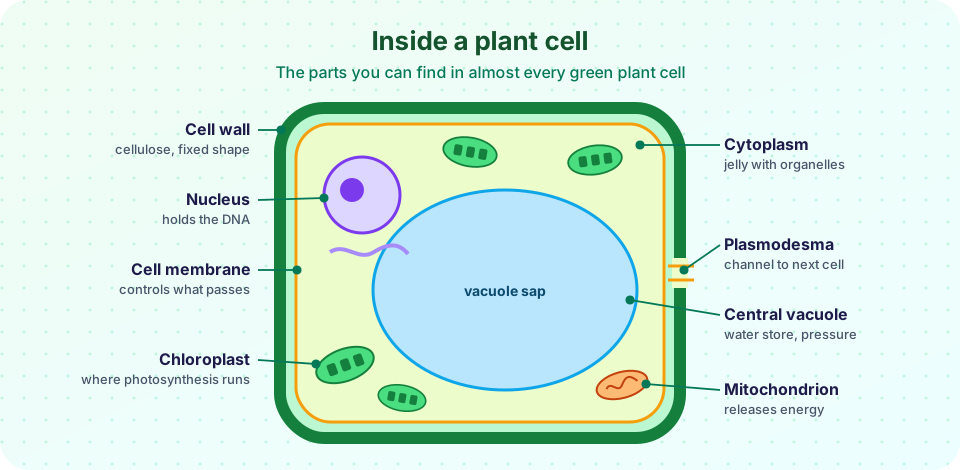
A plant cell is a tiny factory with several departments. One makes sugar from sunlight, one releases energy from that sugar, one stores water and pushes outward to keep the plant firm, and a wall around the outside keeps everything in shape. This lesson goes through the departments one at a time, explains how they cooperate and compares them with the cells of animals, which lack several of them.
What you will learn
- The structure and job of each organelle in a plant cell.
- Three differences between plant and animal cells.
- What plastids are and how chloroplasts got into plants.
- How cells in a plant stay connected.
Key terms
- Plasma membrane: the thin, selective boundary of the living part of the cell (the protoplast).
- Plastid: a family of plant organelles including chloroplasts, chromoplasts and amyloplasts.
- Thylakoid: a flat, membrane-bound sac inside a chloroplast where the light reactions occur.
- Tonoplast: the membrane surrounding the central vacuole.
- Plasmodesma (plural plasmodesmata): a microscopic channel through the walls of neighboring cells.
The boundary: wall and membrane
Outside everything lies the cell wall, made mostly of cellulose (the next lesson looks at it in detail). It is porous, so water and dissolved substances pass through freely. It is the membrane just inside the wall that decides what actually enters the cell.
The plasma membrane is a double layer of phospholipid molecules, about 7 to 10 nanometers thick, studded with proteins that act as channels, pumps and sensors. This structure is called the fluid mosaic. Water, oxygen and carbon dioxide cross relatively easily; ions and sugars need protein help. By pumping ions in and out, the membrane builds up the gradients that drive many of the cell's activities, including the uptake of mineral nutrients.
The control center: nucleus
The nucleus is surrounded by a double membrane called the nuclear envelope, which has pores that regulate traffic. Inside lie the chromosomes, long molecules of DNA wrapped around proteins, and the nucleolus, where ribosome parts are assembled. A plant's genome varies enormously: Arabidopsis, the small mustard relative that scientists use as a model, has about 135 million base pairs of DNA and five chromosome pairs, while some lilies have genomes more than 100 times larger. The nucleus reads genes as RNA and sends instructions out into the cytoplasm.
The protein and sugar workshop
- Ribosomes build proteins by reading messenger RNA. They float free in the cytoplasm or sit on the membranes of the rough endoplasmic reticulum.
- The endoplasmic reticulum (ER) is a network of flattened sacs and tubes. The rough ER, studded with ribosomes, makes proteins for export or membranes. The smooth ER makes lipids.
- The Golgi apparatus (in plants, a set of separate stacks called dictyosomes) sorts, modifies and packages materials. In plants it also makes the non-cellulose carbohydrates of the cell wall, such as pectin and hemicellulose, and ships them in vesicles to the surface.
The energy converters
Mitochondria are bean-shaped organelles, 1 to 2 micrometers long, with a smooth outer membrane and a folded inner membrane (cristae). Inside, the final steps of cellular respiration turn the chemical energy of sugar into ATP, the energy currency of the cell. A plant cell has mitochondria, and uses them day and night.
Chloroplasts are the organelles that make plants green. Typically 4 to 10 micrometers long, they have an outer and an inner membrane enclosing a fluid called the stroma. Inside float stacks of flat, coin-shaped sacs called thylakoids; one stack is a granum (plural grana). The thylakoid membranes hold chlorophyll and the proteins of the light reactions. The stroma holds the enzymes of the Calvin cycle that build sugar (Chapter 4). A leaf cell can contain dozens of chloroplasts, roughly 20 to 100 in many species.
Chloroplasts and mitochondria have their own small circular DNA and their own ribosomes. This supports the endosymbiotic theory, championed by Lynn Margulis in the late 1960s: mitochondria descend from free-living bacteria swallowed by an ancestral cell more than a billion years ago, and chloroplasts descend from cyanobacteria taken up later by a cell that already had mitochondria. The two organelles still divide like bacteria, inside the cell.
Other plastids
Chloroplasts are one kind of plastid. Others include:
| Plastid | Contents and job | Where to see it |
|---|---|---|
| Chloroplast | Chlorophyll, photosynthesis | Leaves, green stems |
| Chromoplast | Orange, red and yellow carotenoid pigments | Ripe tomatoes, carrot roots, petals |
| Amyloplast | Stores starch | Potato tubers, seeds, root caps |
| Leucoplast (general) | Colorless, stores oils or proteins | Storage cells |
When a green tomato ripens, its chloroplasts convert into chromoplasts: the green fades and red lycopene appears. Plastids can change type, which is one reason a potato tuber turns green if left in the light.
The central vacuole
Young cells have many small vacuoles that merge as the cell grows into one large central vacuole, bounded by the tonoplast and filled with cell sap. In a mature cell it can take up 80 percent or more of the volume. Its jobs include:
- storing water, ions, sugars and organic acids;
- storing pigments (the red and purple anthocyanins of beets and red cabbage are dissolved in vacuoles);
- storing waste and defensive chemicals;
- pushing the cytoplasm against the wall, which creates turgor pressure and keeps non-woody parts of plants firm (see cell walls and osmosis).
Growth is cheap this way: a plant cell can enlarge enormously just by filling its vacuole with water, without making much new cytoplasm.
Other structures
- Peroxisomes are small compartments that handle reactive oxygen compounds and take part in photorespiration.
- The cytoskeleton of microtubules and actin filaments gives the cell internal scaffolding, guides how cellulose is laid in the wall and moves organelles in a streaming motion (cytoplasmic streaming), easily seen in the large cells of the pond plant Elodea.
- Plasmodesmata are narrow channels, a few dozen nanometers wide, that pass through the walls of neighbors and join their cytoplasm. Water, small molecules and even some proteins and RNA move through them. This turns a plant into a connected network, which is called the symplast; the space inside the walls is the apoplast.
Plant cells versus animal cells
| Feature | Plant cell | Animal cell |
|---|---|---|
| Cell wall | Yes (cellulose) | No |
| Chloroplasts | Yes, in green tissue | No |
| Large central vacuole | Yes, in mature cells | No (small vesicles) |
| Shape | Usually fixed, often box-like | Variable |
| Centrioles | Absent in flowering plants and conifers | Present |
| Energy storage | Starch | Glycogen |
| Cell connections | Plasmodesmata | Gap junctions |
Common misconceptions
- "The cell wall is the cell's boundary and controls what enters." The wall is porous. The plasma membrane just inside it does the selecting.
- "Plants have chloroplasts instead of mitochondria." Plant cells have both. Chloroplasts make sugar, mitochondria release energy from it, and the cell needs both.
- "All plant cells are green." Root cells have no chloroplasts and many cells are colorless or colored by other pigments.
Try it
Press Run (or Ctrl + Enter) to see the result here.
Program input · what you'd type while the program runs
Type the answers before you press Run, one per line. Each time the program reads a line (with input()), it gets the next line from this box.
Check your understanding
Quick check · 5 questions
of 5 answered You scored / 5 · perfect!
-
1. Which organelle is the site of the light reactions of photosynthesis?
Chlorophyll and the light-reaction proteins sit in the thylakoid membranes. -
2. Which feature do plant cells have that animal cells lack?
Walls, chloroplasts and a large central vacuole are typical of plants; animal cells lack all three. -
3. Chloroplasts are thought to descend from...
Endosymbiotic theory: a host cell took up a photosynthetic bacterium related to cyanobacteria. -
4. A ripening tomato turns red because chloroplasts convert into...
Chromoplasts accumulate red and orange carotenoids such as lycopene. -
5. What are plasmodesmata?
They pass through the walls and join cells into a connected symplast.
Summary
- The cell wall gives shape; the plasma membrane just inside it controls what crosses.
- The nucleus holds the DNA; ER, ribosomes and Golgi make and ship proteins, lipids and wall carbohydrates.
- Mitochondria release energy; chloroplasts capture it. Both descend from bacteria taken in by ancestral cells.
- Plastids include chloroplasts, chromoplasts and amyloplasts; they can change type.
- The central vacuole stores water, ions and pigments and creates turgor pressure.
- Plant cells have a wall, chloroplasts and a large vacuole; animal cells do not. Plasmodesmata link plant cells.
Track your progress
Create a free account to tick off lessons and pick up where you left off on any device.
of Botany and Plant Science lessons completed