


















Lesson 11 of 48 · Plant Cells and Tissues
Chapter 2 review: plant cells and tissues
Review plant cell structure, walls, osmosis, mitosis and the three tissue systems with a one-page picture, a recap table and a ten-question quiz.
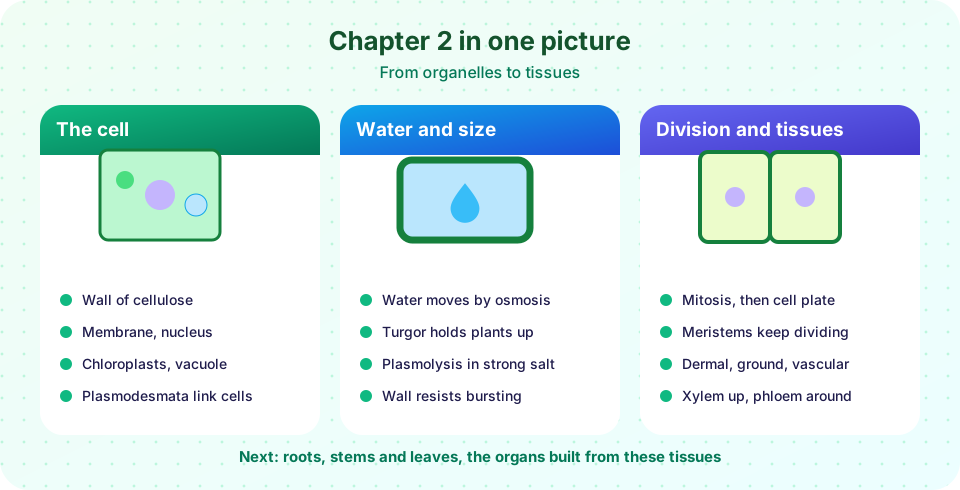
This chapter took you from the whole plant down to the chloroplast and back up to the tissues that cells form together. Before moving on to organs, test how well the ideas stick. The picture shows the chapter at a glance, the table lists what to remember, and the quiz mixes questions from all four lessons.
What you will learn
- Which facts from Chapter 2 to know cold.
- How structure, water and division fit together in plant growth.
- Which topics need another look, from your quiz score.
Recap table
| Topic | Key facts |
|---|---|
| Cell wall | Cellulose microfibrils in pectin and hemicellulose; middle lamella; secondary wall with lignin |
| Plasma membrane | Selective phospholipid bilayer just inside the wall |
| Nucleus | DNA, nucleolus, double envelope with pores |
| Chloroplast | Thylakoids in grana, stroma; photosynthesis; descended from cyanobacteria |
| Mitochondrion | Cristae; makes ATP by respiration in plants too |
| Vacuole | Water store, pigments, turgor pressure; may fill 80 percent or more of the cell |
| Water potential | Ψ = Ψs + Ψp; water flows toward more negative Ψ |
| Cell states | Turgid (firm), flaccid (limp), plasmolyzed (membrane pulled away) |
| Cell cycle | G1, S, G2, M; mitosis = prophase, metaphase, anaphase, telophase |
| Plant cytokinesis | Phragmoplast builds a cell plate; plate becomes middle lamella |
| Meristems | Apical (length), lateral (width), intercalary (grasses) |
| Tissue systems | Dermal, ground (parenchyma, collenchyma, sclerenchyma), vascular (xylem, phloem) |
How the lessons connect
Structure explains function. The wall resists the turgor that the vacuole creates, and turgor is what lets cells grow, which is how meristem cells become the tissues of lesson 4. Mitosis supplies the cells, osmosis enlarges them and differentiation gives them jobs. Chapter 3 shows how these tissues are arranged into roots, stems, leaves and flowers.
Try drawing a plant cell from memory with at least eight labels, then compare it with the picture in lesson 2. The parts you forget are the ones to review.
Exam-style practice prompts
Answer each in a few sentences. The reasoning matters more than the wording.
- Compare cells. List three structures found in a mature leaf cell but not in a human cheek cell, and say what each one does.
- Predict the direction. A potato slice with Ψ = -0.7 MPa is placed in a beaker holding 0.2 M sucrose (Ψ about -0.49 MPa at 20 degrees C). Which way does water move, and what happens to the slice's mass? (Water moves into the slice, because the solution has the higher, less negative, potential, so the mass rises.)
- Explain a stage. Why does a plant cell need a phragmoplast and a cell plate, while an animal cell can simply pinch in two?
- Place the tissue. A cell is long, dead at maturity, has a lignified spiral wall and conducts water. Name the tissue and the cell type. What would you expect to find next to a living sieve tube element, and why?
Each prompt connects at least two lessons of the chapter, which is how questions in exams and in research usually work.
Try it
Press Run (or Ctrl + Enter) to see the result here.
Program input · what you'd type while the program runs
Type the answers before you press Run, one per line. Each time the program reads a line (with input()), it gets the next line from this box.
Press Run (or Ctrl + Enter) to see the console output here.
No output.
Check your understanding
Quick check · 10 questions
of 10 answered You scored / 10 · perfect!
-
1. Which organelle makes ATP by cellular respiration?
Mitochondria release energy from sugar as ATP in plant cells too. -
2. The layer of pectin that glues neighboring cells together is the...
The middle lamella lies between cells and is pectin-rich. -
3. A cell has Ψs = -1.0 MPa and Ψp = +0.6 MPa. Its water potential is...
-1.0 + 0.6 = -0.4 MPa. -
4. A plasmolyzed cell is one in which...
Water loss makes the protoplast shrink away from the wall. -
5. Which phase of mitosis sees sister chromatids pulled apart?
Anaphase is the separation of sister chromatids. -
6. A plant cell completes cytokinesis by...
Golgi vesicles fuse into a plate that grows outward. -
7. Which ground tissue is alive, flexible and has unevenly thickened walls?
Collenchyma supports growing parts of the plant. -
8. Grass keeps growing after mowing because of...
The growth region at the base of the leaf is protected below the cut. -
9. What do companion cells do?
They keep the sieve tube element alive and supply the machinery it lacks. -
10. Which statement about turgor is correct?
Turgor pressure is the cell's contents pushing against the wall.
Summary
- Plant cells have a cellulose wall, chloroplasts and a large vacuole, along with the organelles shared with animal cells.
- Osmosis, driven by water potential, fills the vacuole; the wall balances the resulting turgor.
- Mitosis copies cells exactly; plants finish by building a cell plate.
- Meristems supply new cells, and tissues are dermal, ground or vascular.
- Chapter 3 shows how these tissues form roots, stems, leaves and flowers.
Track your progress
Create a free account to tick off lessons and pick up where you left off on any device.
of Botany and Plant Science lessons completed