


















Lesson 18 of 48 · Photosynthesis and Plant Metabolism
Chapter 4 overview: photosynthesis and plant metabolism
Preview Chapter 4: the overall photosynthesis equation, the two linked stages in the chloroplast, how the discovery unfolded, and how light intensity limits the rate.
Photosynthesis is the reason there is food, fuel in the form of wood and fossil carbon, and oxygen in the air. Every second, plants, algae and cyanobacteria convert light energy into the chemical energy of sugar. On land alone, plants fix on the order of 100 billion tonnes of carbon a year. This chapter explains how: the light reactions that capture energy, the Calvin cycle that builds sugar, the C4 and CAM variations that cope with heat and drought, and respiration, the process that releases the energy again.
What you will learn
- The overall equation and what each term means.
- How the two stages connect through ATP and NADPH.
- How scientists discovered the steps, from van Helmont to Calvin.
- How light intensity affects the rate of photosynthesis.
- A roadmap for the rest of the chapter.
Key terms
- Photosynthesis: the process in which light energy drives the conversion of CO2 and H2O into sugar and O2.
- ATP: adenosine triphosphate, the cell's energy currency.
- NADPH: a carrier of high-energy electrons used to build sugar.
- Chloroplast: the organelle where photosynthesis occurs.
- Carbon fixation: attaching inorganic carbon (CO2) to an organic molecule.
The overall equation
In words: carbon dioxide and water, with light energy, give sugar and oxygen.
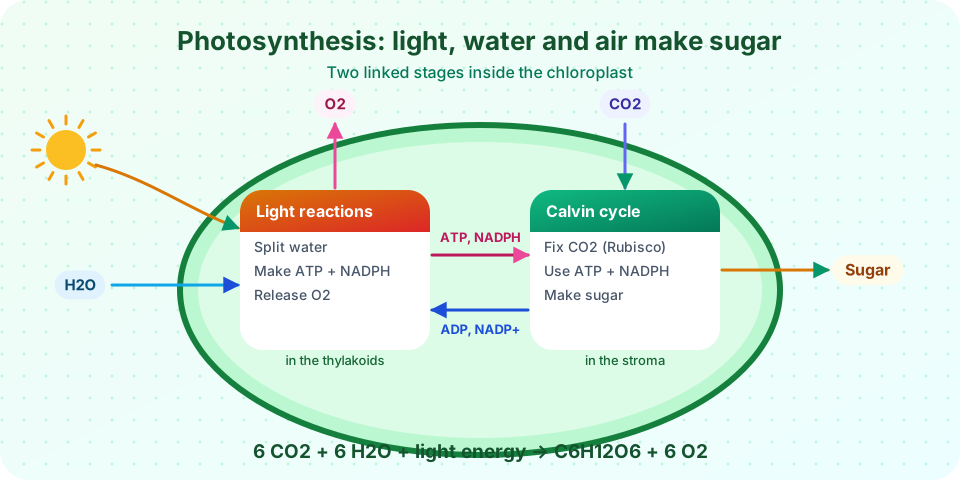
6 CO2 + 6 H2O + light energy → C6H12O6 + 6 O2
This equation is the reverse of burning glucose. Combustion and respiration release energy by combining sugar with oxygen; photosynthesis stores energy by splitting water and building sugar. The energy stored is large: about 2,870 kilojoules for each mole (180 g) of glucose made. Light supplies that energy.
Notice that the glucose formula is a simplification. The first sugar made is a three-carbon one, glyceraldehyde 3-phosphate (G3P), and plants build sucrose, starch and cellulose from it. Chapter 4's lesson on respiration and metabolism covers what happens next.
Two stages in two places
The equation hides two separate sets of reactions that are linked by two carrier molecules.
Stage 1: Light reactions
Stage 2: Calvin cycle
Where it happens
The light reactions take place in the thylakoid membranes: light energy is used to split water and make ATP and NADPH, and oxygen is released as a by-product. The Calvin cycle takes place in the stroma: it uses ATP and NADPH to fix CO2 into sugar. The Calvin cycle is sometimes called the "dark reactions", but this is misleading. It does not need light directly, but it stops soon after dark because its enzymes are switched on by light and its supplies of ATP and NADPH run out.
How we found out
Photosynthesis was pieced together over three centuries.
- 1640s, van Helmont: a willow tree gained far more mass than the soil lost, so soil is not the main source.
- 1770s, Priestley and Ingenhousz: plants in light restore "spoiled" air; light and green parts are needed.
- 1804, de Saussure: measured that plants gain mass from both carbon dioxide and water.
- 1882, Engelmann: shining a spectrum of light on a green alga with oxygen-sensing bacteria around it, he saw the bacteria gather at red and blue light, which gave the first action spectrum.
- 1930s-40s: Robin Hill showed that isolated chloroplasts release oxygen when given a suitable electron acceptor; Ruben and Kamen used heavy oxygen (18O) to show that the O2 comes from water, not from CO2.
- 1950s, Calvin, Benson and Bassham: fed algae radioactive carbon-14 dioxide and followed the label with paper chromatography, mapping the cycle of carbon fixation. Melvin Calvin received the Nobel Prize in Chemistry for this in 1961.
- 1960s: Peter Mitchell's chemiosmotic theory explained how a proton gradient drives ATP synthesis; he won the 1978 Nobel Prize.
What limits the rate?
Photosynthesis speeds up with more light but only to a point. A leaf in dim light is limited by light; in strong light it is limited by the Calvin cycle, by carbon dioxide supply or by temperature. Several things set the ceiling:
- Light intensity. Rate rises roughly in proportion at first and then levels off (saturates).
- CO2 concentration. Air has about 0.04 percent CO2 (about 420 parts per million today). Raising it raises the rate of C3 plants, which is why greenhouse growers sometimes add CO2.
- Temperature. Enzymes work faster when warm, up to an optimum, then denature.
- Water. A water-stressed plant closes its stomata and so cuts off its own CO2 supply.
Even with everything perfect, plants capture only a small fraction of the energy that falls on them: typically about 1 to 2 percent over a growing season for crops (the theoretical maximum for C3 plants is several times higher).
Chapter roadmap
- The light reactions follows an electron from water to NADPH and a proton from lumen to ATP.
- The Calvin cycle tracks carbon atoms as they are fixed, reduced and regenerated.
- C4 and CAM plants shows how some plants avoid the wasteful side reaction of Rubisco.
- Respiration and plant metabolism covers how plants burn and build with sugar.
- Chapter 4 review gives you a summary picture and a quiz.
Try it
Press Run (or Ctrl + Enter) to see the result here.
Program input · what you'd type while the program runs
Type the answers before you press Run, one per line. Each time the program reads a line (with input()), it gets the next line from this box.
Press Run (or Ctrl + Enter) to see the console output here.
No output.
Check your understanding
Quick check · 4 questions
of 4 answered You scored / 4 · perfect!
-
1. In which part of the chloroplast do the light reactions occur?
Chlorophyll and the electron transport proteins sit in the thylakoid membranes. -
2. Ruben and Kamen's experiment with heavy oxygen showed that the O2 from photosynthesis comes from...
Labeled oxygen in water appeared in the released O2. -
3. Which molecules carry energy from the light reactions to the Calvin cycle?
ATP and NADPH are the energy and electron carriers. -
4. At very high light the photosynthesis rate levels off because...
The curve saturates when another step becomes the bottleneck.
Summary
- Photosynthesis: 6 CO2 + 6 H2O + light → C6H12O6 + 6 O2; it stores about 2,870 kJ per mole of glucose.
- Light reactions (thylakoids) make ATP, NADPH and O2; the Calvin cycle (stroma) fixes CO2 into sugar.
- Key discoveries: Engelmann's action spectrum, Hill's reaction, Ruben and Kamen's 18O, Calvin's 14C mapping, Mitchell's chemiosmosis.
- Rate depends on light, CO2, temperature and water; field crops capture only about 1 to 2 percent of incoming light energy.
Next: The light reactions
Track your progress
Create a free account to tick off lessons and pick up where you left off on any device.
of Botany and Plant Science lessons completed