


















Lesson 23 of 48 · Photosynthesis and Plant Metabolism
Chapter 4 review: photosynthesis and plant metabolism
Review the light reactions, the Calvin cycle, C4 and CAM photosynthesis, and respiration with a one-page picture, a recap table and a ten-question quiz.
This chapter followed a packet of light from a leaf's surface to a molecule of sugar, then to the ATP that powers the cell, and finally to the cell wall, starch grain or defense compound it becomes. Use the picture and the table below to bring the whole chain back to mind, then test yourself with the quiz of ten questions drawn from all five lessons.
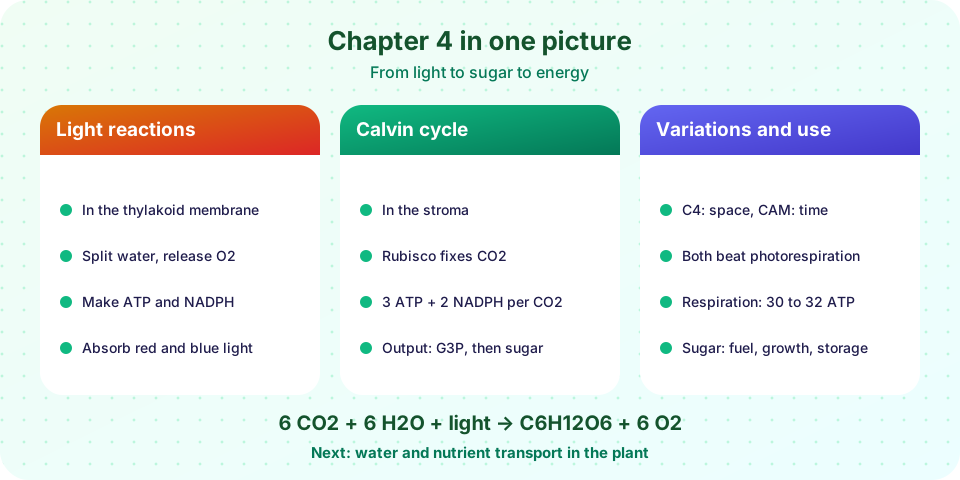
What you will learn
- The key facts and numbers of Chapter 4.
- How the light reactions, Calvin cycle and respiration connect.
- Which topics to revisit, based on the quiz.
Recap table
| Topic | Key facts |
|---|---|
| Equation | 6 CO2 + 6 H2O + light → C6H12O6 + 6 O2; about 2,870 kJ stored per mole of glucose |
| Pigments | Chlorophyll a and b absorb red and blue; carotenoids protect; green is reflected |
| Light reactions | In thylakoid membranes; PSII splits water; PSI makes NADPH; proton gradient drives ATP synthase |
| Calvin cycle | In the stroma; Rubisco fixes CO2 into RuBP; per CO2: 3 ATP and 2 NADPH; 3 turns give 1 G3P |
| Photorespiration | Rubisco fixes O2; wasteful, worse in heat |
| C4 | PEPC in mesophyll, Rubisco in bundle sheath (Kranz); maize, sugarcane |
| CAM | Stomata open at night, malate stored in vacuoles; cacti, pineapple |
| Respiration | Glycolysis (2 ATP), Krebs cycle (2 ATP), electron transport (26 to 28 ATP); about 30 to 32 ATP per glucose |
| Metabolism | Sucrose transport, starch and oil storage, cellulose, proteins; secondary metabolites defend |
How the pieces fit
Water enters the roots and rises to the leaves. In the thylakoids, light splits it, and the light reactions deliver ATP and NADPH to the stroma. The Calvin cycle uses them to build G3P from CO2 that entered through the stomata. The G3P becomes sucrose that the phloem carries to roots, shoots and fruit, where respiration in mitochondria releases its energy as ATP for growth, and where starch, oils and cellulose lock some of it away. In hot or dry places, C4 and CAM add a CO2 pump in front of the same cycle.
Try to retell the chain from a photon to a starch grain in under a minute without notes. Where you stumble is where to reread.
Exam-style practice prompts
Work through these on paper before checking the lessons.
- Follow the atoms. Using the overall equation, state where each atom of oxygen in the released O2 comes from, and which experiment demonstrated it.
- Do the sums. A plant fixes 24 CO2 molecules in the Calvin cycle. How many ATP and NADPH are needed, and how many G3P molecules can be exported? (72 ATP, 48 NADPH, 8 G3P.)
- Choose the pathway. A crop is grown in a hot, bright field with limited irrigation. Argue for or against a C4 crop and a CAM crop, naming the benefit and the cost of each.
- Balance the budget. A leaf's gross photosynthesis in a day is 0.40 mol CO2 per square meter and its respiration is 0.15 mol. What is the net gain, and what happens to the sign of the net exchange at night?
Questions like these combine energy, carbon and water, which is exactly where Chapter 5 picks up: how the plant keeps its leaves supplied.
Try it
Press Run (or Ctrl + Enter) to see the result here.
Program input · what you'd type while the program runs
Type the answers before you press Run, one per line. Each time the program reads a line (with input()), it gets the next line from this box.
Press Run (or Ctrl + Enter) to see the console output here.
No output.
Check your understanding
Quick check · 10 questions
of 10 answered You scored / 10 · perfect!
-
1. Which products of the light reactions power the Calvin cycle?
ATP supplies energy and NADPH supplies electrons for reduction. -
2. Which photosystem splits water?
P680 in PSII is a strong enough oxidant to pull electrons from water. -
3. Three turns of the Calvin cycle net how many G3P?
Six are made, five are recycled, one is exported. -
4. Why does Rubisco's oxygenase activity matter more in a hot climate?
Heat increases photorespiration, so C3 plants lose more carbon. -
5. Which plant uses the CAM pathway?
Pineapple and cacti fix CO2 at night. -
6. In C4 plants, Rubisco is located in...
Kranz anatomy puts Rubisco in the bundle sheath, around the CO2 supply. -
7. Oxygen is needed in respiration because it...
Without it electrons would back up and ATP synthesis would stop. -
8. Most ATP in respiration is produced at...
26 to 28 of about 30 to 32 ATP come from chemiosmosis. -
9. Which is a secondary metabolite?
Caffeine is an alkaloid used in defense; glucose, starch and ATP are primary metabolites. -
10. A plant in the dark...
Respiration continues all the time; photosynthesis needs light.
Summary
- Light and water make ATP, NADPH and O2 in the thylakoids; ATP and NADPH turn CO2 into G3P in the stroma.
- C4 and CAM add CO2-concentrating steps to reduce photorespiration and water loss.
- Respiration releases about 30 to 32 ATP per glucose, day and night.
- Sugar becomes sucrose, starch, cellulose, oils, proteins and secondary metabolites.
- Chapter 5 asks how the water and minerals that feed all of this get from the soil to the leaves.
Track your progress
Create a free account to tick off lessons and pick up where you left off on any device.
of Botany and Plant Science lessons completed