


















Lesson 15 of 48 · Anatomy and Morphology
Leaves: solar panels with pores
Learn leaf morphology and anatomy: simple and compound leaves, venation, the layers of the blade, how stomata open and close, and leaf adaptations.
A leaf is a solar panel that breathes. It has to be thin and wide to catch sunlight, but a wide, thin sheet of wet cells in the open air would dry out in minutes. Every feature of a leaf, from the waxy skin to the tiny pores on its underside, is a compromise between getting light and carbon dioxide in, and keeping water in. In this lesson you will go from the outside shape of a leaf to a cross-section and then to a single pore.
What you will learn
- The parts of a leaf and how leaves are classified.
- The layers of a leaf blade and what each does.
- How guard cells open and close a stoma.
- Why a leaf is a trade-off between photosynthesis and water loss.
- Examples of leaf adaptations to different habitats.
Key terms
- Blade (lamina): the broad, flat part of a leaf.
- Petiole: the stalk that attaches the blade to the stem.
- Mesophyll: the photosynthetic tissue inside the leaf, between the two epidermal layers.
- Cuticle: a waxy, waterproof film on the outer surface of the epidermis.
- Transpiration: loss of water vapor from the leaf, mostly through stomata.
Leaf morphology
A typical leaf has a flat blade, a stalk called the petiole and sometimes small leaf-like stipules at the base of the petiole. Grass leaves lack a petiole and instead wrap the stem in a sheath.
Simple and compound. A simple leaf has one blade (maple, oak). A compound leaf divides the blade into separate leaflets. In a pinnate compound leaf (ash, rose) the leaflets are arranged along a central axis like a feather; in a palmate compound leaf (horse chestnut) they spread from a single point like fingers. To tell a leaflet from a leaf, look for a bud: a true leaf has an axillary bud in the axil of its petiole; a leaflet does not.
Arrangement. Leaves are attached in an alternate (one per node), opposite (two per node) or whorled (three or more per node) pattern. This spacing helps leaves avoid shading each other.
Venation. Veins are the vascular bundles of the leaf.
- Net (reticulate) venation has a branching network; it is typical of eudicots. It may be pinnate (one main vein) or palmate (several).
- Parallel venation has veins running side by side along the leaf; it is typical of monocots such as grasses.
Margin. Leaf edges can be smooth, toothed or lobed, which botanists use for identification.
Inside the blade
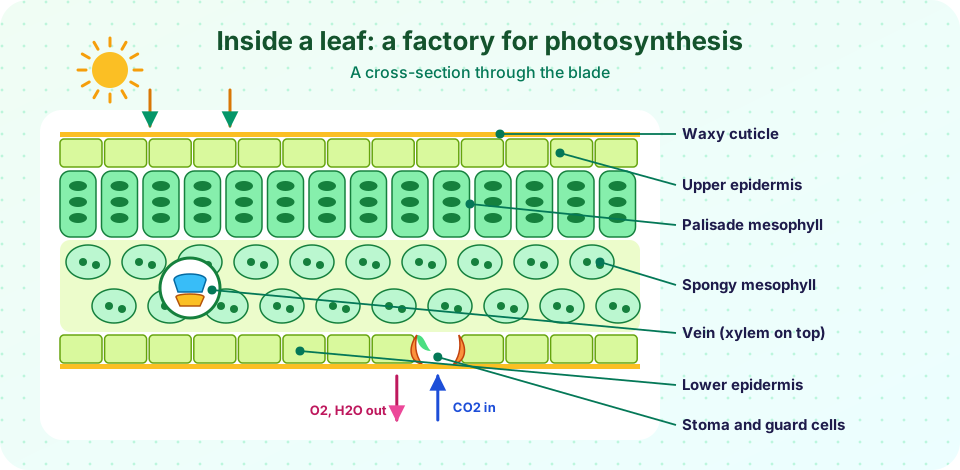
The cross-section reveals layers from top to bottom.
- Cuticle. A wax and cutin film that makes the leaf surface waterproof and reflects some light. It is thicker in dry habitats.
- Upper epidermis. A single layer of tightly fitting, transparent cells with no chloroplasts in most species, so light passes through.
- Palisade mesophyll. One or two layers of tall, column-shaped cells packed with chloroplasts, directly under the light. This layer does most of the photosynthesis. The elongated shape lets chloroplasts line up along the walls and lets light penetrate deep between cells.
- Spongy mesophyll. Loosely arranged, rounded cells with large air spaces between them. Carbon dioxide diffuses through the air spaces to reach the cell surfaces, where it dissolves in a thin film of water on the walls.
- Veins. Vascular bundles with xylem (usually on the upper side) delivering water and minerals and phloem (on the lower side) carrying sugar away. Veins also help support the blade. In many leaves no cell is more than a few cells away from a vein.
- Lower epidermis. Similar to the upper one but with many stomata.
The air spaces matter more than they seem. Carbon dioxide diffuses about 10,000 times more slowly through water than through air, so a leaf with air channels reaches its cells far faster than a solid block of tissue could.
Stomata and guard cells
A stoma (plural stomata, "mouths") is a pore in the epidermis surrounded by two kidney-shaped guard cells. It is the leaf's gate. Through it:
- carbon dioxide enters for photosynthesis;
- oxygen made by photosynthesis leaves;
- water vapor escapes (transpiration), which also cools the leaf and pulls water up from the roots.
Most broadleaf plants have more stomata on the lower surface (hypostomatous), where it is cooler and less exposed to sun. Typical densities run from about 50 to 500 stomata per square millimeter, depending on the species and growing conditions. Grasses often have stomata on both sides, and floating water lilies have them only on the top.
How a stoma opens
The guard cell walls are thicker on the side facing the pore and thinner on the outer side. When light, especially blue light, strikes the guard cells, they pump potassium ions in. Water follows by osmosis, the cells become turgid and, because of the uneven wall, they bow outward like two bananas curving apart, and the pore opens. In the dark, or when the plant is short of water, ions leave, the cells lose turgor and the pore closes. A hormone, abscisic acid (ABA), made in dry soil and roots, triggers closure and protects the plant in drought.
Even when wide open, the pores occupy well under 1 percent of the leaf's surface, but gas diffuses so effectively through many tiny holes that a perforated sheet admits nearly as much carbon dioxide as a completely open surface of the same area. Many small pores work better than a few large ones.
The central trade-off
For every carbon dioxide molecule that enters, a leaf in warm, dry air can lose hundreds of water molecules. That is the price of photosynthesis. Plants manage it by opening stomata in the morning when the air is cool and humid, closing them at midday heat and keeping them open only as long as water supply allows. This balance of carbon gain against water loss shapes almost every leaf adaptation.
Leaf adaptations
- Dry habitats (xerophytes). Thick cuticle, small or needle-like leaves (pine), sunken stomata, hairs that trap humid air, or leaves reduced to spines (cactus) with photosynthesis in the stem.
- Shade. Shade leaves are larger and thinner, with more chlorophyll per area, to catch weak light. Sun leaves are smaller and thicker, with more palisade layers.
- Water plants (hydrophytes). Floating leaves with stomata on top and large air spaces for buoyancy.
- Climbers. Leaves or leaflets modified into tendrils (peas).
- Carnivorous plants. Traps (pitchers, sticky hairs, snapping lobes) that supply nitrogen where the soil is poor. The plants still photosynthesize.
- Storage. Fleshy leaves of succulents such as aloe store water; onion bulbs store food in leaf bases.
- Defense. Spines, stinging hairs (nettle), tough or bitter leaves.
Common misconceptions
- "Leaves take in water from the air." Most leaves lose water to the air; they take in carbon dioxide, not water. (Some plants such as certain bromeliads and Spanish moss absorb water through leaf scales, but they are the exception.)
- "Leaves turn red or yellow in autumn because the color is new." The yellow and orange carotenoids were present all summer and are revealed when green chlorophyll breaks down. Red anthocyanins are often made fresh in autumn.
- "All of the leaf is photosynthetic." Epidermis and veins mostly are not; the mesophyll does the job.
- "Stomata are always open in the day." They close on hot, dry or water-short days even in bright light.
Try it
Press Run (or Ctrl + Enter) to see the result here.
Program input · what you'd type while the program runs
Type the answers before you press Run, one per line. Each time the program reads a line (with input()), it gets the next line from this box.
Press Run (or Ctrl + Enter) to see the console output here.
No output.
Check your understanding
Quick check · 5 questions
of 5 answered You scored / 5 · perfect!
-
1. Which layer does most of a leaf's photosynthesis?
Tall palisade cells packed with chloroplasts sit directly under the light. -
2. Why does the spongy mesophyll have large air spaces?
Diffusion through air is thousands of times faster than through water. -
3. A stoma opens when guard cells...
Uptake of K+ lowers water potential, water enters and the uneven walls bow outward. -
4. Parallel leaf veins are typical of...
Parallel venation goes with monocots. -
5. Which hormone signals stomata to close in drought?
ABA made in response to water stress triggers guard cells to lose turgor.
Summary
- Leaves have a blade and petiole; they can be simple or compound, with net or parallel veins.
- The blade has cuticle, upper epidermis, palisade mesophyll, spongy mesophyll with air spaces, veins and a lower epidermis with stomata.
- Guard cells open the stoma by gaining turgor; closure is triggered by darkness and abscisic acid.
- The leaf trades water loss for carbon dioxide gain, and adaptations tilt that trade-off for each habitat.
Track your progress
Create a free account to tick off lessons and pick up where you left off on any device.
of Botany and Plant Science lessons completed