


















Lesson 42 of 48 · Ecology, Agriculture and Biotechnology
Agriculture and crops
How wild plants became crops: domestication, centers of origin, polyploid wheat, hybrid breeding, the Green Revolution and sustainable farming, with breeding calculators.
Every meal is a botany lesson. Bread is milled endosperm of a grass seed, rice is another grass, a potato is a swollen underground stem, a tomato is a fruit, and sugar comes from a grass stem or a root. Almost none of these plants looks like its wild ancestor. In roughly the last 12,000 years, human selection has remodeled a few dozen wild species into crops with big, easily harvested, non-shattering seeds and fruits. Understanding how that happened explains how modern plant breeding works and why farming leans so heavily on a small set of species.
What you will learn
- What domestication is and the common traits it produces.
- Where major crops came from and how they changed.
- How polyploidy, hybrids and the Green Revolution reshaped yields.
- Principles of sustainable farming, with two calculators.
Key terms
Domestication: genetic change in a species under human selection, making it suited to cultivation and often dependent on people.
Domestication syndrome: the set of traits that crops share, such as larger seeds, non-shattering seed heads and reduced dormancy.
Polyploid: an organism with more than two sets of chromosomes.
Heterosis (hybrid vigor): the extra vigor of a hybrid compared with its parents.
Growing degree days (GDD): a measure of accumulated heat that predicts crop development.
Domestication and its syndrome
Early farmers did not set out to change a species. They gathered seeds from plants that were easier to harvest and planted them. Over many generations, selection shifted the population. Crops from many families end up with a similar set of changes, called the domestication syndrome:
- Non-shattering seed heads. A wild grass drops its seeds when ripe, which is good for the plant and bad for a harvester. Mutations that keep seeds on the head were selected: they are easy to harvest, but the plant cannot spread its seed alone.
- Bigger seeds, fruits or tubers, and often fewer, more uniform ones.
- Reduced seed dormancy so that all seeds germinate together after sowing.
- Less bitterness and fewer defenses (many wild almonds contain cyanide, and bitter forms have been replaced by sweet ones).
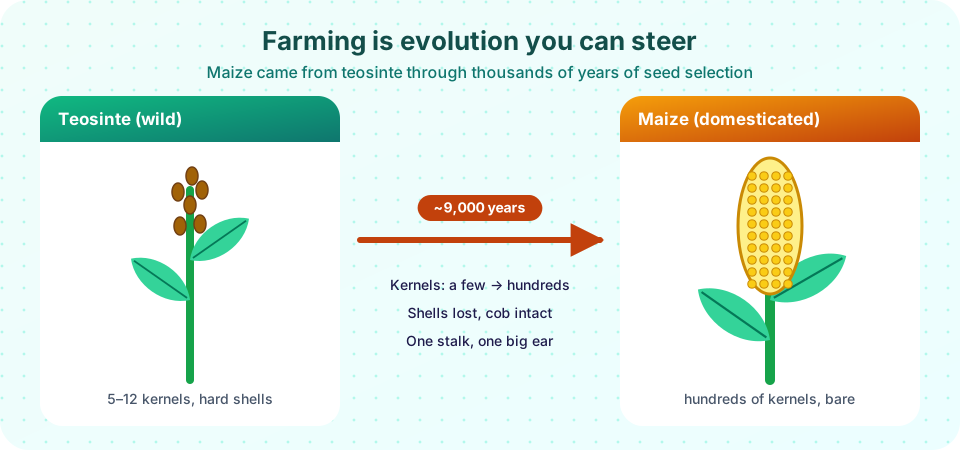
- Changes in plant shape, such as fewer branches in maize, which has one main stalk and one or two large ears.
Modern genetics has found some of the genes behind these changes. A few genes with large effects, such as teosinte branched1 (tb1) and teosinte glume architecture1 (tga1) in maize, explain much of the difference between maize and teosinte. tga1 changed the hard fruitcase around each kernel into the soft glumes of modern maize.
Where crops came from
The Russian botanist Nikolai Vavilov, in the 1920s and 1930s, collected crop plants worldwide and noticed that their diversity and wild relatives were concentrated in a small number of regions, which he called centers of origin. Archaeology and genetics refine his picture, which is more complex than eight tidy centers, but it remains a useful map.
| Region | Early crops (approximate age of cultivation) |
|---|---|
| Fertile Crescent (Southwest Asia) | Emmer and einkorn wheat, barley, lentil, pea, chickpea, flax (about 11,000 to 10,000 years ago) |
| China (Yangtze and Yellow River valleys) | Rice, millet, soybean (about 9,000 years ago and later) |
| Mesoamerica | Maize, beans, squash (maize about 9,000 years ago from teosinte) |
| Andes and Amazonia | Potato, quinoa, cassava, peanut |
| Sub-Saharan Africa | Sorghum, pearl millet, African rice, yams |
| New Guinea | Banana, sugarcane (early cultivation) |
Gathering these into a few cultural packages, such as the "Three Sisters" of maize, beans and squash in the Americas, gave balanced diets: cereals for starch, legumes for protein and nitrogen.
Polyploidy and hybrids
Bread wheat (Triticum aestivum) is a hexaploid with 42 chromosomes (2n = 6x = 42, genomes AABBDD). It arose when a tetraploid emmer wheat (AABB) hybridized with a wild goat grass, Aegilops tauschii (DD), in farmers' fields about 8,000 to 10,000 years ago. The extra genomes gave bread wheat a wide climate range and its gluten proteins, which make dough stretchy. Cultivated bananas are mostly sterile triploids, so they can only be propagated by cuttings, and many strawberries are octoploids.
Hybrid vigor. In the early 1900s George Shull and others showed that crossing two inbred maize lines can give a first-generation (F₁) hybrid that outyields both parents. Hybrid maize became the basis of a seed industry: farmers buy new F₁ seed each year because the next generation segregates. Hybrids are now common in maize, sunflower, many vegetables and some rice.
The Green Revolution
By the 1940s populations were growing quickly and food shortages loomed. In Mexico Norman Borlaug and colleagues crossed local wheat with the dwarf Japanese variety Norin 10, which carried reduced-height genes. The result was short, stiff-stemmed wheat that could carry heavy grain heads without falling over (lodging) and responded to nitrogen fertilizer. At the International Rice Research Institute in the Philippines, a similar semi-dwarf rice, IR8, was released in 1966. These varieties, combined with irrigation, synthetic fertilizer and pesticides, raised yields in South Asia and elsewhere. Borlaug received the Nobel Peace Prize in 1970.
Between roughly 1960 and 2000, world cereal production roughly tripled while the area cultivated grew by only about a third. This avoided clearing vast areas of land. It also had costs: heavy fertilizer and water use, pesticide pollution, loss of crop diversity, and uneven benefits among farmers. Agriculture now occupies about half of the world's habitable land and accounts for around 70% of freshwater withdrawals.
Diversity and risk
Genetic uniformity is efficient but risky. In the 1840s the Irish potato crop, grown from a few clones, was devastated by the potato blight, Phytophthora infestans, contributing to the Great Famine. Modern breeders protect against such disasters by drawing on wild relatives and landraces (traditional varieties) for resistance genes, and by storing seeds in gene banks.
Sustainable farming
Farming works on ecological principles, and good practice mirrors what you learned in the last lesson and the nutrition lesson.
- Rotation and legumes. Alternating crops breaks pest cycles, and legumes add nitrogen.
- Cover crops and mulch keep soil covered, reduce erosion and add organic matter.
- Reduced tillage protects soil structure and soil life.
- Integrated pest management (IPM) combines monitoring, resistant varieties, natural enemies and, when needed, targeted spraying.
- Efficient water use, for example drip irrigation and drought-tolerant varieties.
- Right amount, right place, right time for fertilizer, to feed crops without feeding algal blooms downstream.
Different systems (conventional, organic, agroforestry, regenerative) emphasize different trade-offs between yield, inputs and environmental effects, and the best choice depends on place and goals. Crops are also measured by weight: by tonnage, sugarcane, maize, rice and wheat lead the world, and by calories wheat, rice and maize dominate.
Common misconceptions
"Domestication means plants were deliberately designed." Most changes came from unintentional selection by people planting and harvesting, followed by deliberate selection later.
"Modern crops are unnatural because they are genetically changed." Every crop is genetically different from its wild ancestor, since selection changed its DNA long before genetics existed.
"The Green Revolution was all about GM plants." It relied on conventional breeding of dwarf varieties, plus fertilizer and irrigation. Genetic modification came later.
Try it
First, a growing-degree-day calculator. A crop needs a certain amount of heat to complete development, and GDD adds up each day's warmth above a base temperature. This simplified version uses daily mean temperature, a base of 10 °C and an upper cap of 30 °C (typical for maize), and a made-up requirement of 1,500 °C-days. It compares a cool and a warm site, with an invented smooth temperature curve instead of real weather data.
Press Run (or Ctrl + Enter) to see the result here.
Program input · what you'd type while the program runs
Type the answers before you press Run, one per line. Each time the program reads a line (with input()), it gets the next line from this box.
Second, a breeding calculator. If you want a plant that is homozygous recessive at several independent genes, how many F₂ plants must you grow to have a 95% chance of finding at least one?
Press Run (or Ctrl + Enter) to see the result here.
Program input · what you'd type while the program runs
Type the answers before you press Run, one per line. Each time the program reads a line (with input()), it gets the next line from this box.
Check your understanding
Quick check · 6 questions
of 6 answered You scored / 6 · perfect!
-
1. Which is part of the domestication syndrome in cereals?
Non-shattering seed heads were selected because they let farmers harvest grain. -
2. Bread wheat is hexaploid. What does that mean?
Hexaploid means six chromosome sets (AABBDD), 2n = 42, from hybridization between emmer wheat and goat grass. -
3. Why were semi-dwarf wheat and rice varieties important in the Green Revolution?
Short stiff stems carry heavy heads without falling over, so higher fertilizer rates raised yield. -
4. Nikolai Vavilov is best known for
Vavilov mapped regions where crop diversity and wild relatives were concentrated. -
5. You want a plant homozygous recessive at 2 independent genes in an F2 population. What fraction of plants has that genotype?
Each recessive homozygote is 1/4, so two independent genes give 1/4 x 1/4 = 1/16. -
6. Why is genetic uniformity in a crop risky?
If all plants share the same susceptibility, one pathogen can devastate a whole crop.
Summary
- Domestication is genetic change under human selection, with common traits such as non-shattering heads, larger seeds and reduced dormancy.
- Crops arose in several regions, including the Fertile Crescent, China, Mesoamerica and the Andes.
- Polyploidy (bread wheat is hexaploid), hybrids and the Green Revolution's semi-dwarf varieties raised yields.
- Uniformity brings risk, so breeders and gene banks preserve diversity.
- Sustainable farming uses rotation, cover crops, careful water and nutrient management, and integrated pest control.
Next: Plant biotechnology
Track your progress
Create a free account to tick off lessons and pick up where you left off on any device.
of Botany and Plant Science lessons completed