


















Lesson 28 of 48 · Water, Nutrients and Transport
Mineral nutrition and soil
Learn the 17 essential plant elements, how roots take up nutrients from soil, how fungi and bacteria help, and how to read deficiency symptoms and fertilizer labels.
Plants build their bodies from air, water and a short list of minerals from the soil. Carbon comes from carbon dioxide, and most of the dry mass of a tree is carbon fixed by photosynthesis. Yet a plant that has plenty of light, water and air will still yellow, stunt or fail if it lacks a few milligrams of the right ion. Gardeners, farmers and ecologists all read plants as indicators of what the soil is missing. This lesson covers the elements plants need, how roots collect them, how fungi and bacteria help, and how to turn a pale leaf into a diagnosis.
What you will learn
- Which 17 elements are essential for plants and how they are classified.
- How roots absorb nutrients, and how soil, pH and fungi affect that.
- How nitrogen fixation and fertilizers fit in.
- How to match deficiency symptoms to nutrients and read an N-P-K label.
Key terms
Essential element: an element a plant cannot complete its life cycle without, that has no substitute and has a direct role in the plant.
Macronutrient and micronutrient: elements needed in large amounts (N, P, K, Ca, Mg, S) or tiny amounts (Fe, Mn, Zn, Cu, B, Mo, Cl, Ni).
Cation exchange capacity (CEC): how many positive ions soil particles can hold on their surface.
Mycorrhiza: a partnership between a fungus and plant roots.
Mobile nutrient: one that a plant can move from old tissue to young tissue.
The essential elements
Botanists call an element essential if a plant cannot complete its life cycle without it, no other element can replace it, and it plays a direct role in the plant's metabolism. This was tested by growing plants in hydroponic solutions with one element left out at a time. Julius von Sachs grew plants in nutrient solution in the 1860s, and Dennis Hoagland's recipes from the 1930s and 1950s are still in use. Daniel Arnon and Perry Stout formalized the criteria in 1939.
There are 17 essential elements:
- From air and water: carbon (C), hydrogen (H), oxygen (O).
- Macronutrients (usually more than about 0.1% of dry mass): nitrogen (N), phosphorus (P), potassium (K), calcium (Ca), magnesium (Mg), sulfur (S).
- Micronutrients: iron (Fe), manganese (Mn), zinc (Zn), copper (Cu), boron (B), molybdenum (Mo), chlorine (Cl) and nickel (Ni).
Some other elements are beneficial in certain plants, such as silicon in rice and grasses, which strengthens cell walls, or sodium in some salt-tolerant species. They are not counted as essential for all plants.
What each does
| Element | Main roles |
|---|---|
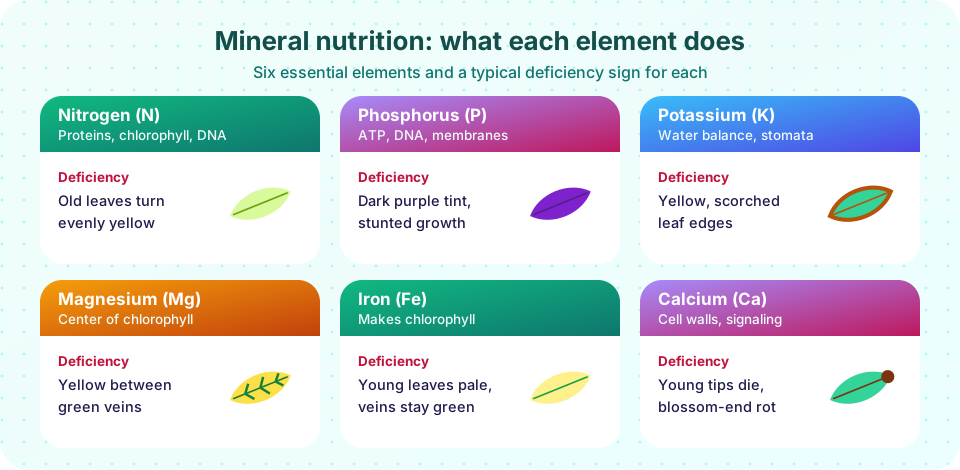
| N | Amino acids, proteins, nucleic acids, chlorophyll |
| P | ATP, DNA and RNA, phospholipids in membranes |
| K | Osmotic balance, stomatal opening, enzyme activation |
| Ca | Cell walls (pectin cross-links), signaling |
| Mg | Center of the chlorophyll molecule, enzyme cofactor |
| S | Two amino acids (cysteine, methionine), coenzymes |
| Fe | Chlorophyll synthesis, electron transport |
| Others | Cofactors for specific enzymes (Mn, Zn, Cu, Mo, Ni), boron in cell walls and sugar transport, Cl in water splitting |
Nitrogen is the one plants need most; it commonly makes up 1.5% to 4% of dry matter, and nitrogen shortage limits plant growth in a large part of the world.
From soil to root
Soil is a mix of mineral particles, organic matter, water, air and organisms. Most of a plant's nutrients exist as ions, either dissolved in soil water or loosely held on the surface of clay and humus particles.
Cation exchange. Clay and humus carry negative charge, so they hold on to positive ions such as K⁺, Ca²⁺, Mg²⁺ and NH₄⁺. Roots release H⁺ ions, which swap places with the nutrient cations and free them into the soil solution. A soil with a high CEC, such as a clay or organic soil, holds more nutrients than sandy soil, which is why sandy soils need more frequent fertilizing.
Negative ions (nitrate NO₃⁻, sulfate SO₄²⁻, and phosphate H₂PO₄⁻) are not held by negatively charged particles, so nitrate leaches easily with rain. Phosphate is the opposite problem: it binds tightly to iron, aluminum and calcium in soil, so it moves only a few millimeters by diffusion and plants run short of it even when total soil phosphorus is high.
Root structure matters. Water and ions enter through the huge surface of root hairs, then cross the root cortex either through cell walls (the apoplast) or through cell interiors linked by plasmodesmata (the symplast). The Casparian strip, a waxy band in the endodermis, blocks the wall route, so every ion must pass through a cell membrane before it enters the xylem. This is where plants can select what comes in, using transport proteins and energy from proton pumps.
pH controls availability. In acidic soils (pH below about 5.5) aluminum and manganese may reach toxic levels and phosphorus is tied up. In alkaline soils (above about 7.5) iron, manganese and zinc become insoluble, so plants such as blueberries and azaleas yellow on limy ground. Most crops grow best near pH 6 to 7, where most nutrients are available.
Helpers: fungi and bacteria
Mycorrhizae. Roughly 70% to 80% of land plant species form partnerships with fungi. In arbuscular mycorrhizae, fungal threads enter root cells and branch into tiny tree-like structures; the fungus extends the root system far beyond root hairs, delivering phosphate and other nutrients and receiving sugar in return. In ectomycorrhizae (common in pines and oaks), the fungus wraps the root in a sheath. Plants in nutrient-poor soil rely heavily on this trade.
Nitrogen fixation. The atmosphere is 78% N₂, but the triple bond is far too strong for plants to use directly. Certain bacteria contain the enzyme nitrogenase, which reduces N₂ to ammonia. In legumes such as beans, clover and peas, Rhizobium and related bacteria live in root nodules. The plant supplies sugar and a low-oxygen environment, protected by the red protein leghemoglobin, and gets ammonia in return. This is why crop rotations with legumes enrich soil and why soybean crops need little nitrogen fertilizer. Other plants, such as alder, partner with the actinobacterium Frankia.
Nitrification. Soil microbes convert ammonium to nitrite and then to nitrate, the form most plants absorb in aerated soil. Plants take up NO₃⁻ and NH₄⁺ and reduce nitrate back to ammonium inside the plant, which costs energy.
Carnivorous plants. Venus flytraps and sundews grow in boggy soil poor in nitrogen and phosphorus. They still photosynthesize, but they catch and digest insects to get nutrients, not energy.
Reading deficiency symptoms
Where a symptom shows up depends on mobility. A mobile nutrient is moved out of old leaves to feed new growth when supply runs short, so deficiency appears first in older leaves. An immobile one is stuck where it was deposited, so young leaves show the problem.
| Nutrient | Mobility | Typical symptom |
|---|---|---|
| Nitrogen | Mobile | Old leaves turn pale yellow evenly; stunted growth |
| Phosphorus | Mobile | Dark green or purplish leaves, slow growth |
| Potassium | Mobile | Yellow margins, then brown scorching on older leaves |
| Magnesium | Mobile | Yellowing between veins on older leaves (veins stay green) |
| Iron | Immobile | Young leaves pale with green veins |
| Calcium | Immobile | Dying shoot tips; blossom-end rot in tomatoes |
| Sulfur | Fairly immobile | Whole young leaves pale |
| Boron, Zn | Immobile | Distorted, small young leaves |
Be careful with diagnosis. Pale leaves can also come from waterlogging, root disease, cold soil or too much of another nutrient. The only certain tests are soil and tissue analysis, and the symptoms above are starting hypotheses.
Fertilizers and Liebig's law
Plants cannot tell whether a nitrate ion came from compost or from a bag, but the source matters for soil structure, cost and runoff. Fertilizer labels list three numbers: N-P-K, being the percentage by weight of N, P₂O₅ and K₂O. A 50 kg bag of 10-10-10 holds 5 kg N, 5 kg P₂O₅ (about 2.2 kg elemental P) and 5 kg K₂O (about 4.2 kg elemental K).
Industrial nitrogen fixation, the Haber-Bosch process (developed by Fritz Haber and Carl Bosch from 1909 to 1913), makes ammonia from N₂ and H₂ under high pressure and temperature. It supports roughly half of the world's population through the food produced with synthetic nitrogen, but it also leads to runoff that feeds algal blooms in rivers and coastal waters.
Liebig's law of the minimum says that growth is limited by whichever essential resource is in shortest supply, not by the total of resources; picture a barrel whose water level is set by its shortest stave. Adding more of an abundant nutrient does nothing until the limiting one is fixed. Yield responses also flatten: the first kilogram of nitrogen helps a lot, the hundredth helps a little. The Mitscherlich equation, y = A × (1 − e^(−c × x)), captures that diminishing return.
Common misconceptions
"Plants eat soil." Soil supplies only a small fraction of a plant's dry mass. Most of it is carbon from the air and the oxygen and hydrogen of water.
"More fertilizer is always better." Excess salts lower the soil Ψ and burn roots, and surplus nitrogen can weaken stems or reduce fruiting.
"Yellow leaves always mean nitrogen is short." Several deficiencies, toxicities and diseases look alike. Check which leaves are affected (old or young) and whether veins stay green.
Try it
First, a response curve showing diminishing returns and Liebig's minimum: yield limited by whichever nutrient gives the smaller value.
Press Run (or Ctrl + Enter) to see the result here.
Program input · what you'd type while the program runs
Type the answers before you press Run, one per line. Each time the program reads a line (with input()), it gets the next line from this box.
Second, a fertilizer calculator that turns a label into kilograms of each nutrient and works out how many bags a field needs.
Press Run (or Ctrl + Enter) to see the result here.
Program input · what you'd type while the program runs
Type the answers before you press Run, one per line. Each time the program reads a line (with input()), it gets the next line from this box.
Check your understanding
Quick check · 5 questions
of 5 answered You scored / 5 · perfect!
-
1. How many elements are considered essential for plants?
Seventeen: C, H, O, six macronutrients (N, P, K, Ca, Mg, S) and eight micronutrients (Fe, Mn, Zn, Cu, B, Mo, Cl, Ni). -
2. A plant shows yellowing between the veins on its oldest leaves. Which nutrient is the likeliest shortage?
Magnesium is mobile and sits at the center of chlorophyll, so old leaves show interveinal yellowing. -
3. Why do young leaves show iron deficiency first?
Immobile nutrients stay where they were deposited; new growth gets only what the xylem delivers. -
4. What do legume root nodules do?
Rhizobium bacteria in nodules use nitrogenase to reduce N2 to ammonia, giving the plant usable nitrogen. -
5. A bag is labeled 20-10-5. How much N does a 25 kg bag contain?
20 percent of 25 kg is 5 kg of nitrogen.
Summary
- Seventeen elements are essential: C, H, O, six macronutrients and eight micronutrients.
- Roots take up ions from soil water and from cation exchange; the Casparian strip forces ions through membranes.
- pH, CEC, mycorrhizal fungi and nitrogen-fixing bacteria all change what is available.
- Deficiency symptoms in old leaves point to mobile nutrients (N, P, K, Mg); symptoms in young leaves point to immobile ones (Ca, Fe).
- Fertilizer labels give percent N, P₂O₅ and K₂O; yield responses show diminishing returns and Liebig's minimum.
Next: Chapter 5 review
Track your progress
Create a free account to tick off lessons and pick up where you left off on any device.
of Botany and Plant Science lessons completed