


















Lesson 31 of 48 · Growth, Hormones and Reproduction
Plant hormones
Meet the five classic plant hormones, the experiments that discovered them, what each does, and how hormone balance controls growth, dormancy and ripening.
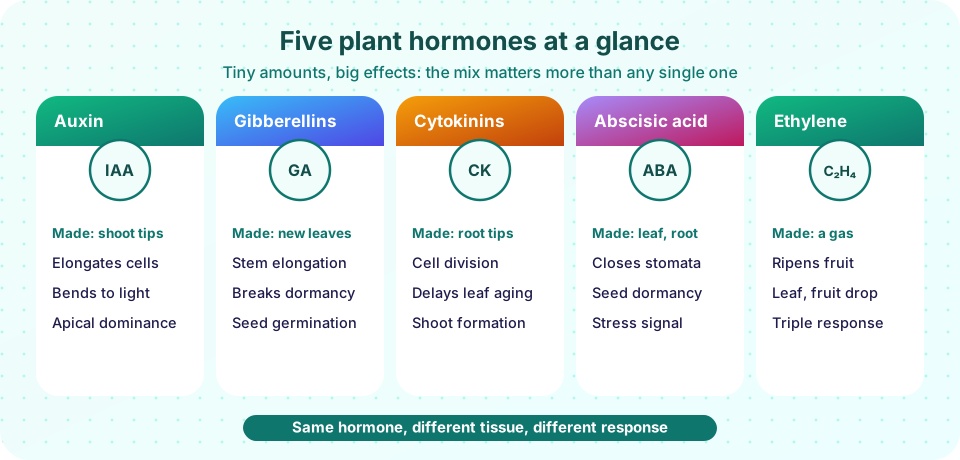
Put a ripe banana in a bag with a green avocado and the avocado softens in days. Pinch the tip off a bushy plant and side branches appear. Spray a dwarf plant with a certain chemical and it shoots up. Each of these effects is the work of a hormone, a compound made in tiny amounts that changes how cells behave. Plants have no nervous system and no blood circulation, so hormones, together with electrical and calcium signals, carry messages across the plant. This lesson tours the five classic plant hormones, the discoveries behind them, and the key point: it is the balance between hormones, not any one of them, that decides what a cell does.
What you will learn
- The five main plant hormones, where they are made and what they do.
- The classic experiments that found auxin, gibberellin and ethylene.
- How hormones interact, for example auxin with cytokinin and gibberellin with ABA.
- Why the same hormone can have different effects in different tissues.
Key terms
Hormone: a signaling molecule that acts at low concentrations, often far from where it was made.
Polar auxin transport: one-way movement of auxin from the shoot tip toward the root, via PIN efflux carriers.
Apical dominance: suppression of side buds by the growing tip.
Climacteric fruit: a fruit (banana, tomato, apple) that ripens with a burst of ethylene.
Triple response: the seedling reaction to ethylene: shorter, thicker stems that grow sideways.
Auxin: the growth director
Discovery. In 1880 Charles Darwin and his son Francis noticed that grass seedlings bent toward light only if the tip was uncovered, and concluded that "some influence" passes from the tip to the part below. Later Boysen-Jensen showed the influence could pass through a block of gelatin. In 1928 Frits Went put the tips of oat seedlings (coleoptiles) on small blocks of agar, then placed the agar blocks off-center on decapitated seedlings. The seedlings bent away from the side with the block, showing that a chemical made in the tip promotes growth on the side where it goes. This chemical, indole-3-acetic acid (IAA), is the main natural auxin.
What it does. Auxin makes cells elongate by the acid growth mechanism: it activates proton pumps that acidify the cell wall, which activates wall-loosening proteins called expansins, and turgor then stretches the cell. It also organizes vascular tissue, triggers root formation (the active ingredient in rooting powder), maintains apical dominance and helps seeds develop into fruit. Auxin is carried from shoot to root by polar transport: PIN proteins sit at one end of each cell and pump auxin out, so it flows in one direction down the stem.
Concentration matters. Shoots and roots respond differently. A concentration that speeds shoot elongation can slow root growth, and a high concentration can inhibit both. Synthetic auxins such as 2,4-D, applied in high doses, kill broadleaf weeds in lawns while leaving grasses, because broadleaf plants are far more sensitive.
Gibberellins: stretch and awaken
Discovery. Japanese farmers knew bakanae ("foolish seedling") disease, in which rice seedlings grew tall, thin and weak. In the 1920s Eiichi Kurosawa showed that a fungus, Gibberella fujikuroi, secreted something that caused it. The active compounds, the gibberellins (GAs), were isolated in the 1930s, and later found to be made by plants themselves.
What they do. Gibberellins stimulate stem elongation (genetic dwarf plants often lack GA or its signaling), break seed dormancy, and promote germination: in a barley seed, GA from the embryo tells the outer aleurone layer to make amylase, which digests starch into sugar for the seedling. They also promote bolting and flowering in some plants and help fruit grow, which is why grape growers spray seedless grapes with GA to enlarge the berries.
A farming story. The semi-dwarf wheat and rice varieties of the Green Revolution have shortened stems because of changes in gibberellin signaling or synthesis. Short, stiff plants carry heavy heads of grain without falling over (lodging), which let farmers use more fertilizer to raise yields.
Cytokinins: divide and delay
Discovery. Folke Skoog and Carlos Miller found in the 1950s that tobacco tissue cultured in the lab would grow into a shapeless mass called callus unless a substance from degraded DNA (kinetin) was added, which made cells divide. Natural cytokinins such as zeatin were found later.
What they do. Cytokinins, made mainly in root tips and moved up in the xylem, promote cell division, release side buds from apical dominance, and delay leaf senescence. Florists use them to keep cut greens fresh. Skoog and Miller also showed that the ratio decides what the tissue becomes: a high auxin-to-cytokinin ratio gives roots, a high cytokinin-to-auxin ratio gives shoots, and a middle ratio gives undifferentiated callus. This principle underlies plant tissue culture, which you will meet again in the biotechnology lesson.
Auxin and cytokinin as a duet. The shoot tip makes auxin, which flows downward and suppresses side buds; the roots make cytokinin, which flows upward and encourages them. The balance between the two decides whether a plant is tall and unbranched or bushy. Pinching off the tip removes the auxin source, and the buds break.
Abscisic acid: the stress and sleep signal
Discovery. In the 1960s several labs, led by Frederick Addicott and Philip Wareing, isolated a compound that caused leaves and fruit to fall (abscission) or buds to go dormant. It is now known as abscisic acid (ABA), though it turned out to have little to do with abscission in most plants.
What it does. ABA is made in roots, leaves and seeds. When soil dries, roots send ABA to leaves, where it closes stomata within minutes (the mechanism you saw in the transpiration lesson). In seeds, ABA maintains dormancy and blocks germination; seed germination depends on the balance between ABA, which holds the seed asleep, and gibberellin, which wakes it. ABA also helps plants tolerate cold, drought and salt by switching on protective genes.
Ethylene: the gas that ripens and ages
Discovery. In 1901 Dimitry Neljubow found that pea seedlings grown in a lab with gas lighting developed odd, thickened, horizontal stems, and he traced the effect to ethylene in the gas. Much later, in the 1930s, Richard Gane showed that plants themselves make this simple gas, C₂H₄.
What it does. Ethylene is a gas, so it diffuses through air and between neighboring plants. It triggers ripening in climacteric fruits, causes leaves and flowers to be shed, and makes seedlings respond to obstacles with the triple response: shorter stems, thicker stems, and horizontal growth, which helps a seedling push around a stone. Ripening is autocatalytic: a little ethylene makes the fruit produce more, so the process accelerates, spreading from one fruit to another. This is why "one bad apple spoils the barrel" and why a ripe banana speeds up a green one nearby. Storage rooms regulate ripening with controlled atmospheres, low temperature, and ethylene absorbers or inhibitors.
Other messengers
The five above are the traditional list. Researchers have added brassinosteroids (growth and cell elongation), jasmonates (defense against insects and wounds), salicylic acid (defense against microbes), strigolactones (branching, and signals to mycorrhizal fungi) and several peptide hormones. A few other signals, such as electrical pulses and calcium waves, travel quickly after wounding. Together they form a network, not a simple list.
Why the same hormone does different things
Cells decide how to respond using three tools: how much hormone is present, which receptors they carry, and what other hormones are around. A root cell and a shoot cell both sense auxin, yet they respond in opposite ways because they have different internal wiring. This is also why plant hormones are difficult to use in simple rules: context matters more than the molecule.
Common misconceptions
"Each hormone has one function." Each does many things. ABA closes stomata, keeps seeds dormant and helps in cold tolerance. Ethylene ripens fruit and also shapes seedlings.
"Hormones are like animal hormones made in glands." Plants have no glands. Many cells can make hormones, and they often act in the cells that make them or their neighbors.
"Ripening bananas are rotting." Ripening is a programmed process driven by ethylene, not spoilage, although the two can follow each other.
Try it
The first plot is a schematic (not measured data) of the classic idea that shoots and roots respond to the same auxin range in different ways.
Press Run (or Ctrl + Enter) to see the result here.
Program input · what you'd type while the program runs
Type the answers before you press Run, one per line. Each time the program reads a line (with input()), it gets the next line from this box.
The second is a toy model of autocatalytic ripening. It is a simple differential-equation sketch, not a fruit-physiology model, but it shows why one ripe fruit speeds up its neighbors.
Press Run (or Ctrl + Enter) to see the result here.
Program input · what you'd type while the program runs
Type the answers before you press Run, one per line. Each time the program reads a line (with input()), it gets the next line from this box.
Check your understanding
Quick check · 5 questions
of 5 answered You scored / 5 · perfect!
-
1. In Went's 1928 experiment, an agar block containing the chemical from oat coleoptile tips was placed off-center on a decapitated seedling. What happened?
Auxin from the block stimulated elongation on its side, so the seedling curved away from that side. -
2. Which hormone balance favors root formation in tissue culture?
Skoog and Miller found high auxin:cytokinin gives roots, high cytokinin:auxin gives shoots. -
3. Which hormone pair controls seed dormancy versus germination?
ABA maintains dormancy and gibberellin promotes germination; the balance decides. -
4. Why does a ripe banana speed up the ripening of a green avocado in a bag?
Ethylene is a gas, and in climacteric fruit it drives autocatalytic ethylene production. -
5. Pinching off the tip of a shoot makes the plant bushier. Why?
The tip is the source of auxin that maintains apical dominance; removing it lets side buds grow.
Summary
- Auxin (IAA) elongates cells by acid growth, organizes vascular tissue and roots, and maintains apical dominance through polar transport.
- Gibberellins stretch stems, break dormancy and mobilize seed reserves; ABA holds seeds dormant and closes stomata under stress.
- Cytokinins promote division and delay senescence; the auxin-to-cytokinin ratio decides root versus shoot formation.
- Ethylene is a gas that ripens climacteric fruit autocatalytically and produces the seedling triple response.
- Context matters: the same hormone can give opposite responses in different tissues or at different concentrations.
Track your progress
Create a free account to tick off lessons and pick up where you left off on any device.
of Botany and Plant Science lessons completed