


















Lesson 22 of 48 · Photosynthesis and Plant Metabolism
Respiration and plant metabolism
Learn how plants release energy by cellular respiration, why they respire day and night, how they use sugar for growth, storage and defense, and what secondary metabolites do.
Photosynthesis stores energy; respiration spends it. A plant cell uses sugar to power nearly everything it does: building proteins, pumping ions, loading sugar into the phloem, growing roots. A growing plant keeps a careful balance sheet in which photosynthesis is the income and respiration, growth and storage are the spending. This lesson looks at the spending: how plants release energy from sugar, and what else they do with it, from starch granules in a potato to the caffeine in a coffee bean.
What you will learn
- The overall equation of respiration and its three stages.
- How many ATP a glucose yields and where it is made.
- Why plants respire all the time, and how fast respiration responds to temperature.
- How sugar becomes starch, cellulose, oils, proteins and defense compounds.
- What primary and secondary metabolism mean.
Key terms
- Cellular respiration: the release of energy from organic molecules, as ATP, by oxidation.
- Glycolysis: splitting glucose into two 3-carbon pyruvate molecules in the cytosol.
- Krebs cycle (citric acid cycle): a cycle in the mitochondrial matrix that finishes oxidizing pyruvate to CO2.
- Primary metabolism: reactions every cell needs: energy, growth, basic building blocks.
- Secondary metabolites: compounds not needed for basic growth but important for defense, attraction or protection.
Respiration: the reverse of photosynthesis
C6H12O6 + 6 O2 → 6 CO2 + 6 H2O + energy (about 30 to 32 ATP)
Both processes make ATP by chemiosmosis, but they use opposite directions of the same chemistry. In respiration, glucose is oxidized and its energy is captured in ATP.
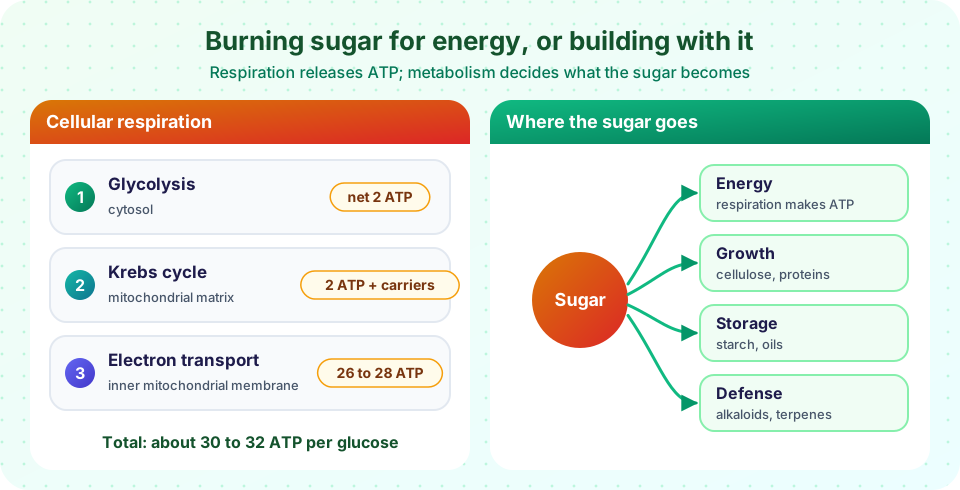
Stage 1, glycolysis (cytosol). One glucose (6 C) is split into two pyruvate (3 C). The cell invests 2 ATP early and gets 4 back, a net gain of 2 ATP, plus 2 NADH. This stage does not need oxygen.
Stage 2, pyruvate oxidation and the Krebs cycle (mitochondrial matrix). Pyruvate enters the mitochondrion and loses a carbon as CO2, forming acetyl-CoA. The acetyl group is oxidized in the Krebs cycle, releasing the rest of the carbon as CO2. For each glucose, stages 1 to 2 together release all six carbons as CO2 and capture the energy in 2 more ATP, 10 NADH (2 from glycolysis, 2 from pyruvate oxidation and 6 from the Krebs cycle) and 2 FADH₂.
Stage 3, electron transport and chemiosmosis (inner mitochondrial membrane). NADH and FADH₂ hand their electrons to a chain of protein complexes embedded in the folded inner membrane (cristae). The electrons flow downhill to oxygen, which accepts them and combines with protons to form water. As the electrons pass, the complexes pump protons across the membrane, and ATP synthase, just like the one in the thylakoid, uses the gradient to make about 26 to 28 ATP. This is why oxygen is needed: it is the final electron acceptor.
Total: about 30 to 32 ATP per glucose (the older textbook figure of 36 to 38 is no longer used). Roughly 40 percent of the energy of glucose ends up in ATP, and the rest is heat.
Plants respire all the time
A frequent mistake is to think that plants photosynthesize by day and respire by night. In fact every living cell respires, all day and all night. In the light, photosynthesis in leaves is faster than respiration, so the plant takes in more CO2 than it gives out and releases net oxygen. At night, respiration continues and only CO2 is released. Roots, flowers and stems that do not photosynthesize respire all the time and depend on sugar delivered by the phloem. Plants typically respire a third to a half of the carbon they fix in a day.
Respiration rate rises with temperature. A useful rule: for each 10 degrees C rise, the rate roughly doubles, so the ratio Q10 is about 2. This is why stored fruit and grain are kept cold, and why a plant's net growth can fall on very warm nights: respiration eats more of the sugar it made in the day.
When oxygen is short
Roots in waterlogged soil, or seeds buried deep, run low on oxygen. Cells then rely on fermentation: pyruvate is turned into ethanol and CO2 so that glycolysis can continue, but only 2 ATP are made per glucose. Rice is unusually tolerant of flooded fields; most crop plants die if roots are underwater for several days.
Heat-producing flowers
A few plants use respiration to make heat. The skunk cabbage (Symplocarpus foetidus) can melt snow around its flowers, and the arum lily family uses an alternative oxidase pathway that skips the proton-pumping steps, wasting the energy as heat to volatilize scent that attracts pollinating insects.
What the sugar becomes
Sugar from the Calvin cycle is the raw material for almost everything.
| Use | Product | Where |
|---|---|---|
| Energy | ATP from respiration | Every living cell |
| Transport | Sucrose in the phloem | Leaves to sinks |
| Structure | Cellulose, hemicellulose, pectin, lignin | Cell walls |
| Short-term storage | Starch in chloroplasts | Leaves (day), broken down at night |
| Long-term storage | Starch in amyloplasts; oils; proteins | Potato tubers, grains, seeds |
| Growth molecules | Amino acids, nucleotides, lipids | All growing cells |
Plants also build amino acids and proteins, but to do so they need nitrogen, which they take from the soil as nitrate (NO₃⁻) or ammonium. Chapter 5 covers mineral nutrition.
Starch is a polymer of glucose with two forms: amylose (unbranched) and amylopectin (branched). Seeds of cereals such as wheat, rice and maize are mostly starch, and so are tubers of potato and cassava. They feed most of humanity. Oils are packed into seeds such as sunflower, rapeseed and olive fruits because fat stores more than twice the energy per gram of starch.
Secondary metabolites: chemistry for defense and attraction
Plants cannot run away from a hungry caterpillar or a fungal infection, so they use chemistry. Secondary metabolites are not needed for basic cell function but have major roles in survival. Three main families:
- Alkaloids contain nitrogen and often act on animal nerves. Examples: caffeine (coffee, tea), nicotine (tobacco), morphine (opium poppy), quinine (cinchona bark).
- Terpenoids are built from 5-carbon isoprene units. They include menthol, the scents of pine and citrus, rubber and the carotenoid pigments.
- Phenolics include flavonoids and anthocyanins (flower and fruit colors), tannins (bitter, astringent compounds) and lignin.
Many drugs and spices come from these compounds: aspirin was first developed from compounds in willow bark, and capsaicin makes chili peppers hot. Plants' own reasons for making them are mainly to deter herbivores, fight microbes, attract pollinators and seed dispersers, and protect against ultraviolet light.
Educational information only. Plant compounds can be strongly active or poisonous. Never use a wild plant as food or medicine without expert identification and professional advice.
Common misconceptions
- "Plants breathe in CO2 and breathe out O2, and that is all." They also take in O2 and give out CO2 all the time through respiration; the net exchange depends on the light.
- "Respiration is breathing." Breathing is gas exchange; cellular respiration is the chemical process in mitochondria.
- "Respiration makes energy." It converts energy from one form (sugar) to another (ATP and heat); energy is conserved.
- "Secondary means unimportant." These compounds are vital for survival, even if not needed for basic growth.
Try it
Press Run (or Ctrl + Enter) to see the result here.
Program input · what you'd type while the program runs
Type the answers before you press Run, one per line. Each time the program reads a line (with input()), it gets the next line from this box.
Press Run (or Ctrl + Enter) to see the console output here.
No output.
Check your understanding
Quick check · 5 questions
of 5 answered You scored / 5 · perfect!
-
1. Where is most ATP made in plant respiration?
Electron transport and ATP synthase work on the inner mitochondrial membrane. -
2. Which molecule is the final electron acceptor in aerobic respiration?
Oxygen accepts electrons and forms water. -
3. A plant at night...
Cells respire all the time; photosynthesis needs light. -
4. Caffeine, nicotine and morphine are examples of...
Alkaloids contain nitrogen and often affect animal nervous systems. -
5. With Q10 = 2, a 10 degree C rise makes respiration...
Q10 is the factor by which the rate changes per 10 degrees.
Summary
- Respiration oxidizes sugar in three stages (glycolysis, Krebs cycle, electron transport) and yields about 30 to 32 ATP per glucose.
- Every cell respires day and night; a plant gains net carbon when photosynthesis exceeds respiration.
- Respiration roughly doubles for each 10 degrees C; without oxygen, cells ferment for much less ATP.
- Sugar becomes sucrose for transport, cellulose for walls, starch and oils for storage, and proteins for growth.
- Secondary metabolites (alkaloids, terpenoids, phenolics) defend plants and attract partners.
Next: Chapter 4 review
Track your progress
Create a free account to tick off lessons and pick up where you left off on any device.
of Botany and Plant Science lessons completed