


















Lesson 13 of 48 · Anatomy and Morphology
Roots: anchors, absorbers and storage
Learn root systems, the four zones of a root tip, root hairs, the layers from epidermis to stele, the Casparian strip, and how roots team up with fungi and bacteria.
The part of a plant that you rarely see is often the larger one. A mature tree may have as much root mass below ground as branch mass above it, and a single grass plant can have thousands of kilometers of root and root hair. Roots anchor the plant, absorb water and minerals, store food and sometimes form partnerships with microbes. In this lesson you will explore the outside of a root, then cut it open to see how water gets from the soil to the vascular tissue in the center.
What you will learn
- The difference between a taproot system and a fibrous root system.
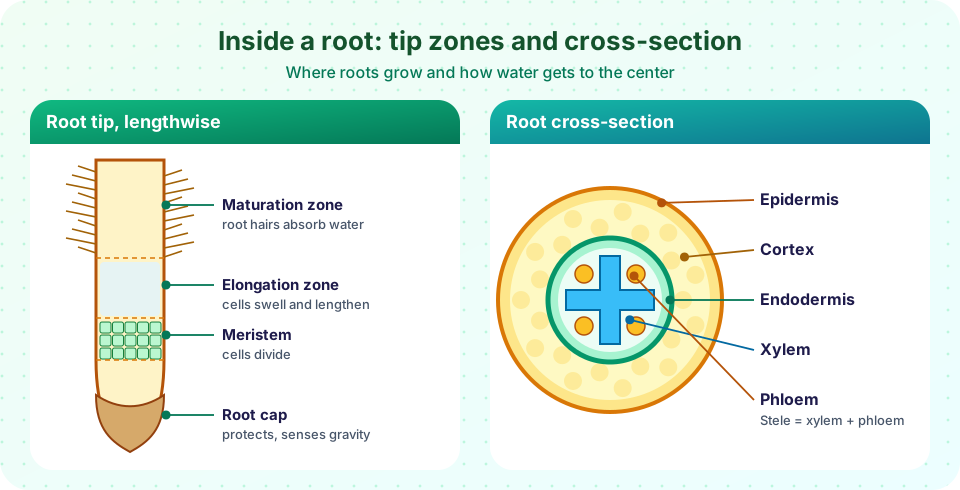
- The four zones of a root tip and what happens in each.
- The tissues of a root, from the epidermis to the stele.
- What the Casparian strip does.
- How mycorrhizae and root nodules help plants.
Key terms
- Taproot: one thick main root with smaller lateral roots.
- Fibrous roots: many roots of similar size that spread from the stem base.
- Root hair: a tiny outgrowth of a single epidermal cell that absorbs water.
- Endodermis: the single cell layer around the central stele, whose walls carry the Casparian strip.
- Stele: the central cylinder of a root containing xylem, phloem and pericycle.
Root systems
When a seed germinates, the first organ to emerge is the radicle, which becomes the primary root. What happens next gives two main patterns.
- Taproot system. The primary root keeps growing as one thick central root with thinner lateral roots. Carrot, dandelion and oak seedlings have a taproot. It reaches deep water and can store food, so carrots, beets and radishes are storage roots.
- Fibrous root system. The primary root dies early and many similar roots grow from the base of the stem. Grasses and most other monocots have fibrous roots. They form a dense mat near the surface, which is why turf holds soil in place and protects against erosion.
Roots that arise from stems or leaves rather than from other roots are adventitious roots. Examples are the prop roots that brace maize, the aerial roots of ivy and the roots that appear when a cutting is placed in water. Gardeners dip cuttings in rooting hormone to encourage them.
Note that a potato is not a root; it is a swollen underground stem (see Stems), whereas a sweet potato is a swollen root.
Roots are bigger than you think
In a well-known study from the 1930s, the botanist H. J. Dittmer examined a single winter rye plant grown for four months in a box of soil. He counted about 14 million root branches with a combined length of several hundred kilometers, and many billions of root hairs with an even greater total length. The exact figures have been debated, but the lesson is sound: root systems pack a huge absorbing surface into a few liters of soil.
The root tip: four zones
New cells are made only near the tip, so the tip is the active part of a root. From the tip upward you find:
- Root cap. A thimble of loosely packed cells that protects the delicate meristem as the root pushes through soil. Its outer cells slough off and are replaced, and they secrete a slippery mucilage. Cap cells containing starch grains settle downward and help the root sense gravity.
- Zone of cell division (apical meristem). Cells divide rapidly. Behind the tip this zone supplies new cells in both directions.
- Zone of elongation. Cells absorb water into their vacuoles and lengthen, sometimes ten-fold. This pushes the root tip through the soil. Most of the growth in length happens here.
- Zone of maturation (differentiation). Cells take on their final jobs: epidermis, cortex, vascular tissue. Root hairs appear here, which is why this is the main absorbing region.
Roots grow only at the tip, so if you plant a seedling and mark its root with ink dots every millimeter, the dots near the tip spread apart while those higher up stay put.
Root hairs
A root hair is a long, thin extension of one epidermal cell, typically 5 to 17 micrometers in diameter and anywhere from a fraction of a millimeter to a few millimeters long. Each lives for only days or weeks and is replaced as the root grows. Their huge number multiplies the surface area for absorbing water and dissolved minerals and, because they are in direct contact with soil particles, they reach thin films of water around them. Gently pulling a seedling from the soil tears off the root hairs, which is one reason transplants wilt: they need time to grow new ones.
Inside the root: a cross-section
Cut across the maturation zone and you can see concentric layers (see the right half of the illustration).
- Epidermis. The outermost layer. Its cells absorb and have root hairs, but have no thick cuticle.
- Cortex. Wide layer of parenchyma cells with air spaces. It stores starch and allows water to move inward.
- Endodermis. One layer of cells forming a tight ring. Each cell has a waxy, waterproof band in its side and end walls, the Casparian strip, made of suberin.
- Stele (vascular cylinder). Includes the pericycle, a layer that can divide to produce lateral roots, and the vascular tissue: xylem in the center, often star-shaped, with phloem in the notches between the arms.
Why the Casparian strip matters
Water can travel through the root by three routes: through the cell walls (apoplast), through the cytoplasm connected by plasmodesmata (symplast), and across membranes. In the cortex, water moves easily through the walls. But at the endodermis the Casparian strip blocks the wall route like a rubber seal, forcing all water and dissolved ions to pass through the membrane and cytoplasm of the endodermal cells. The effect is a checkpoint: the plant controls which minerals enter the xylem, and it prevents most toxins and soil pathogens from slipping in unchecked. It also helps the root keep ions in the xylem against leakage, which creates root pressure (Chapter 5).
Partnerships underground
- Mycorrhizae. Roughly 80 percent of land plant species form partnerships with fungi. The fungal threads (hyphae) extend far into the soil, reach phosphate and water the roots cannot, and give them to the plant. The plant pays in sugar. Some species of forest tree depend on mycorrhizal partners to grow at all.
- Root nodules. Legumes (peas, beans, clover) house bacteria of the genus Rhizobium and its relatives in swellings called nodules. The bacteria fix nitrogen gas from the air into ammonia the plant can use. The plant supplies sugars. This is why farmers rotate legumes with other crops: the soil is left richer in nitrogen.
Chapter 5 returns to both partnerships when we study mineral nutrition.
Common misconceptions
- "Roots absorb water along their whole length." Most absorption happens in the root-hair zone near the tip. Older, woody roots are mainly for anchorage and transport.
- "Roots grow downward toward water." Roots respond to gravity, but they also grow toward moist, nutrient-rich patches; they do not "sense" distant water.
- "A potato is a root." It is a stem tuber. A sweet potato is a storage root.
- "A tree's roots mirror its crown." Most tree roots lie in the top meter of soil and spread far wider than the crown, usually 1 to 3 times its width.
Try it
Press Run (or Ctrl + Enter) to see the result here.
Program input · what you'd type while the program runs
Type the answers before you press Run, one per line. Each time the program reads a line (with input()), it gets the next line from this box.
Press Run (or Ctrl + Enter) to see the result here.
Program input · what you'd type while the program runs
Type the answers before you press Run, one per line. Each time the program reads a line (with input()), it gets the next line from this box.
Check your understanding
Quick check · 5 questions
of 5 answered You scored / 5 · perfect!
-
1. Which zone of the root tip makes most of the length growth?
Cells swell and lengthen here, pushing the tip through the soil. -
2. Grasses usually have...
Monocots typically have a fibrous system of similar roots. -
3. What does the Casparian strip do?
It is a waterproof band that blocks the wall route, giving the plant control over what enters. -
4. Root nodules on legumes contain bacteria that...
Rhizobia convert nitrogen gas into ammonia that the plant uses. -
5. Which is true about a potato?
A potato tuber is a stem; the eyes are nodes with buds.
Summary
- Root systems are taproot (one main root) or fibrous (many similar roots); adventitious roots grow from stems or leaves.
- A root tip has a cap, a meristem, an elongation zone and a maturation zone with root hairs.
- A cross-section shows epidermis, cortex, endodermis and stele; the Casparian strip makes water cross membranes.
- Mycorrhizal fungi and nitrogen-fixing bacteria extend what roots can do.
- Roots absorb mostly near the tip; transplanting damages root hairs.
Next: Stems
Track your progress
Create a free account to tick off lessons and pick up where you left off on any device.
of Botany and Plant Science lessons completed