


















Lesson 19 of 48 · Photosynthesis and Plant Metabolism
The light reactions
Follow light energy through chlorophyll, photosystems II and I, the electron transport chain and ATP synthase to understand how water, light and protons make ATP and NADPH.
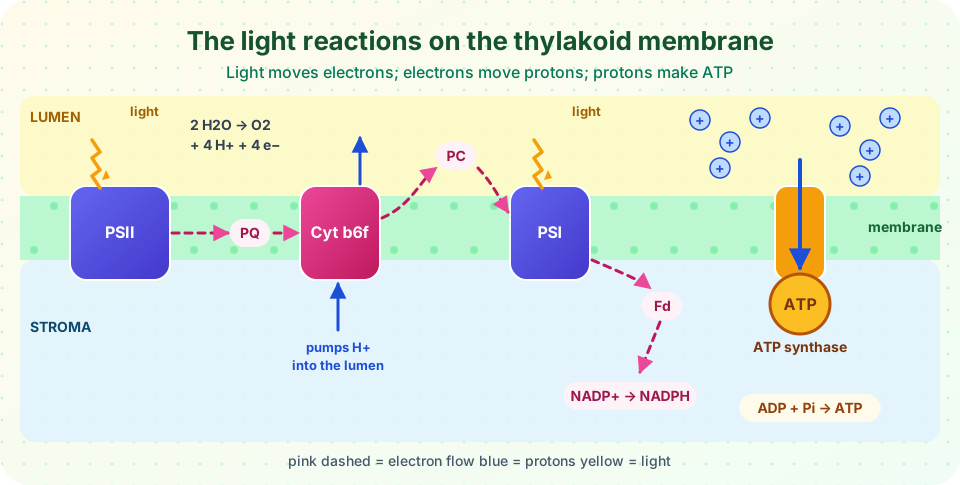
The first stage of photosynthesis turns the energy of light into chemical form. It does this with a remarkable piece of nanotechnology: protein complexes set in the thylakoid membrane that catch photons, split water, pass electrons down a chain and pump protons across the membrane. The result is two energy carriers, ATP and NADPH, plus oxygen. This lesson follows the process step by step. The diagram traces the electron path, which is called the Z-scheme because the energy plot of the electrons looks like a sideways Z.
What you will learn
- Which pigments absorb light and which colors they use.
- How photosystems II and I work together.
- Where oxygen comes from, and how the proton gradient forms.
- How ATP synthase turns a proton gradient into ATP.
- What cyclic electron flow is for.
Key terms
- Photosystem: a protein complex with chlorophyll and other pigments that absorbs light and excites an electron. Photosystem II (PSII) and photosystem I (PSI).
- Electron transport chain: a series of carriers that pass electrons downhill in energy.
- Chemiosmosis: using a proton gradient across a membrane to make ATP.
- ATP synthase: the molecular turbine that makes ATP as protons flow through it.
- Lumen: the space inside a thylakoid.
Capturing light
Light is made of photons, packets of energy. The energy of a photon is E = hc/λ, so shorter wavelengths carry more energy. Pigments absorb photons only at particular wavelengths.
- Chlorophyll a absorbs strongly in the violet-blue (peak near 430 nm) and the red (near 660 nm).
- Chlorophyll b has peaks near 450 and 640 nm; it widens the range of light the leaf can use.
- Carotenoids absorb blue-green light (roughly 450 to 500 nm) and also protect chlorophyll from damage by excess light.
Chlorophyll absorbs little green light (about 500 to 570 nm), so green light is reflected and transmitted. That is why leaves look green. Many photons pass through the top layers and are still used by deeper cells; in practice, green light also drives photosynthesis in thick leaves.
A chlorophyll molecule has a flat ring with a magnesium atom at the center and a long hydrocarbon tail that anchors it in the membrane. The ring absorbs the photon and holds an electron in a higher energy state.
Photosystems: antenna and reaction center
Pigments are arranged in photosystems. Each has many antenna pigments that collect photons and pass the energy by resonance from molecule to molecule to a reaction center, a special pair of chlorophyll a molecules. When the reaction center is excited, it hands off an electron to an acceptor, leaving it positively charged and ready to receive an electron from somewhere else.
- Photosystem II (PSII) has a reaction center that absorbs best at 680 nm (called P680).
- Photosystem I (PSI) has a reaction center that absorbs best at 700 nm (P700).
The linear electron flow, step by step
The numbers match the diagram.
- A photon strikes PSII. The P680 reaction center loses an electron to a nearby acceptor, plastoquinone (PQ).
- Water is split. The positively charged P680 is one of the strongest biological oxidizing agents. An enzyme complex with a cluster of manganese and calcium atoms on the lumen side pulls electrons from water:
2 H2O → O2 + 4 H+ + 4 e−. The oxygen is released as a gas, and the protons stay in the lumen. This is the source of nearly all the oxygen in the atmosphere. - Electrons move down the chain. PQ carries electrons to cytochrome b6f. As electrons move through this complex, it pumps protons from the stroma into the lumen.
- Plastocyanin (PC), a small copper protein that diffuses in the lumen, hands the electrons to PSI.
- A second photon strikes PSI. Its P700 reaction center is excited, passing an electron up to a still higher energy level, then to ferredoxin (Fd) in the stroma.
- NADPH forms. The enzyme ferredoxin–NADP⁺ reductase uses two electrons from ferredoxin to turn
NADP⁺ + H⁺into NADPH.
Two photons are needed for each electron to travel the whole path, one at each photosystem. To make one O2, four electrons must pass, so eight photons are needed in all. This is the quantum requirement of photosynthesis.
The proton gradient and ATP
Protons accumulate in the lumen from two sources: the water splitting and the pumping by cytochrome b6f. The stroma, in contrast, loses protons. In the light, the lumen reaches a pH of about 5 to 6 while the stroma is about pH 8, a difference of two to three pH units (a hundred- to thousand-fold in concentration). This is a store of energy, as in a dam.
ATP synthase spans the membrane. As protons flow back through it from lumen to stroma, a rotor turns inside the complex, like a water wheel, and forces ADP and phosphate together to make ATP. This is chemiosmosis, proposed by Peter Mitchell in 1961. The same mechanism works in mitochondria and in bacteria, which supports the idea that they share a common origin.
The ATP and NADPH are released into the stroma, where the Calvin cycle uses them. The ADP and NADP⁺ return to the thylakoid to be recharged.
Cyclic electron flow
The Calvin cycle needs ATP and NADPH in a ratio of 3 to 2. Linear flow makes slightly less ATP than required. To close the gap, PSI can recycle electrons: instead of going to NADP⁺, they flow back through cytochrome b6f to PSI. This cyclic electron flow pumps more protons and makes extra ATP but no NADPH and no oxygen. The plant adjusts the amount of cyclic flow to match its needs.
Energy accounting
A photon of 680 nm light carries about 176 kilojoules per mole of photons (an "einstein"). Because about 8 photons are used per O2, around 48 photons are needed to make one glucose at the ideal quantum requirement. That is about 8,440 kJ of light energy to store 2,870 kJ in a mole of glucose, an efficiency of about 34 percent at the chemical level. In real leaves, losses (reflection, heat, respiration, photorespiration) bring the overall efficiency down to a few percent at most.
Common misconceptions
- "The oxygen comes from carbon dioxide." Experiments with heavy oxygen showed it comes from water.
- "Leaves are green because chlorophyll absorbs green light." It absorbs red and blue and reflects or transmits green.
- "The light reactions need light and the Calvin cycle works only in the dark." The Calvin cycle runs in the light, using the ATP and NADPH made by the light reactions; it needs no extra photons directly.
- "ATP is made by a chemical reaction in the thylakoid." It is made by a physical turbine driven by the proton gradient.
Try it
Press Run (or Ctrl + Enter) to see the result here.
Program input · what you'd type while the program runs
Type the answers before you press Run, one per line. Each time the program reads a line (with input()), it gets the next line from this box.
Press Run (or Ctrl + Enter) to see the console output here.
No output.
Check your understanding
Quick check · 5 questions
of 5 answered You scored / 5 · perfect!
-
1. Where does the oxygen released in photosynthesis come from?
PSII splits water into O2, protons and electrons. -
2. The proton gradient in the thylakoid is used to...
Protons flowing out of the lumen through ATP synthase drive ATP formation. -
3. Photosystem I ends up reducing...
Electrons from PSI go to ferredoxin and then to NADP+. -
4. Why are leaves green?
The green gap in the absorption spectrum is why we see green. -
5. What is cyclic electron flow for?
Electrons loop around PSI and cytochrome b6f, pumping protons for ATP.
Summary
- Chlorophyll a and b absorb red and blue light; carotenoids absorb blue-green and protect.
- PSII (P680) splits water, releasing O2, protons and electrons; PSI (P700) energizes electrons for NADPH.
- Cytochrome b6f pumps protons; the gradient drives ATP synthase (chemiosmosis).
- Cyclic electron flow adds ATP to meet the Calvin cycle's 3:2 ATP to NADPH requirement.
- The ideal chemical efficiency is about 34 percent; real leaves convert much less.
Next: The Calvin cycle
Track your progress
Create a free account to tick off lessons and pick up where you left off on any device.
of Botany and Plant Science lessons completed