


















Lesson 39 of 48 · Plant Diversity and Evolution
Chapter 7 review: Plant diversity and evolution
Review chapter 7 of Botany: compare bryophytes, ferns, gymnosperms and angiosperms, alternation of generations, the fossil timeline and phylogeny, with ten questions.
Four big groups, four big innovations, and one repeating life cycle: that is the core of chapter 7. This review compares the groups side by side, revisits the fossil timeline and checks that you can use the vocabulary: gametophyte, sporophyte, vascular, ovule, clade, molecular clock. If a row in the table feels weak, follow the link back to that lesson.
What you will learn
- How the four groups differ in tissue, reproduction and dominant generation.
- How the fossil record and DNA fit together.
- Mixed questions to check your recall.
Key terms
Gametophyte / sporophyte: the haploid (n) and diploid (2n) bodies of the plant life cycle.
Vascular tissue: xylem and phloem.
Ovule / seed: the structure that holds the female gametophyte, and what it becomes after fertilization.
Clade: an ancestor and all its descendants.
Molecular clock: dating splits with DNA differences, T = d / (2r).
The chapter in one paragraph
Land plants arose from streptophyte algae about 470 million years ago and invented the cuticle, stomata and a protected embryo. Bryophytes stayed small with a dominant gametophyte and swimming sperm. Ferns and lycophytes added lignified xylem, phloem and true roots, with a large sporophyte and a tiny gametophyte, but kept spores and swimming sperm. Gymnosperms added heterospory, pollen, ovules and seeds, shrinking the gametophyte to a few cells inside the cone. Angiosperms added flowers, double fertilization, endosperm and fruit, and diversified into roughly 300,000 species. The fossil record shows the order of these inventions, while DNA and shared derived traits give the tree and, with calibrations, the dates.
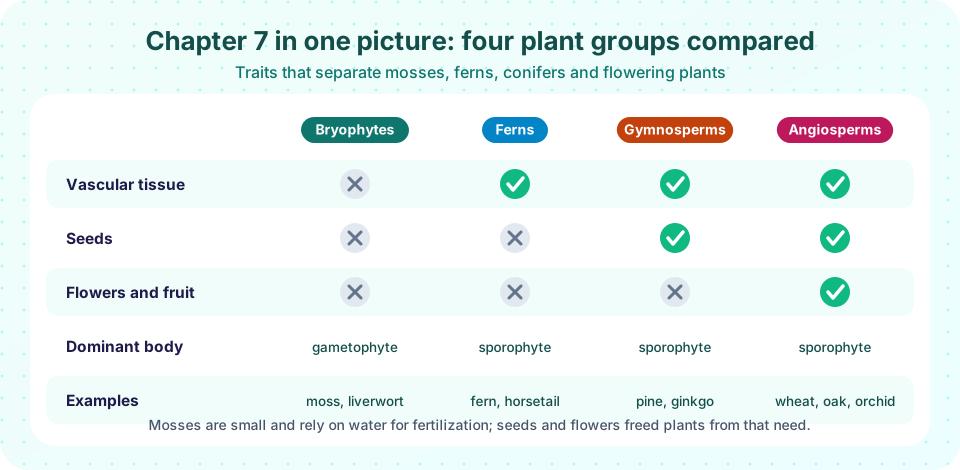
Recap table
| Group | Vascular tissue | Seeds | Flowers and fruit | Dominant generation | Example |
|---|---|---|---|---|---|
| Bryophytes | No | No | No | Gametophyte | Moss, liverwort |
| Ferns and lycophytes | Yes | No | No | Sporophyte | Bracken, club moss |
| Gymnosperms | Yes | Yes (naked) | No | Sporophyte | Pine, ginkgo |
| Angiosperms | Yes | Yes (enclosed) | Yes | Sporophyte | Oak, wheat |
| Lesson | Key idea |
|---|---|
| Mosses, ferns and relatives | Alternation of generations; swimming sperm tie these plants to water |
| Seed plants | Naked versus enclosed seeds; monocots versus eudicots |
| Plant evolution and phylogeny | Fossil timeline, shared derived traits, T = d / (2r) |
How the groups connect
Read the table from left to right and you can see the story of the plant kingdom as a series of trade-offs. Giving up swimming sperm freed plants from water but required pollen and ovules. Building lignified conduits allowed height but cost energy and made the plant vulnerable to embolism. Shrinking the gametophyte protected the next generation inside the parent but reduced the chance of independent dispersal, which fruits and cones then solved in new ways. When an exam question asks why a group lives where it does, look for the trait in the table that explains it.
Worked review problems
Problem 1. A plant has xylem and phloem, produces cones, and its seeds sit on scales. Where does it belong, and what tissue feeds its embryo?
It is a gymnosperm. The embryo is fed by haploid female gametophyte tissue, not by triploid endosperm.
Problem 2. A botanist finds two lineages that differ by 0.05 substitutions per site and estimates a rate of 0.5 × 10⁻⁹ per site per year. How long ago did they split?
T = 0.05 / (2 × 0.5 × 10⁻⁹) = 5 × 10⁷ years, or 50 million years.
Problem 3. A leaf has parallel veins and the flower has six petals. The seed has one cotyledon. Monocot or eudicot?
Monocot. Parallel veins, one cotyledon and floral parts in threes (six is a multiple of three) all point the same way.
Common misconceptions
"The leafy fern is the gametophyte." The leafy fern is the diploid sporophyte; the gametophyte is a tiny heart-shaped prothallus.
"Flowering plants are the newest and 'best' plants." They are the most diverse, but every living lineage has persisted for hundreds of millions of years.
"Seeds always come from flowers." Gymnosperm seeds develop on cone scales, not in flowers.
Check your understanding
Quick check · 10 questions
of 10 answered You scored / 10 · perfect!
-
1. Which generation is dominant in a moss?
In bryophytes the haploid gametophyte is the leafy green plant; the sporophyte is dependent on it. -
2. Which pair describes ferns correctly?
Ferns reproduce by spores and have xylem and phloem; they have no seeds or flowers. -
3. What does meiosis produce in plants?
Plants make spores by meiosis and gametes by mitosis in the gametophyte. -
4. Which feature is unique to angiosperms?
Pollen and seeds are shared with gymnosperms; double fertilization with endosperm, and fruit, are only in flowering plants. -
5. A plant has two cotyledons, net-veined leaves and flower parts in fives. It is most likely
Those traits are typical of eudicots. -
6. About when do the oldest widely accepted land-plant spores date?
Resistant spores from the Ordovician, about 470 Ma, give the earliest evidence. -
7. Why are mosses and ferns restricted to wet habitats for sexual reproduction?
Both groups rely on swimming sperm. -
8. What is a clade?
A clade, or monophyletic group, includes a common ancestor and every descendant. -
9. In which period did coal-swamp forests of giant lycophytes and tree ferns flourish?
The Carboniferous, about 359 to 299 million years ago, is named for its coal. -
10. Which feature of a pine seed differs from a bean seed?
Gymnosperm seeds are provisioned with haploid female gametophyte tissue; angiosperm seeds use triploid endosperm or cotyledons.
Summary
- Four innovations structure plant diversity: cuticle and embryo, vascular tissue, seeds, flowers and fruit.
- The gametophyte shrinks across the groups, from dominant in bryophytes to a few cells in seed plants.
- Fossils date the milestones; DNA and shared derived traits give relationships; a molecular clock gives dates.
- Flowering plants are the most diverse group, but all lineages remain successful in their own habitats.
- Chapter 8 moves from the plants themselves to their communities, to farming and to biotechnology.
Next: Chapter 8 overview: Ecology, agriculture and biotechnology
Track your progress
Create a free account to tick off lessons and pick up where you left off on any device.
of Botany and Plant Science lessons completed