


















Lesson 25 of 48 · Water, Nutrients and Transport
Water potential and osmosis
Learn water potential, solute and pressure potential, turgor and plasmolysis, and use the equation Ψ = Ψs + Ψp to predict which way water moves in plants.
Why does lettuce go limp in a warm kitchen and snap back in cold water? Why does salt kill garden plants? Both questions are about the same thing: which way does water move across a cell membrane, and what does it do to the cell? Botanists answer with one tidy quantity called water potential. It lets you predict the direction of water movement from soil to root to leaf, and it turns a vague idea ("water goes where there is less water") into numbers you can calculate.
What you will learn
- What water potential is and why water moves toward lower values.
- How solute potential and pressure potential add up: Ψ = Ψs + Ψp.
- Why plant cells become turgid, flaccid or plasmolyzed.
- How to calculate solute potential for a solution and predict the direction of water movement.
Key terms
Water potential (Ψ): the potential energy of water per unit volume relative to pure water at atmospheric pressure, measured in megapascals (MPa). Pure water at standard conditions has Ψ = 0.
Solute potential (Ψs): the effect of dissolved solutes on Ψ; always zero or negative.
Pressure potential (Ψp): the physical pressure on the water; positive when a cell presses against its wall.
Turgor: the pressure of cell contents against the wall; the same thing as positive Ψp.
Osmosis: net movement of water across a selectively permeable membrane toward lower Ψ.
Water has a "free energy"
Water molecules are always moving. In a glass of pure water at atmospheric pressure they have a certain amount of free energy available to do work, such as moving into a neighboring region. Botanists define that reference state as Ψ = 0. Anything that makes water less free to move lowers Ψ below zero. Dissolved particles do that by tying up water molecules, and so does a vacuum or tension pulling on the water. Pressure does the opposite: squeezing water raises Ψ.
Water always moves toward the region of lower (more negative) water potential. This is just downhill flow, like a ball rolling down a slope, and it needs no energy from the cell. The units are megapascals. For scale, 1 MPa equals 10 bar, about 9.9 times the pressure of the atmosphere, so a value such as −1.5 MPa is a big number in everyday terms.
The two parts that matter in cells
For a plant cell, two components do almost all the work:
Ψ = Ψs + Ψp
Solute potential (Ψs) depends on how many dissolved particles the water contains. For an ideal solution it is given by the van 't Hoff relation:
Ψs = −i × C × R × T
where i is the number of particles each solute unit makes (1 for sucrose, about 2 for NaCl), C is the molar concentration, R is 0.008314 L·MPa/(mol·K) and T is temperature in kelvin. Notice the minus sign: adding solute can only lower Ψ.
Pressure potential (Ψp) is the physical pressure. In an open beaker it is zero. Inside a living plant cell with a rigid cell wall it is usually positive, because water pushing into the cell presses the membrane against the wall. In xylem under tension it is negative.
Worked example 1: a sucrose solution
How much does 0.1 M sucrose lower water potential at 20 °C (293 K)?
Ψs = −1 × 0.1 × 0.008314 × 293Ψs ≈ −0.24 MPa
An open beaker has Ψp = 0, so the solution's Ψ is also about −0.24 MPa. A 0.4 M solution gives roughly −0.97 MPa, which is close to the value inside many ordinary plant cells.
Osmosis in a plant cell
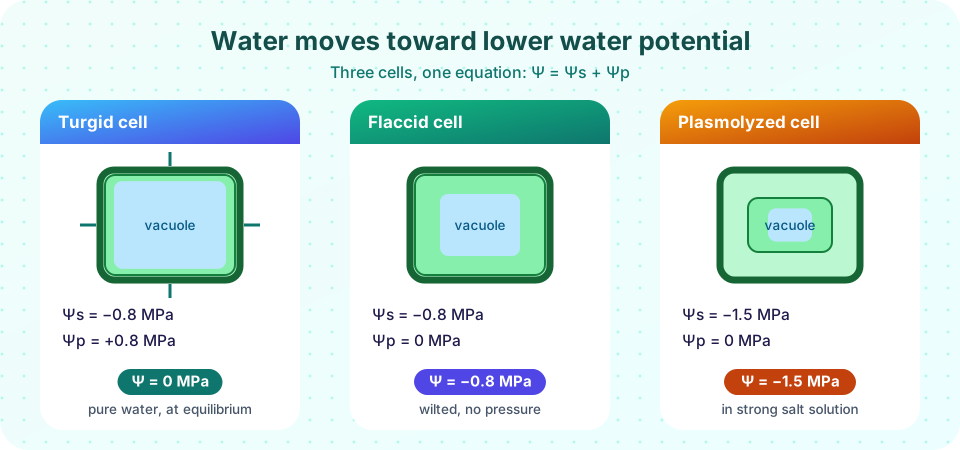
Put a cell in water and ask which way water moves. A typical leaf cell might have Ψs = −0.8 MPa because its vacuole holds sugars, salts and acids. Suppose the cell is bathed in pure water (Ψ = 0).
- At first Ψp = 0, so the cell Ψ is −0.8 MPa, lower than the water outside. Water enters.
- As the vacuole expands, the membrane presses on the wall. The wall pushes back, so Ψp rises.
- Water keeps entering until the cell's Ψ has risen to 0. That happens when Ψp = +0.8 MPa, which exactly cancels Ψs. The cell is turgid, and there is no net movement.
The rigid wall is the key. An animal cell in pure water would keep swelling and burst, but a plant cell stops swelling because the wall resists. Turgor is not a side effect; it is what holds leaves out flat and young stems upright. It also drives cell growth, because a cell can only enlarge when turgor pushes against a wall that has been loosened.
Wilting and plasmolysis
Now reverse it. If the surroundings have a lower Ψ than the cell, water leaves.
- Flaccid: as water leaves, the vacuole shrinks and Ψp falls to zero. The cell is limp. This is what you see in a wilted leaf, where Ψ equals Ψs.
- Plasmolyzed: in a strong solution, say Ψ = −1.5 MPa, the cell loses so much water that the membrane pulls away from the wall. This is plasmolysis. Mild plasmolysis is reversible, but badly plasmolyzed cells die. Over-fertilizing, road salt and salt spray cause this kind of injury.
The point at which Ψp has just fallen to zero but the membrane still touches the wall is called incipient plasmolysis, and in that state the cell's Ψ equals its Ψs. Experimenters use it to measure Ψs: soak tissue in a series of solutions and find the concentration where half the cells begin to plasmolyze.
Worked example 2: which way does water go?
A cell has Ψs = −0.8 MPa and Ψp = +0.5 MPa. It sits in 0.2 M NaCl at 20 °C. Which way does water move?
- Cell Ψ = −0.8 + 0.5 = −0.3 MPa.
- Solution Ψs = −2 × 0.2 × 0.008314 × 293 ≈ −0.97 MPa (assuming ideal behavior and i = 2). With Ψp = 0 outside, Ψ ≈ −0.97 MPa.
- The solution has the lower Ψ, so water moves out of the cell.
Notice that a cell with a positive turgor pressure can still lose water if the outside is salty enough. Direction depends on total Ψ, never on Ψs alone.
Water potential in the soil-plant-air path
Ψ is not just a cell-level idea. It explains the whole pathway:
| Where | Typical Ψ (MPa) |
|---|---|
| Moist soil | −0.01 to −0.3 |
| Root cells | slightly lower than the soil |
| Leaf cells in daytime | −0.5 to −2 or lower |
| Air at 50% relative humidity, 20 °C | about −94 |
The air value comes from the relation Ψ = (R × T / Vw) × ln(RH), where RH is relative humidity as a fraction and Vw is the molar volume of water (about 18 cm³/mol). At 20 °C the factor is about 135 MPa, so RH = 0.5 gives 135 × ln 0.5 ≈ −94 MPa. That enormous drop is what pulls water out of leaves, and it explains why plants in dry air lose water so quickly. You will use this in transpiration and stomata.
Real cells also have a matric potential (water bound to surfaces, important in dry soil and seeds) and a gravitational component (0.01 MPa per meter of height). They are ignored in a simple cell model but matter for tall trees and dry seeds.
Aquaporins: speeding up osmosis
Water crosses membranes slowly through the lipid layer. Plant cells therefore carry aquaporins, channel proteins that let water through quickly. Aquaporins do not change the direction of flow (that is set by Ψ), only how fast the cell reaches equilibrium. Plants can open or close many aquaporins, for example in roots during flooding or drought, which gives them a way to tune water uptake.
Common misconceptions
"Water moves from where there is more water to where there is less." Better: it moves from higher Ψ to lower Ψ. A cell full of sugar can attract water from a solution with a lower sugar concentration even if the solution is "wetter."
"Pressure is bad for water potential." Positive pressure raises Ψ. A turgid cell has Ψp above zero, which is exactly why Ψ climbs back toward zero as the cell fills.
"Salt water is poisonous to plants because of the salt itself." Salt does cause toxicity at high levels, but the first problem is physical: a low Ψ outside makes it hard for roots to take up water, so salty soil acts like drought.
Try it
First, a calculator that applies the van 't Hoff formula and predicts the direction of water movement for a cell with a fixed Ψ.
Press Run (or Ctrl + Enter) to see the result here.
Program input · what you'd type while the program runs
Type the answers before you press Run, one per line. Each time the program reads a line (with input()), it gets the next line from this box.
Next, a plot of how a cell's potentials change as it loses water (a simplified Hofler diagram). It uses a simple model: solute potential becomes more negative as the cell shrinks, and pressure falls to zero at 85% of full water content.
Press Run (or Ctrl + Enter) to see the result here.
Program input · what you'd type while the program runs
Type the answers before you press Run, one per line. Each time the program reads a line (with input()), it gets the next line from this box.
Check your understanding
Quick check · 5 questions
of 5 answered You scored / 5 · perfect!
-
1. A solution has a solute potential of -0.5 MPa and is in an open beaker. What is its water potential?
Pressure potential is zero in an open beaker, so Psi = Psi_s + 0 = -0.5 MPa. -
2. A turgid cell in pure water has Psi_s = -0.9 MPa. At equilibrium, what is its pressure potential?
At equilibrium with pure water the cell Psi equals 0, so Psi_p must cancel Psi_s and equal +0.9 MPa. -
3. Which statement about the direction of water movement is correct?
Water moves down its potential gradient, from higher (less negative) to lower (more negative) Psi, and pressure counts as well as solutes. -
4. In a wilted, flaccid cell, which is true?
A flaccid cell has lost its turgor, so pressure potential is about zero and water potential equals solute potential. -
5. Why does a plant cell not burst when placed in pure water?
The rigid wall pushes back against the swelling vacuole; pressure rises until the cell is in equilibrium and net water entry stops.
Summary
- Water potential (Ψ, in MPa) predicts water movement: water goes toward lower Ψ.
- For a cell, Ψ = Ψs + Ψp. Solutes make Ψs negative; wall pressure makes Ψp positive.
- A turgid cell has high Ψp; a flaccid cell has Ψp near zero; a plasmolyzed cell has lost so much water that its membrane has pulled from the wall.
- Solute potential for an ideal solution is
−i × C × R × T. - The huge negative Ψ of dry air is what ultimately pulls water through the plant.
Track your progress
Create a free account to tick off lessons and pick up where you left off on any device.
of Botany and Plant Science lessons completed