


















Lesson 38 of 48 · Plant Diversity and Evolution
Plant evolution and phylogeny
Trace plant evolution from green algae to flowering plants through the fossil record, learn how phylogenetic trees are built from traits and DNA, and use a molecular clock.
For most of Earth's history, the land was bare. Rock, sand and the occasional crust of microbes stretched from coast to coast. Then, around 470 million years ago, something green crept out of the water and began to change the planet. Over the next few hundred million years, plants turned rock into soil, drew down carbon dioxide, built forests that became coal, and gave rise to the flowers that now dominate the landscape. We know this story from three kinds of evidence: fossils, the structures and life cycles of living plants, and DNA. This lesson puts the evidence together and shows how a botanist turns it into a family tree.
What you will learn
- The main steps in plant evolution, with approximate dates.
- The evidence for the algal origin of land plants.
- How phylogenetic trees are built from traits and DNA.
- How a molecular clock estimates divergence times.
Key terms
Embryophyte: a land plant; an organism whose zygote develops into an embryo within the parent.
Clade (monophyletic group): an ancestor and all of its descendants.
Homology and convergence: similarity from common ancestry, versus similar features that arose independently.
Phylogenetic tree: a diagram of inferred evolutionary relationships.
Molecular clock: using the rate of DNA change to estimate how long ago lineages split.
From algae to land plants
Land plants (embryophytes) belong to a larger group, the streptophytes, together with a set of freshwater green algae. Several lines of evidence agree on this: land plants and these algae share chlorophyll types, cellulose-based cell walls, a particular way of dividing cells (the phragmoplast), and a long list of genes. Recent comparisons of whole genomes and transcriptomes suggest that the Zygnematophyceae, a group of filamentous and single-celled freshwater algae, are the closest living relatives of land plants, though the question is still being studied.
Life on land meant new problems: drying out, getting enough light and carbon dioxide without losing water, supporting the body against gravity, and reproducing without a surrounding pool. A list of key innovations solves those problems, many of which you met in mosses, ferns and relatives and seed plants:
| Problem | Innovation |
|---|---|
| Drying out | Waxy cuticle; stomata; spores with tough sporopollenin walls |
| Protecting the young | Embryo retained and nourished by the parent |
| Making gametes in air | Gametangia (antheridia and archegonia) with sterile jackets |
| Standing up and moving water | Lignified vascular tissue, true roots |
| Reproducing without water | Heterospory, pollen, ovules and seeds |
| Feeding and dispersing seeds | Flowers, fruits, endosperm |
Reading the fossil record
Fossils give direct dates, but plants fossilize poorly. They are soft, fall apart into pieces, and live where sediment does not usually form. Even so, a few finds are famous.
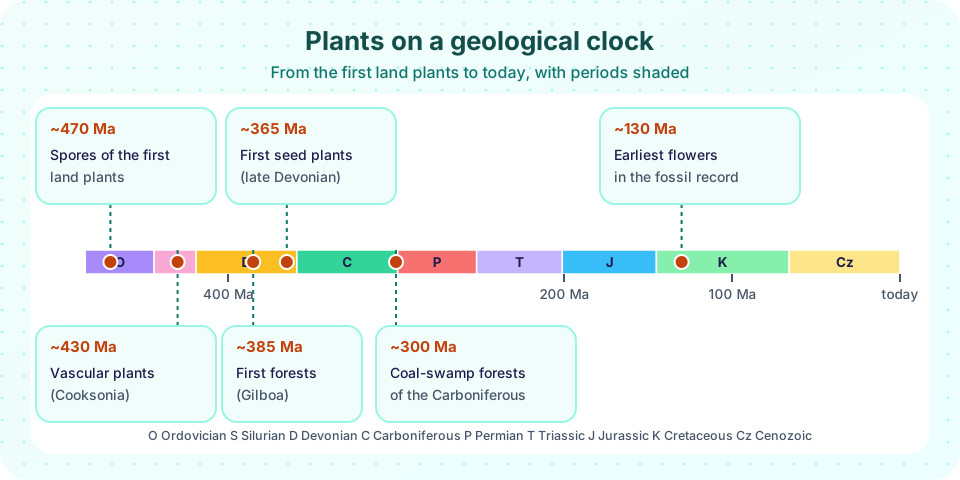
- Spores, about 470 million years ago (Ordovician). The earliest evidence of land plants comes from microscopic spores with resistant walls, found as single cells or in groups. They resemble liverwort spores. Whole plants have not been found from this time.
- Cooksonia, about 430 million years ago (Silurian). A tiny plant a few centimeters high, with branching stems ending in spore-filled capsules, and conducting tissue. It is one of the earliest known vascular plants.
- The Rhynie chert, about 407 million years ago (Early Devonian), Scotland. Hot springs buried a whole ecosystem in silica, preserving cells in three dimensions, including Rhynia and its fungal partners, a snapshot of the early land community.
- First forests, about 385 million years ago (Devonian). Fossil trees at sites such as Gilboa in New York show tree-like cladoxylopsid plants. By the late Devonian Archaeopteris had wood, roots and leaves, the first modern-style tree, and its roots and leaf litter altered soils and rivers.
- Seeds, about 365 million years ago (late Devonian). Early seed plants such as Elkinsia carried ovules in cup-like structures. Even older seed-like structures hint at gradual assembly of the seed.
- Coal swamps (Carboniferous, about 359 to 299 million years ago). Forests of lycophyte trees, giant horsetails, tree ferns and early seed plants grew in wet lowlands. Their burial formed much of the world's coal. By many models, falling carbon dioxide and rising oxygen levels accompanied this period, though the exact values are debated.
- Mesozoic gymnosperms. After the end-Permian mass extinction about 252 million years ago, conifers, cycads and ginkgos dominated the world's forests alongside ferns.
- Flowering plants, about 130 million years ago (Cretaceous). Pollen with typical flowering-plant features appears about 134 million years ago and the first clear flowers a few million years later. Within a few tens of millions of years, angiosperms had spread worldwide and become dominant in many habitats.
- Grasses and grasslands. Grasses appear in the fossil record by the end of the Cretaceous, and open grassland ecosystems expanded widely much later, in the last 20 million years or so, with the spread of C₄ photosynthesis.
Notice a pattern: new plant groups usually appear long before they dominate. Ecological dominance comes later, when the right climate or an extinction opens the door.
Building a phylogenetic tree
A phylogenetic tree shows who shares a more recent common ancestor with whom. Biologists use two main kinds of data.
Traits. Scientists compare structures and life cycle features across species, scoring each trait as present or absent. The key is to use homologous traits (shared by descent) and to avoid convergent ones. Cacti in the Americas and spurges in Africa have both evolved thick, spiny, water-storing stems, yet are unrelated. Traits shared because they are ancestral do not group species either: "has chlorophyll" does not unite flowering plants. The useful traits are shared derived characters, such as seeds, which tell you that pines and oaks share a recent ancestor not shared with ferns.
DNA. Molecular data give thousands of characters at once. Plant biologists have long used chloroplast genes such as rbcL and matK, and now compare whole chloroplast genomes and nuclear genes. The One Thousand Plant Transcriptomes Initiative (published in 2019) sequenced genes from over 1,000 species to build a tree of green plants, and has clarified the algal relatives of land plants. Combining many genes reduces the risk that one gene tells a misleading story, and some branches, such as the exact order of the earliest flowering plants, are still being tested.
A tree made by clustering by overall similarity is a phenogram, and it is not guaranteed to reflect evolutionary history, since it counts ancestral and convergent similarities as well. A cladogram uses only shared derived traits. A phylogeny may also include time.
Naming the branches
Linnaeus's system groups plants by structure, but many traditional groups, such as "dicots" and "gymnosperms plus angiosperms" as separate equal groups, did not match the DNA tree. The Angiosperm Phylogeny Group (APG), which published its fourth system (APG IV) in 2016, reorganized flowering-plant families on molecular evidence. A monophyletic group (a clade) contains an ancestor and all its descendants. "Bryophytes" and "dicots" are not clades in the strict sense, which is why modern texts say "eudicots" and speak of three separate bryophyte lineages.
The molecular clock
When two lineages split, their DNA starts to differ. If differences accumulate at a roughly steady rate r (substitutions per site per year), then the number of differences per site d between two living species grows at 2r (since both lineages change), so
T = d / (2 × r)
where T is the time since their common ancestor. The rate is calibrated with fossils of known age. For example, if fossils show two lineages must have split at least 100 million years ago, the genetic distance between them can be used to set r, which can then date other splits. Rates vary among genes and lineages, which is why modern methods allow rates to change across the tree and use several fossil constraints. Molecular clocks often date plant lineages older than the first fossils, a reminder that the fossil record is incomplete.
Common misconceptions
"Plants evolved from fungi or from moss." Plants and fungi are distant relatives, and modern mosses are cousins of other land plants, not their ancestors.
"Evolution aimed at flowering plants." There is no goal. Angiosperms diversified when conditions favored them, and other groups remain successful in their own habitats.
"A tree of similarity is the same as a family tree." Similarity can come from convergence, so only shared derived traits, or properly modeled DNA, show real relationship.
Try it
First, build a quick tree from a table of traits. The clustering uses overall similarity (average linkage on Hamming distance), so this is a phenogram. It is a good demonstration, but it is not a rigorous phylogeny.
Press Run (or Ctrl + Enter) to see the result here.
Program input · what you'd type while the program runs
Type the answers before you press Run, one per line. Each time the program reads a line (with input()), it gets the next line from this box.
Second, a molecular-clock calculator. The distances and rates are made up for practice, not measurements of real plants.
Press Run (or Ctrl + Enter) to see the result here.
Program input · what you'd type while the program runs
Type the answers before you press Run, one per line. Each time the program reads a line (with input()), it gets the next line from this box.
Check your understanding
Quick check · 6 questions
of 6 answered You scored / 6 · perfect!
-
1. Which group of algae is currently suggested to be the closest living relative of land plants?
Genome-scale studies point to the Zygnematophyceae, within the streptophyte algae, as the closest living relatives. -
2. What kind of fossil gives the earliest evidence of land plants?
Resistant spores from the Ordovician are the earliest land plant evidence; whole plants come later. -
3. Why are shared derived traits better than ancestral traits for building a tree?
Ancestral traits are shared by many groups and do not show closeness; derived traits mark a clade. -
4. Cacti and African spurges both have thick spiny water-storing stems but are unrelated. This is an example of
Similar traits that evolved independently under similar conditions are convergent. -
5. Two lineages differ by d = 0.08 substitutions per site, with a rate of 1 x 10^-9 per site per year in each lineage. When did they split?
T = d / (2r) = 0.08 / (2 x 1e-9) = 40 million years. -
6. Which statement about flowering plants in the fossil record is most accurate?
Flowering-plant pollen and flowers date to the early Cretaceous; they were already diverse before the dinosaurs went extinct.
Summary
- Land plants arose from freshwater streptophyte algae; the first land plant spores date to about 470 million years ago.
- Key steps: vascular plants (about 430 Ma), forests (about 385 Ma), seeds (about 365 Ma), coal swamps (Carboniferous), flowering plants (about 130 Ma).
- Phylogenies use shared derived traits and DNA; convergence and ancestral similarity are traps.
- A molecular clock estimates divergence time with
T = d / (2r), calibrated with fossils. - Modern classification, such as APG IV, groups plants into clades, with names such as eudicots replacing outdated ones.
Next: Chapter 7 review
Track your progress
Create a free account to tick off lessons and pick up where you left off on any device.
of Botany and Plant Science lessons completed