


















Lesson 35 of 48 · Plant Diversity and Evolution
Chapter 7 overview: Plant diversity and evolution
Preview chapter 7 of Botany: the major plant groups from mosses to flowering plants, alternation of generations, the fossil record and how botanists build plant family trees.
Walk through a forest and you may see moss on a rock, ferns along a stream, pine trees overhead and wildflowers in a clearing. They look nothing alike, yet they are cousins, descended from green algae that crept out of water more than 470 million years ago. Each major group of plants invented something new that let it live in a drier, taller or more crowded world: a waxy skin, vascular tissue, seeds, flowers. Chapter 7 is a guided tour of those groups, the fossil record that tells their story, and the evidence that botanists use to draw the family tree.
What you will learn
- The major plant groups and the key innovation of each.
- Why plants alternate between two body forms, and how it changes across groups.
- How lessons in this chapter fit together.
Key terms
Bryophyte: a non-vascular land plant (moss, liverwort, hornwort).
Vascular plant: a plant with xylem and phloem (lycophytes, ferns, gymnosperms, angiosperms).
Gymnosperm: a seed plant with "naked" seeds, such as conifers.
Angiosperm: a flowering plant whose seeds are enclosed in fruit.
Phylogeny: the evolutionary family tree of a group.
A story in four innovations
The plant kingdom's history can be told as a series of solutions to problems of life on land.
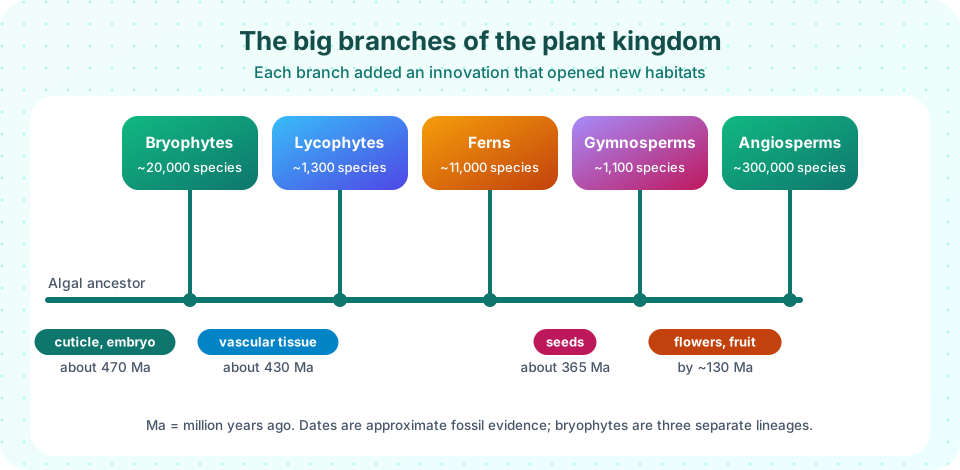
- Keep water in and let gases in. The first land plants evolved a waxy cuticle, pores (stomata) for gas exchange, and a protected embryo that grows inside the parent. Mosses and liverworts are the living descendants of these pioneers, and they stay small because they have no plumbing.
- Build plumbing and stand tall. Xylem reinforced with lignin carried water upward, and phloem carried food. With strong, lignified conduits, plants could grow tens of meters tall. Ferns and their relatives are seedless vascular plants.
- Package the embryo. Seeds pack an embryo, food and a tough coat. Pollen carries sperm through air or by animals, so fertilization no longer needs a film of water. Conifers and their relatives are the main seed plants without flowers.
- Advertise and wrap. Flowers recruit animals for precise pollination, and fruits help disperse seeds. Flowering plants, about 300,000 species, now dominate most land habitats.
Four plant groups
Each added a new trick for life on land
Two generations
Sporophytes get bigger as plants get younger
Alternation of generations in one idea
Every land plant has a life cycle with two multicellular bodies. The sporophyte (2n) makes spores by meiosis. A spore grows into a gametophyte (n), which makes gametes by mitosis. Two gametes fuse to form a zygote and a new sporophyte. In mosses the gametophyte is the leafy green plant you see. In ferns the sporophyte is large and the gametophyte is a tiny heart-shaped scrap. In seed plants the gametophyte shrinks to a few cells inside the flower or cone. Following that trend of shrinking gametophytes is a clear way to understand the whole group.
What each lesson covers
- Mosses, ferns and relatives covers non-vascular and seedless vascular plants and their life cycles, with a loop diagram and a chromosome-shuffling simulation.
- Seed plants: gymnosperms and flowering plants compares cones and flowers, explains the success of angiosperms and how to tell monocots from eudicots.
- Plant evolution and phylogeny covers the fossil record, the algal ancestors, molecular clocks and how scientists build a plant tree.
- Chapter 7 review compares the four groups in a table and quizzes you.
Counting plants
Botanists have named roughly 350,000 to 400,000 species of vascular plants. Almost all are flowering plants (counts run from about 300,000 to 370,000, so this course uses "about 300,000" as a safe round figure), around 1,100 are gymnosperms, and about 11,000 are ferns and horsetails, with 1,300 or so lycophytes. Mosses, liverworts and hornworts add some 20,000 more. Estimates differ with the source and are revised every year as new species are described and old names merged.
Common misconceptions
"Plants evolved from mosses or ferns." Living mosses, ferns and conifers are all modern lineages; none descends from another living group. They share ancestors that no longer exist.
"Evolution is a ladder with flowering plants on top." The tree has many branches, and every living group is equally evolved. Mosses and liverworts thrive in habitats where flowering plants cannot.
Summary
- Four innovations structure plant diversity: cuticle and embryo, vascular tissue, seeds, and flowers with fruit.
- Land plants alternate between a haploid gametophyte and a diploid sporophyte; the gametophyte shrinks across the groups.
- Flowering plants are the largest group by far, with about 300,000 species.
- This chapter tours each group, the fossil record and the tools used to reconstruct the plant tree.
Track your progress
Create a free account to tick off lessons and pick up where you left off on any device.
of Botany and Plant Science lessons completed