


















Lesson 16 of 48 · Anatomy and Morphology
Flowers, fruits and seeds
Learn the four whorls of a flower, how a fruit forms from the ovary, the main fruit types, and what is inside a seed, with a flower and bean seed diagram.
Flowering plants, the angiosperms, are by far the biggest group of plants, with roughly 300,000 species. Their success rests on a single organ system: the flower, which makes seeds, and the fruit, which protects and spreads them. A flower is not decoration. It is a compact reproductive machine, and its shape, color and scent are tuned to wind, insects, birds or bats. This lesson dissects a flower, follows an ovary as it turns into fruit and opens a seed.
What you will learn
- The four parts (whorls) of a flower and their functions.
- How a fruit develops from a flower, and why many "vegetables" are fruits.
- The main fruit types: fleshy, dry, aggregate and multiple.
- The structure of a seed and how monocot and eudicot seeds differ.
- How seeds are dispersed.
Key terms
- Stamen: the male part of a flower: an anther on a filament; the anther makes pollen.
- Carpel: the female part: stigma, style and ovary; one or more joined carpels form the pistil.
- Ovule: a structure inside the ovary containing the egg cell; after fertilization it becomes a seed.
- Fruit: the ripened ovary (sometimes with other parts) containing seeds.
- Cotyledon: a seed leaf, often a food store, inside the seed.
The four whorls of a flower
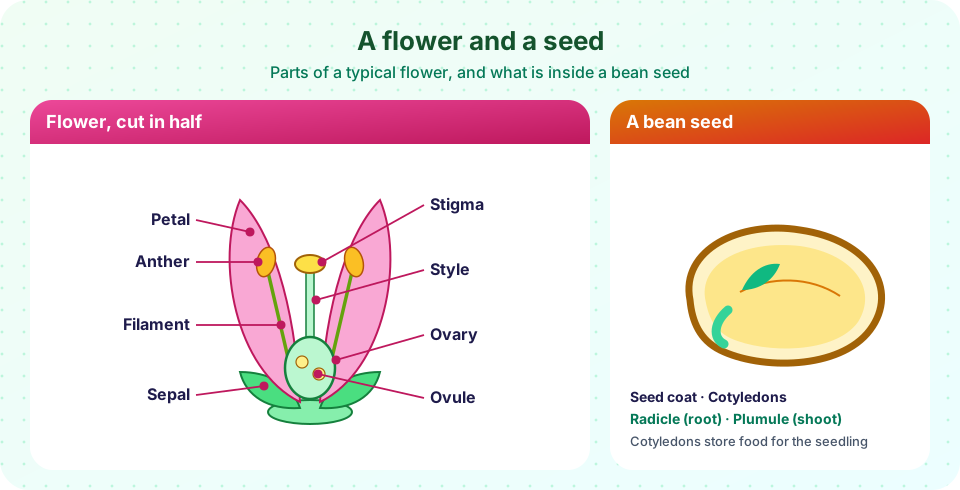
A flower is a short shoot whose leaves are modified into four rings (whorls) attached to a swollen tip, the receptacle.
- Calyx. The outermost whorl of sepals, usually green. They protect the bud.
- Corolla. The petals, often colorful and scented. They attract pollinators. In wind-pollinated flowers (grasses, oak) the petals are tiny or absent.
- Androecium. The male parts: the stamens. Each has a stalk, the filament, and an anther with pollen sacs. Pollen grains contain the sperm-producing cells of the male generation.
- Gynoecium. The female parts, made of one or more carpels. A carpel has a sticky stigma to catch pollen, a style that connects the stigma to the ovary, and ovules inside the ovary.
A flower with all four whorls is complete; one lacking any is incomplete. A flower with both stamens and carpels is perfect (bisexual). In imperfect flowers, the male and female parts are in separate flowers. Maize has male flowers in the tassel on top and female flowers in the ear. If male and female flowers are on separate plants (as in holly and willow) the species is dioecious.
Pollination in brief
Pollination is the transfer of pollen from an anther to a stigma. Wind-pollinated flowers (grasses, birches) make huge quantities of light pollen and have large feathery stigmas. Animal-pollinated flowers offer nectar or pollen to bees, butterflies, birds or bats and often have colors, shapes and scents suited to their visitors. Chapter 6 follows what happens next: pollen grows a tube down the style, and double fertilization produces both an embryo and a food tissue.
From flower to fruit
After fertilization, the ovules become seeds, and the ovary wall grows and ripens into the fruit wall (the pericarp). The petals and stamens usually wither. A fruit in the botanical sense is the matured ovary, whether or not it is sweet.
That is why many things called vegetables are botanical fruits: tomatoes, cucumbers, peppers, pumpkins and eggplants all develop from a flower's ovary and contain seeds. A celery stalk (petiole), a carrot (root) and a spinach leaf are not fruits.
Fruit types
| Group | Type | Description | Example |
|---|---|---|---|
| Simple fleshy | Berry | Whole pericarp fleshy; several seeds | Tomato, grape, banana |
| Drupe | One hard stone around one seed | Peach, cherry, olive, coconut | |
| Pome | Fleshy tissue from the receptacle surrounds the core | Apple, pear | |
| Simple dry | Legume | Pod that splits along two seams | Pea, bean, peanut |
| Nut and grain | Dry, single-seeded; does not split open | Hazelnut; wheat, rice, maize (grains) | |
| Capsule | Dry, splits open to release many seeds | Poppy, cotton | |
| Aggregate | Many small fruits from one flower's many carpels | Raspberry, blackberry | |
| Multiple | Fused fruits from a cluster of flowers | Pineapple, fig, mulberry |
A strawberry is a famous oddity: the red, fleshy part is the swollen receptacle, and the true fruits are the tiny dry "seeds" (achenes) on its surface, so it is an aggregate accessory fruit.
Inside a seed
A seed is a package: a young plant, a food supply and a coat. Three parts:
- Embryo. A miniature plant with a radicle (the future root), a plumule (the first shoot bud, sometimes called the epicotyl) and one or two cotyledons.
- Food store. Either the endosperm (a tissue made at fertilization) or the cotyledons themselves.
- Seed coat (testa). A tough protective layer that prevents drying and blocks disease. It forms from the outer layers of the ovule.
A bean is a eudicot seed: two large cotyledons hold most of the food, and the endosperm is used up as the seed ripens. A maize kernel is a monocot seed: it has one cotyledon (the scutellum) pressed against a large starchy endosperm, and the thin seed coat is fused to the fruit wall because the whole kernel is a one-seeded fruit, a grain.
Seeds in time
Many seeds are dormant: living but metabolically almost stopped until conditions suit growth. Dormancy is broken by water, warmth, cold spells, light, fire or passing through an animal's gut. Some seeds stay alive for decades; in a celebrated experiment, a Phoenix dactylifera (date palm) seed about 2,000 years old, found at the Masada archaeological site, was germinated successfully. Chapter 6 covers germination and dormancy in more detail.
Seed dispersal
A plant cannot walk, so it sends its offspring on trips. Strategies include:
- Wind: the winged seeds of maple, parachutes of dandelion and tiny dust-like seeds of orchids.
- Water: the buoyant husk of the coconut.
- Animals: burrs hook onto fur; juicy fruits reward animals that swallow seeds and drop them elsewhere.
- Explosion: pods that snap open, as in peas, lupins and touch-me-not (Impatiens).
- Ants: some seeds carry a fatty body that attracts ants, which carry them to their nests.
Common misconceptions
- "A fruit has to be sweet." A tomato, pepper, cucumber, bean pod and maize grain are all fruits.
- "Seeds are plant eggs." A seed is a fertilized, developed ovule with a young embryo; the egg is a single cell inside the ovule before fertilization.
- "Every flower has petals." Grass and oak flowers are tiny and petal-less, because they rely on wind.
- "Pollination and fertilization are the same thing." Pollination is pollen landing on a stigma. Fertilization comes later, when a sperm cell fuses with an egg inside an ovule.
Try it
Press Run (or Ctrl + Enter) to see the result here.
Program input · what you'd type while the program runs
Type the answers before you press Run, one per line. Each time the program reads a line (with input()), it gets the next line from this box.
Press Run (or Ctrl + Enter) to see the console output here.
No output.
Check your understanding
Quick check · 6 questions
of 6 answered You scored / 6 · perfect!
-
1. Which part of a flower catches pollen?
The stigma is the sticky tip of the carpel. -
2. After fertilization, the ovary develops into the...
The ripened ovary is the fruit; its ovules become seeds. -
3. A tomato is botanically a...
It develops from the ovary and has a fleshy pericarp with many seeds. -
4. In a bean seed, most of the food is stored in the...
Bean cotyledons are thick food stores. -
5. The radicle becomes the...
Radicle means little root. -
6. Which dispersal method fits a seed with a burr that hooks onto fur?
Burrs ride on passing animals.
Summary
- A flower has sepals, petals, stamens (anther and filament) and carpels (stigma, style, ovary, ovules).
- Pollination moves pollen from anther to stigma; fertilization turns ovules into seeds.
- The ovary becomes the fruit; fruit types include berry, drupe, pome, legume, nut, grain, aggregate and multiple.
- A seed holds an embryo (radicle, plumule, cotyledons), a food store and a protective coat.
- Plants spread seeds by wind, water, animals, explosion and ants.
Next: Chapter 3 review
Track your progress
Create a free account to tick off lessons and pick up where you left off on any device.
of Botany and Plant Science lessons completed