


















Lesson 48 of 48 · Projects and Practice
Where to go next in botany
Plan your next steps after the botany course: related subjects, careers, ways to practice with real plants and a study plan, plus links to neighboring tracks on this site.
You have followed water from soil to sky, sugar from leaf to root, hormones and light through a plant's year, the family tree of plants and the ways people use and change them. Botany is a bridge subject, and the best next step depends on what caught your interest. This lesson maps the neighboring subjects, suggests ways to keep practicing with real plants, and offers a short plan for the coming weeks.
What you will learn
- How botany connects to neighboring fields.
- Where on this site to continue, by interest.
- Practical ways to keep learning with real plants and real data.
Key terms
Interdisciplinary: combining methods from more than one field.
Citizen science: research projects in which volunteers collect or analyze data.
Herbarium: a collection of pressed, dried and labeled plant specimens.
Field guide: a book or app for identifying species in the wild.
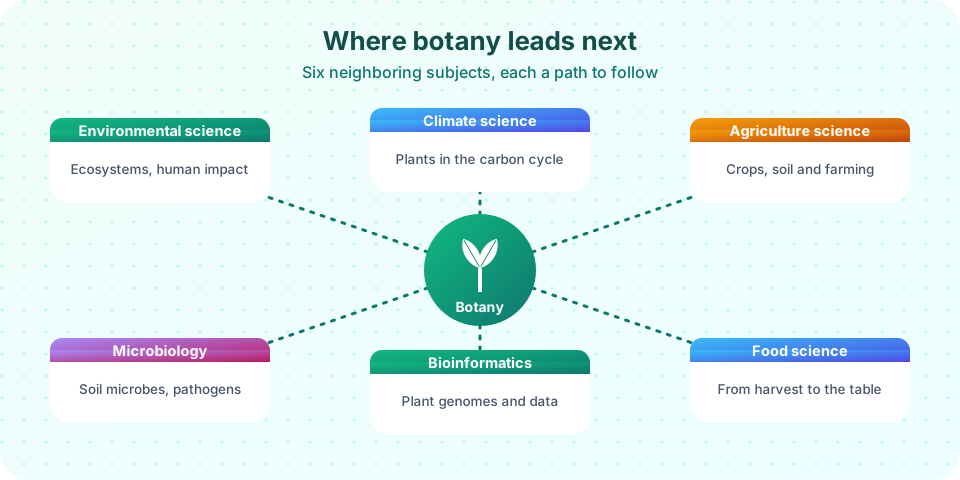
Six paths out of botany
If you liked the ecology chapter, go to the environment. Environmental science studies how living things and their physical surroundings interact and how human activity changes them. Biology: ecology and evolution deepens the ideas of populations, communities, natural selection and speciation that this course touched.
If you liked climate, carbon and biomes, go to climate science. Climate science explains the energy balance of the planet, the carbon cycle in which plants play a central role, and how rising carbon dioxide and warming change vegetation, phenology and crop yields.
If you liked crops and farming, go to agriculture. Agriculture science covers soils, crop production, livestock, pests, irrigation and farming systems. It extends chapter 8 from principles to practice.
If you liked tissue culture, soil microbes and mycorrhizae, go to microbiology. Microbiology covers the bacteria, fungi and viruses that fix nitrogen, cause plant diseases and recycle nutrients.
If you liked genomes, DNA and phylogeny, go to bioinformatics. Bioinformatics teaches you to work with sequences, alignments and trees in code, the same toolset behind plant genome projects and molecular clocks. For the biochemistry underneath, see molecular biology and biology: cells and genetics.
If you liked what happens after the harvest, go to food science. Food science follows plants from field to plate: composition, processing, preservation and safety. It connects directly to ethylene-controlled ripening and storage.
Other neighboring subjects include zoology, for the animals that pollinate and eat plants, geology and earth science, which tell the story of ancient climates and coal, and statistics and probability, which you need to analyze any experiment properly. Chapter 9's potometer project used a t-test and error bars; a statistics course makes that skill solid.
Careers that use plant science
Botany feeds many careers: crop breeder, agronomist, plant pathologist, forester, conservation scientist, restoration ecologist, horticulturist, seed technologist, botanic garden curator, herbarium taxonomist, plant molecular biologist, food scientist, and policy roles in agriculture and environment. Some use the lab, some the field, and many mix data analysis with biology. Entry routes and requirements differ by country, so look at local university courses and professional bodies for specifics.
Keep practicing with real plants
You learn botany best by looking at plants.
- Keep a plant notebook. Sketch a leaf, a flower or a seedling every week. Draw what you see, label the parts, and note the date, weather and place.
- Learn ten local plants well. Use a regional field guide or a plant identification app as a starting point and check names against a reliable flora or herbarium website.
- Grow something. Germinate seeds on damp paper to watch the radicle emerge. Try a window-sill experiment on phototropism: a seedling in a box with a hole on one side. Keep the design a fair test with controls and replicates, as in the potometer project.
- Press a plant. A simple press with newspaper and heavy books gives you a pressed specimen. Record where and when you collected it. Take only common plants, from places where collecting is allowed, and never from protected areas or rare species.
- Join citizen science. Projects that record flowering dates, leaf-out, bird and pollinator visits, or weeds produce real data that scientists use.
- Visit a botanic garden or herbarium and ask how plants are named, collected and preserved.
A short study plan
If you have about six hours a week for the next eight weeks, here is one balanced plan.
- Weeks 1 and 2: Redo the cheat sheet from memory and the practice set from the potometer project. Fix any weak area.
- Weeks 3 and 4: Read one lesson from the neighboring track closest to your interest, and note three links back to this course.
- Weeks 5 and 6: Run a small experiment with real plants, using at least five replicates per treatment, and analyze it with the code from the project lesson.
- Weeks 7 and 8: Write a one-page summary of what you found and what you would change, and present it to a friend or a class.
Try it
First, an interest finder. Pick the topic you enjoyed most, and it suggests a track and a first question to explore. This is a simple demonstration of matching, not a diagnosis of anything.
Second, a planner that turns your weekly hours into a schedule across the eight weeks of the plan above.
Press Run (or Ctrl + Enter) to see the result here.
Program input · what you'd type while the program runs
Type the answers before you press Run, one per line. Each time the program reads a line (with input()), it gets the next line from this box.
Check your understanding
Quick check · 3 questions
of 3 answered You scored / 3 · perfect!
-
1. Which neighboring subject is the best fit if you want to explore carbon cycles and how plants respond to a warming climate?
Climate science covers the energy balance, the carbon cycle and the impacts on vegetation. -
2. Which skill from the potometer project is worth deepening with a statistics course?
Means, standard deviations, SEM and t-tests are the core of analyzing a replicated experiment. -
3. Which is the most responsible way to collect plants for a pressed specimen?
Responsible collecting avoids rare species and protected areas, and records the data that give a specimen scientific value.
Summary
- Botany connects to environmental science, climate science, agriculture, microbiology, bioinformatics and food science.
- Statistics, geology and zoology also support plant science.
- Real practice means observing, growing, identifying and recording plants, and analyzing your own experiments.
- A short, steady plan beats a long, irregular one.
Congratulations on finishing chapters 5 to 9. Return to the Botany and Plant Science track page any time to review a lesson.
Track your progress
Create a free account to tick off lessons and pick up where you left off on any device.
of Botany and Plant Science lessons completed