


















Lesson 9 of 48 · Plant Cells and Tissues
Cell division in plants
Follow the plant cell cycle and the stages of mitosis, see how a cell plate builds a new wall, and learn to calculate a mitotic index from root tip counts.
A plant grows by making more cells and then making each cell larger. Making more cells means dividing one cell into two identical daughters, over and over, in a carefully ordered sequence. Plants divide in the same basic way as animals, with one important difference: because every cell is surrounded by a wall, the cell cannot pinch in two. Instead it builds a new wall across its middle. This lesson follows the sequence from copying DNA to the finished partition.
What you will learn
- The four phases of the cell cycle and what happens in each.
- The stages of mitosis and what chromosomes do in each stage.
- How cytokinesis in plants differs from animals.
- How to compute a mitotic index and estimate how long each stage lasts.
- Where in a plant most divisions happen.
Key terms
- Chromosome: one long DNA molecule with its proteins. After copying, it consists of two identical sister chromatids.
- Mitosis: the division of the nucleus that gives two nuclei with the same chromosomes.
- Cytokinesis: division of the cytoplasm into two cells.
- Cell plate: the new partition built in the middle of a dividing plant cell.
- Mitotic index: the fraction of cells in a sample that are in mitosis.
The cell cycle
The life of a dividing cell is a loop called the cell cycle. Most of it is interphase, the time between divisions, in three parts:
- G1 (first gap): the cell grows and makes proteins and organelles.
- S (synthesis): the cell copies each chromosome, doubling its DNA content. Before S, each chromosome is one DNA molecule; after S, it is two identical copies held together at the centromere.
- G2 (second gap): the cell checks the copies and prepares for division.
Then comes M phase: mitosis followed by cytokinesis. Checkpoints in the cycle, controlled by proteins called cyclins and the enzymes they activate, decide whether the cell goes on. The cycle length differs by species and temperature, but in the dividing cells of a growing root it is often around 10 to 24 hours, and mitosis itself is the shortest part, usually one to two hours.
A species has a characteristic chromosome number. Onion has 16 chromosomes in each body cell (2n = 16), the small mustard relative Arabidopsis has 10, maize has 20 and bread wheat has 42. The number says nothing about how complex the plant is.
Mitosis, stage by stage
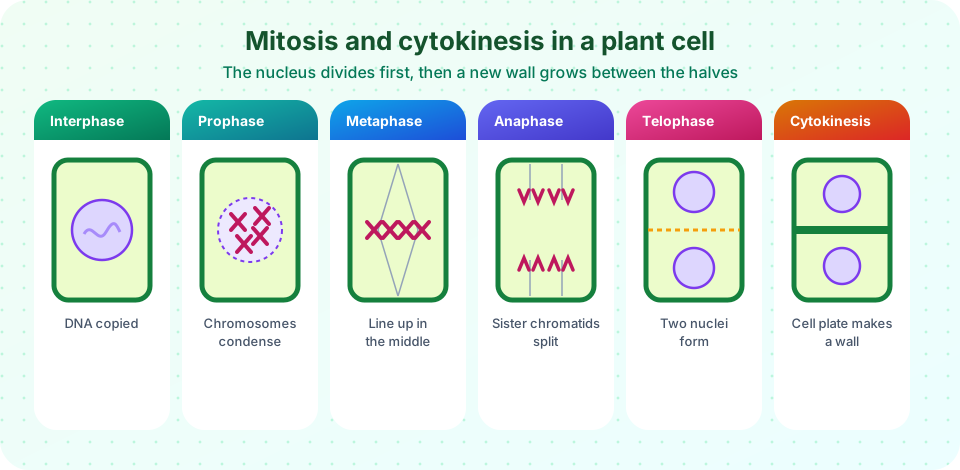
Prophase. The chromatin coils tight enough that each chromosome becomes visible as two sister chromatids joined at a centromere. The nuclear envelope breaks down. Flowering plants have no centrioles, so the spindle forms from microtubules around the nucleus without them. A ring of microtubules called the preprophase band marks the future division plane before prophase begins.
Metaphase. The chromosomes line up along the middle of the cell, the equator. Spindle fibers attach to each centromere from both poles. Cells have a checkpoint here, ensuring every chromosome is attached before it proceeds.
Anaphase. The sister chromatids separate and each one, now a chromosome in its own right, is pulled toward an opposite pole. The cell elongates slightly. This is the shortest stage.
Telophase. The chromosomes arrive at the poles, uncoil, and a nuclear envelope forms around each set. There are now two nuclei with identical DNA.
Cytokinesis: building a wall
An animal cell finishes by pinching inward with a ring of protein, forming a cleavage furrow. A plant cell cannot: the wall is rigid. Instead:
- Microtubules and actin form a structure called the phragmoplast in the center of the dividing cell.
- Tiny vesicles from the Golgi apparatus, filled with pectin and hemicellulose, travel to the middle and fuse into a flat disc, the cell plate.
- The plate grows outward until it reaches the old side walls and joins them, dividing the cytoplasm into two cells.
- Cellulose is added to both sides to form new primary walls; the cell plate becomes the middle lamella, and plasmodesmata are left in it to keep the daughters connected.
The result: two new cells, each with its own full set of organelles, in a plane set by the preprophase band, which determines how a tissue grows.
Where do plants divide?
In animals, most tissues can divide in many places. In plants, division is confined mostly to special regions of young cells called meristems: the tips of roots and shoots (apical meristems) and the cylinder of cambium in woody stems (lateral meristems). Behind a root tip, newly made cells stop dividing, expand by taking up water and finally specialize. That is why a root tip is a favorite place to look at mitosis: the dividing cells are concentrated in a single millimeter.
A classic lab: onion root tips
In a school or university lab, students grow an onion bulb over water until the roots are a few centimeters long, cut off the last 2 to 3 millimeters and soften them in warm dilute hydrochloric acid. Then they stain the DNA, squash the tissue into a thin film on a slide and view it at 400x. In a good squash, cells in each stage are visible. Counting how many cells are in each stage in the field of view is the standard exercise, and the numbers let you estimate how long each stage lasts.
The mitotic index is cells in mitosis ÷ total cells counted. Because a fast-cycling tissue has many cells in mitosis at a given time, the index is a measure of how active the meristem is. Counting the number of cells in each phase also estimates the time spent in it: if a phase appears in 10 percent of the cells and the whole cell cycle lasts 20 hours, the phase takes about 2 hours, assuming the cells divide randomly and in a steady state. (This describes what a lab does; the numbers in the exercises below are practice data, not a real count.)
Why division must be accurate
A mistake in copying or sharing chromosomes yields daughter cells with too many or too few chromosomes, usually with serious problems. Plants, however, tolerate extra full sets of chromosomes far better than animals do. Polyploidy (three or more sets) is common: bread wheat is hexaploid (six sets), strawberries and cotton are polyploid, and seedless bananas are triploid. Breeders even use chemicals such as colchicine, which blocks spindle fibers, to double chromosome numbers on purpose.
Mitosis keeps cells identical. A different division, meiosis, halves the chromosome number to make spores and gametes. It matters for plant reproduction, and you will meet it in Chapter 6.
Common misconceptions
- "Plant cells divide by pinching in the middle." They build a new wall from the inside out; there is no cleavage furrow.
- "Mitosis is the whole cell cycle." Mitosis is a short part of it. Most of the cycle is interphase, when DNA is copied.
- "The chromosome number tells you how advanced a plant is." It does not. Ferns and some simple plants have hundreds of chromosomes.
- "All plant cells keep dividing." Most mature cells stop; division is concentrated in meristems.
Try it
Press Run (or Ctrl + Enter) to see the result here.
Program input · what you'd type while the program runs
Type the answers before you press Run, one per line. Each time the program reads a line (with input()), it gets the next line from this box.
Press Run (or Ctrl + Enter) to see the console output here.
No output.
Check your understanding
Quick check · 5 questions
of 5 answered You scored / 5 · perfect!
-
1. In which phase of the cell cycle are the chromosomes copied?
DNA synthesis occurs in S phase, doubling the DNA content. -
2. During anaphase...
Anaphase is the separation of the sister chromatids. -
3. How does cytokinesis differ in plants and animals?
The rigid wall prevents pinching, so plants build a new wall from the inside out. -
4. In a sample of 200 cells, 18 are in mitosis. The mitotic index is...
18 / 200 = 0.09, or 9 percent. -
5. Where are most dividing cells found in a plant?
Meristems are the regions of continued division.
Summary
- The cell cycle is G1, S (DNA copied), G2 and M (mitosis plus cytokinesis); interphase takes most of the time.
- Mitosis: prophase, metaphase, anaphase, telophase; the result is two nuclei with identical chromosomes.
- Plant cytokinesis builds a cell plate from Golgi vesicles; it becomes the middle lamella.
- Division is concentrated in meristems; the mitotic index measures how active a tissue is.
- Plants tolerate polyploidy, which is common in crops such as wheat and strawberry.
Next: Plant tissues
Track your progress
Create a free account to tick off lessons and pick up where you left off on any device.
of Botany and Plant Science lessons completed