


















Lesson 36 of 48 · Plant Diversity and Evolution
Mosses, ferns and relatives
Learn how mosses, liverworts, hornworts, lycophytes and ferns live and reproduce, with alternation of generations, spores, and why seedless plants still need water.
If you want to see what the first land plants were like, look at a patch of moss on a damp wall. It is small, soft, rootless and entirely dependent on water for its sex life. A fern growing next to it is different: it has real roots, stiff water pipes and fronds that can reach several meters in a tropical tree fern. Both groups reproduce with spores, not seeds, and both date back hundreds of millions of years. Understanding them is the best way to understand the plant life cycle, because the pattern of alternation of generations is easier to see here than anywhere else.
What you will learn
- The three groups of bryophytes and the traits that unite them.
- The key features of seedless vascular plants: lycophytes, ferns and horsetails.
- How alternation of generations works in mosses and ferns.
- Why these plants need water to reproduce, and why they matter ecologically.
Key terms
Gametophyte (n): the haploid generation that makes gametes by mitosis.
Sporophyte (2n): the diploid generation that makes spores by meiosis.
Spore: a single haploid cell that grows into a gametophyte without fertilization.
Archegonium and antheridium: the female and male gamete-producing organs.
Sorus (plural sori): a cluster of sporangia on a fern frond.
Alternation of generations
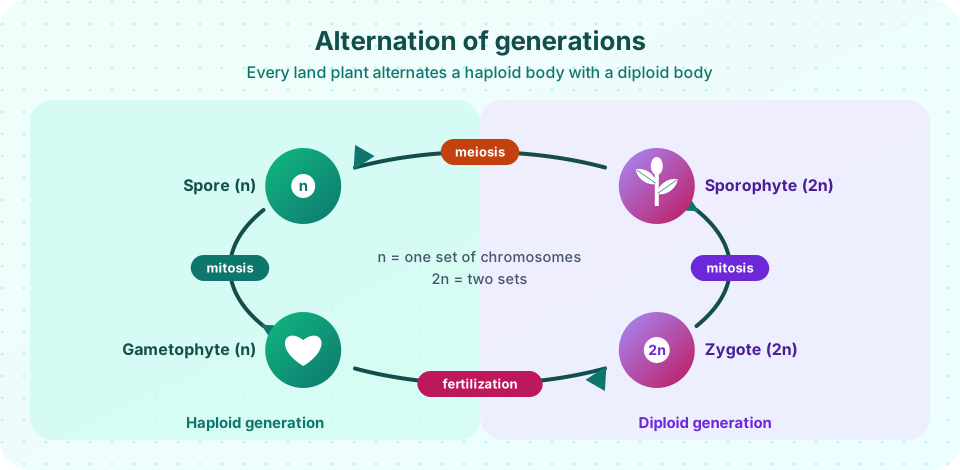
All land plants alternate between two multicellular stages, and which one is bigger tells you a lot about the plant.
- A spore (n) germinates and grows by mitosis into a gametophyte (n).
- The gametophyte makes gametes (n) by mitosis in protective organs: antheridia make sperm and archegonia make eggs.
- Sperm and egg fuse in fertilization to form a zygote (2n).
- The zygote grows by mitosis into a sporophyte (2n).
- In sporangia on the sporophyte, cells undergo meiosis to produce haploid spores, and the cycle repeats.
Compare this with animals, where the only haploid cells are the gametes. In plants a whole multicellular body is haploid. The cycle also differs from fungi and algae, in which a single multicellular stage often dominates. Meiosis in plants makes spores, not gametes.
Bryophytes: the plants without plumbing
Bryophyte is a convenient name for three separate lineages: mosses (about 12,000 species), liverworts (about 7,000 to 9,000) and hornworts (roughly 200 to 250). They are not each other's closest relatives in a simple way, and the group is probably not one branch of the tree, but they share features.
- No xylem or phloem (no true vascular tissue). Water enters mostly through the whole surface, and some mosses have simple conducting cells. Without lignin, they cannot stand tall; most are a few centimeters high.
- No true roots, stems or leaves. Slender rhizoids anchor them. Moss "leaves" are one cell thick in many species.
- Dominant gametophyte. The green moss cushion you see is haploid. The sporophyte is a stalk topped by a capsule, which grows out of the female gametophyte and depends on it for food.
- Swimming sperm. Sperm have flagella and swim through a film of water, such as rain or dew, to reach the egg. That is why bryophytes thrive in damp places and release sperm in wet weather.
- Poikilohydric. Many mosses dry out almost completely and revive when rewetted, a trick that vascular plants rarely manage.
Why they matter. Mosses colonize bare rock and soil, trap moisture and make a seedbed for other plants. Peat moss (Sphagnum) builds peatlands, waterlogged ecosystems where plant material decays so slowly that it piles up. Peatlands cover only a few percent of the land surface but, by many estimates, store about a third of the world's soil carbon, so draining or burning them releases huge amounts of carbon dioxide. People also use peat as fuel and in horticulture, which is controversial for that reason.
Seedless vascular plants
Two groups evolved vascular tissue but never seeds: the lycophytes (about 1,300 species: club mosses, spike mosses, quillworts) and the monilophytes (ferns, about 10,500 species, together with horsetails and whisk ferns). Their key innovations are:
- Xylem and phloem reinforced with lignin, which made it possible to grow tall and to transport water over distances.
- A dominant sporophyte: the plant you see is diploid, and the gametophyte is tiny and short-lived.
- True roots, which anchor the plant and absorb water.
- Leaves with veins. Lycophytes have small leaves (microphylls) with one vein; ferns have large, branched leaves (megaphylls, called fronds) with many veins.
The fern life cycle
A fern is a good example because you can find every stage in the wild.
- The large leafy plant is the sporophyte (2n). On the underside of some fronds are brownish dots, the sori, each a cluster of sporangia.
- In each sporangium, cells undergo meiosis and make many haploid spores. A ring of cells in the sporangium dries and snaps back like a catapult, flinging the spores into the air.
- A spore lands on moist soil and germinates into a gametophyte (n), a thin, green, heart-shaped sheet called a prothallus, often about a centimeter across, that photosynthesizes on its own.
- On the underside of the prothallus are antheridia making flagellated sperm and archegonia with eggs.
- In a film of water, sperm swim to the egg and fertilize it, forming a zygote (2n).
- The zygote grows into a young sporophyte that is attached to the prothallus at first. The gametophyte then withers away.
Most ferns are homosporous, making one kind of spore. Some lycophytes and the water ferns are heterosporous, producing small male spores and large female spores. Heterospory is a stepping stone to seeds.
Coal swamps
About 300 million years ago, in the Carboniferous period, tropical wetlands were covered by forests of giant lycophytes (such as Lepidodendron, trees 30 meters or more tall), horsetails and tree ferns. When these plants died, their remains accumulated in waterlogged ground and, over millions of years, were converted into the coal that powered the Industrial Revolution. Burning that coal returns the carbon those ancient plants once took from the air.
Both groups still need water
Whether they have vascular tissue or not, seedless plants rely on swimming sperm. This restricts sex to wet conditions and limits them to moist habitats, though ferns can live in surprisingly dry or high places because the sporophyte copes with drought while the gametophyte, short-lived and tiny, waits for rain. Seed plants broke the link with the water film, and that is the subject of the next lesson.
Common misconceptions
"Ferns have flowers or seeds that we cannot see." Ferns reproduce by spores and have no flowers or seeds, ever.
"The green moss you see is a small version of a fern or tree." It is a different generation: the moss plant is haploid, while the leafy tree or fern is diploid.
"Mosses are primitive and useless." Mosses are ancient but well adapted, and peat moss stores a large share of terrestrial carbon.
Try it
First, a simulation of what meiosis does to genes. In a plant with n pairs of chromosomes, each spore receives one chromosome of each pair by chance. That gives 2^n possible combinations before crossing over adds even more variation.
Press Run (or Ctrl + Enter) to see the result here.
Program input · what you'd type while the program runs
Type the answers before you press Run, one per line. Each time the program reads a line (with input()), it gets the next line from this box.
Second, an interactive stepper for the life cycles of a moss and a fern. Click the buttons to step through the stages and watch which generation is on stage.
Check your understanding
Quick check · 6 questions
of 6 answered You scored / 6 · perfect!
-
1. In a moss, which generation forms the leafy green plant you normally see?
In bryophytes the gametophyte (n) is dominant; the sporophyte is a dependent stalk and capsule. -
2. Which feature do ferns have that mosses lack?
Ferns are vascular plants with lignified xylem, phloem and true roots; mosses lack them. -
3. Where does meiosis occur in the fern life cycle?
Plants make spores by meiosis; gametes are made by mitosis in the gametophyte. -
4. Why do mosses and ferns need liquid water to reproduce sexually?
Both groups have motile, flagellated sperm that move through a film of water. -
5. Which statement about peat moss (Sphagnum) is most accurate?
Waterlogged peatlands accumulate undecayed plant matter, and by many estimates hold about a third of soil carbon. -
6. Which of these is a stepping stone toward seeds?
Heterospory separates male and female spores, setting the stage for pollen and ovules.
Summary
- Land plants alternate between a haploid gametophyte (makes gametes by mitosis) and a diploid sporophyte (makes spores by meiosis).
- Bryophytes (mosses, liverworts, hornworts) are small, lack vascular tissue, and have a dominant gametophyte.
- Lycophytes and ferns have xylem, phloem and true roots, with a dominant sporophyte and a tiny independent gametophyte.
- All seedless plants rely on swimming sperm, so they depend on water for fertilization.
- Carboniferous lycophyte and fern forests formed much of the world's coal; peat moss stores carbon today.
Track your progress
Create a free account to tick off lessons and pick up where you left off on any device.
of Botany and Plant Science lessons completed