


















Lesson 12 of 48 · Anatomy and Morphology
Chapter 3 overview: anatomy and morphology
Preview Chapter 3: the shoot and root systems, the four plant organs, the difference between monocots and dicots, and why plants branch.
Chapter 2 gave you the building blocks. Chapter 3 shows what they build. Morphology is the study of the outside shape of an organism, and anatomy is the study of its internal structure. Together they explain why a root looks and works so differently from a leaf, even though both are made from the same three tissue systems. This overview gives the map for the chapter and the vocabulary you will need.
What you will learn
- The two systems and four organs of a flowering plant.
- The jobs of each organ.
- How monocots and eudicots differ in anatomy.
- Why surface area matters, and why plants branch.
Key terms
- Shoot system: the parts above ground: stems, leaves, flowers and fruits.
- Root system: the parts below ground: roots and root hairs.
- Organ: a structure made of several tissues with a specific job.
- Monocot: a flowering plant whose seed has one cotyledon (seed leaf), such as grasses, lilies and palms.
- Eudicot: a flowering plant, generally with two cotyledons, such as beans, roses and sunflowers.
The plant body at a glance
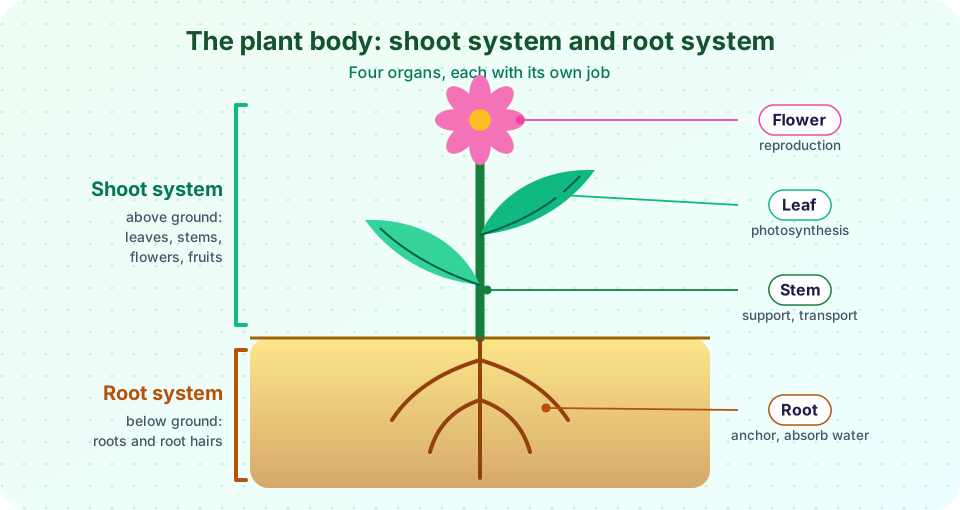
A flowering plant has two systems. The shoot system rises into the air to capture light and carbon dioxide. The root system stays in the soil to anchor the plant and take in water and minerals. The two are linked by the vascular tissue in the stem, which carries water up and sugar down.
Roots
Stems
Leaves
Flowers, fruits, seeds
- Roots looks at root types, the root tip and how water reaches the center of a root.
- Stems covers buds, nodes, modified stems and the rings of a tree.
- Leaves opens the leaf and the stoma.
- Flowers, fruits and seeds takes apart the reproductive organs.
- Chapter 3 review summarizes everything with a quiz.
Monocots and eudicots
Flowering plants (angiosperms) fall into a few big lineages. The two largest are the monocots and the eudicots. Older books call the second group simply "dicots"; DNA evidence shows that the true dicot group is broader and not a single natural clade, so botanists now say eudicots for the main lineage. The features below are useful, but they are tendencies with exceptions.
| Feature | Monocots | Eudicots |
|---|---|---|
| Seed leaves (cotyledons) | One | Two |
| Leaf veins | Parallel | Branched (net) |
| Vascular bundles in the stem | Scattered | In a ring |
| Root system | Fibrous (many similar roots) | Often a taproot |
| Flower parts | Usually in threes | Usually in fours or fives |
| Pollen grain openings | One pore or furrow | Three pores or furrows |
| Secondary growth (wood) | Rare | Common |
| Examples | Grasses, rice, maize, lilies, orchids, palms | Beans, oak, tomato, sunflower, rose |
Why plants branch: surface area and volume
A plant takes in light, water and gases across surfaces, but it consumes resources according to its volume. A cube with side s has surface area 6s² and volume s³, so the ratio of surface to volume is 6/s. Double the size and the ratio halves. Large, unbranched structures would starve; thin, branching ones keep a high ratio. That is why leaves are thin, roots branch into fine hairs and trees divide into thousands of twigs. The same principle appears in lungs and intestines in animals.
Life forms: herbs, woody plants and life spans
Plants also differ in how long they live and how they are built.
- Herbaceous plants have soft, green stems that die back at the end of the growing season: lettuce, sunflower, grass.
- Woody plants make wood and bark that persist for years: oak, pine, roses.
- Annuals complete their life cycle in one growing season (wheat, marigold). Biennials take two years (carrot, parsley: leaves first, flowers in the second year). Perennials live for many years (trees, tulips).
Try it
Press Run (or Ctrl + Enter) to see the result here.
Program input · what you'd type while the program runs
Type the answers before you press Run, one per line. Each time the program reads a line (with input()), it gets the next line from this box.
Press Run (or Ctrl + Enter) to see the console output here.
No output.
Check your understanding
Quick check · 4 questions
of 4 answered You scored / 4 · perfect!
-
1. Which parts belong to the shoot system?
The shoot system is everything above ground. -
2. A plant has parallel leaf veins and scattered stem bundles. It is most likely a...
Both traits point to monocots, such as grasses. -
3. A cube changes from side 2 mm to side 4 mm. Its surface-to-volume ratio...
The ratio is 6 / s, so doubling s halves it. -
4. A biennial plant such as carrot...
Biennials need two growing seasons to complete their life cycle.
Summary
- A flowering plant has a shoot system (stems, leaves, flowers) and a root system, linked by vascular tissue.
- Monocots and eudicots differ in seed leaves, venation, bundle arrangement, roots and flower parts, but the rules are tendencies.
- Surface-to-volume ratio falls as size grows, which is why plants use thin leaves, fine roots and branching.
- Plants may be herbaceous or woody and annual, biennial or perennial.
Next: Roots
Track your progress
Create a free account to tick off lessons and pick up where you left off on any device.
of Botany and Plant Science lessons completed