


















Lesson 43 of 48 · Ecology, Agriculture and Biotechnology
Plant biotechnology
Learn plant tissue culture, Agrobacterium transformation, GM crops and CRISPR gene editing, with the evidence and debates, and run a CRISPR site finder and an explant planner.
For most of agriculture's history, breeders could only reshuffle the genes that a species already had, by crossing plants and selecting the offspring. Since the 1950s, plant biotechnology has added three new tools. Tissue culture grows whole plants from single cells or tiny fragments. Genetic engineering moves a gene from one organism to another. Genome editing changes a plant's own DNA at a chosen spot. Each tool depends on a basic property of plants that animals mostly lack: many plant cells are totipotent, so a single differentiated cell can, with the right hormones, grow into a complete new plant. This lesson explains the methods, the crops they have produced, and the evidence and debates about them.
What you will learn
- How tissue culture works, and why hormone balance matters.
- How Agrobacterium and gene guns deliver genes into plants.
- What GM crops exist and what the evidence says about them.
- How CRISPR genome editing works in plants, and the main debates.
Key terms
Totipotency: the ability of a single cell to regenerate a whole organism.
Callus: a mass of undifferentiated plant cells grown in culture.
T-DNA: the segment of the Agrobacterium Ti plasmid that is transferred into plant cells.
Transgenic (GM) plant: a plant containing a gene from another species.
CRISPR-Cas9: a system in which a guide RNA directs the Cas9 enzyme to cut DNA at a matching sequence.
Tissue culture
In the 1950s Folke Skoog and Carlos Miller showed that the ratio of auxin to cytokinin controls what cultured tobacco tissue becomes: a high auxin-to-cytokinin ratio gives roots, a high cytokinin-to-auxin ratio gives shoots, and a middle ratio gives callus (see plant hormones). In 1962 Toshio Murashige and Skoog published a nutrient mixture (MS medium) that remains the standard base for plant culture. The basic procedure is:
- Cut a small piece of tissue (an explant) from a leaf, stem or meristem. Sterilize its surface.
- Place it on sterile agar medium with sugar, minerals, vitamins and hormones.
- Induce callus, then shoots, then roots by changing the hormone ratio.
- Move the rooted plantlets to soil gradually (hardening off).
Uses include micropropagation (thousands of identical plants from one parent, widely used for orchids, bananas and ornamental plants), meristem culture to make virus-free plants (the tips of shoots often lack viruses), production of haploid and doubled-haploid plants for breeding, and the regeneration step in genetic engineering. A disadvantage is somaclonal variation: culture itself can cause mutations.
Moving genes into plants
Agrobacterium: nature's genetic engineer
Agrobacterium tumefaciens is a soil bacterium that causes crown gall, a tumor-like growth on plants. The bacterium carries a Ti (tumor-inducing) plasmid. When it infects a wound, a stretch of the plasmid called T-DNA is copied, transported into the plant cell and inserted into the plant's chromosomes, where its genes make the plant produce hormones and special nutrients that feed the bacterium. In 1977 Mary-Dell Chilton and colleagues showed that this T-DNA is found in the tumor cells' genome. Scientists realized they could "disarm" the plasmid by removing the tumor genes and put a gene of interest between the T-DNA border sequences instead. In 1983, several groups produced the first transgenic plants, tobacco carrying an antibiotic resistance gene.
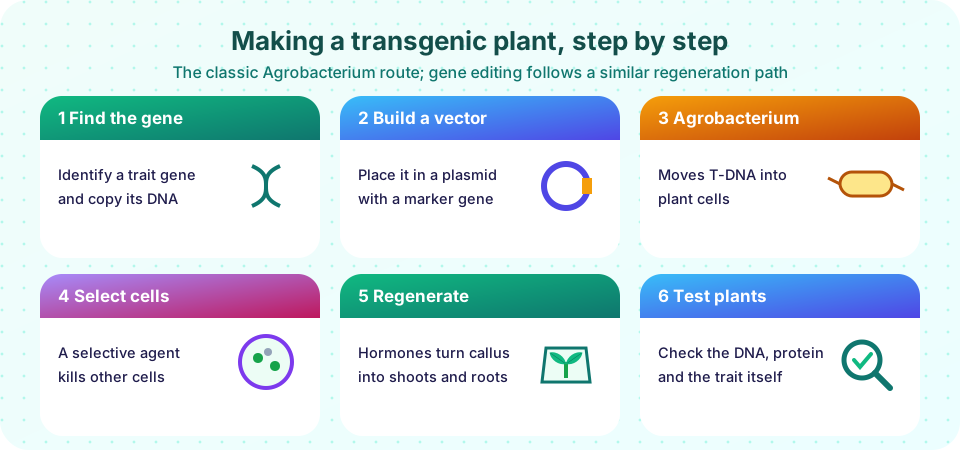
A typical project proceeds as follows. The gene of interest is placed in a vector with a promoter that switches it on and a selectable marker, such as a gene for herbicide or antibiotic resistance. Leaf discs are soaked in Agrobacterium and put on culture medium. Only cells that took up the T-DNA survive the selection agent. Hormones regenerate shoots and roots from those cells, and the resulting plants are tested for the inserted gene, its product and the desired trait. Many monocots, such as maize and wheat, are harder to transform this way, though improved methods now work.
The gene gun and other methods
In biolistics, invented by John Sanford in 1987, microscopic gold or tungsten particles coated with DNA are shot into plant tissue. It works for many species that Agrobacterium does not infect easily, and for transforming chloroplasts. Others methods include electroporation of protoplasts (cells without walls) and viral vectors.
GM crops in the field
Genetically modified (GM, or transgenic) crops have been commercially grown since the mid-1990s. Examples:
| Trait | How it works | Example |
|---|---|---|
| Insect resistance | Genes for Bacillus thuringiensis (Bt) proteins that are toxic to certain insect larvae | Bt cotton, Bt maize |
| Herbicide tolerance | A version of an enzyme not blocked by the herbicide (for example glyphosate) | Soybean, maize, canola |
| Virus resistance | A gene piece from the virus protects the plant | Hawaiian papaya (ringspot virus), commercial since 1998 |
| Nutrition | Pathway genes that make provitamin A | Golden Rice (Ingo Potrykus and Peter Beyer, 2000) |
| Shelf life | Reduced softening | Flavr Savr tomato (1994), the first GM food on sale |
The main GM crops are soybean, maize, cotton and canola, grown on roughly 190 million hectares worldwide in recent years, mostly in a handful of countries.
What does the evidence say?
Assessments by many scientific bodies, such as the US National Academies of Sciences (2016), have found that approved GM crops on the market are not more likely to harm human health than their conventional counterparts, and that Bt crops have often reduced insecticide use. At the same time, researchers document real issues: weeds evolve resistance to herbicides used heavily with tolerant crops, insects can evolve resistance to Bt (managed with "refuge" areas of non-Bt plants), pollen can move genes to relatives, and seed patents and costs raise social and economic questions. Public views vary strongly between countries, and regulation ranges from permissive to restrictive. The most useful question is usually not "GM or not?" but which trait, in which crop, in which place, and who benefits.
Genome editing with CRISPR
CRISPR-Cas9 was adapted from a bacterial defense system. In 2012, Jennifer Doudna, Emmanuelle Charpentier and colleagues showed that Cas9 can be directed by a short guide RNA to cut DNA at a matching sequence, and the 2020 Nobel Prize in Chemistry honored Doudna and Charpentier. Plant scientists used it from 2013.
How it works:
- Design a guide RNA of about 20 nucleotides that matches the target gene. The target must sit next to a PAM (protospacer-adjacent motif; for the common Streptococcus pyogenes Cas9 it is NGG, where N is any base).
- Cas9 and the guide RNA enter plant cells (usually delivered by Agrobacterium or a gene gun).
- Cas9 cuts both strands about three bases upstream of the PAM.
- The cell repairs the break. The most common repair is error-prone and often disables the gene. With a template, more precise changes are possible; newer tools, base editors and prime editors, change single letters without cutting both strands.
Editing differs from classical transgenics because the final plant can carry no foreign DNA: the CRISPR machinery can be bred away. Examples include a tomato with higher GABA content, approved for sale in Japan in 2021, waxy maize, mildew-resistant wheat in research, and non-browning mushrooms. Regulations differ among countries about whether edited plants without foreign DNA should be treated like GM plants, and the question is still evolving. Editing also shortens breeding timelines, but it does not remove the need for field testing.
Other tools
Marker-assisted selection uses DNA markers to pick seedlings with the right alleles before they grow. Genome-wide association studies link genes to traits. Speed breeding uses long days and controlled conditions to raise several generations a year. RNA interference silences genes. Phytoremediation uses plants to clean contaminated soils.
Common misconceptions
"GM means the plant has a gene from an animal." Most GM crops contain genes from bacteria or other plants; the donor depends on the trait, and many commercial traits are from bacteria.
"Genome editing and GM are the same." Both change DNA, but editing can make small changes in the plant's own genes without adding foreign DNA, and regulators treat them differently in many countries.
"Plants cannot be cloned." Plant cloning by cuttings, grafting and tissue culture is routine and very old.
Try it
First, a CRISPR target finder. It scans a made-up DNA sequence for NGG PAM sites on the forward strand and lists the 20-letter guides next to them, with the predicted cut position. This is a toy for learning the rule; real design software also checks the reverse strand, off-target matches elsewhere in the genome and the guide's efficiency.
Press Run (or Ctrl + Enter) to see the result here.
Program input · what you'd type while the program runs
Type the answers before you press Run, one per line. Each time the program reads a line (with input()), it gets the next line from this box.
Second, a planner for a transformation experiment. If only 5% of explants yield a transgenic plant, how many explants should you start with?
Press Run (or Ctrl + Enter) to see the result here.
Program input · what you'd type while the program runs
Type the answers before you press Run, one per line. Each time the program reads a line (with input()), it gets the next line from this box.
Check your understanding
Quick check · 6 questions
of 6 answered You scored / 6 · perfect!
-
1. In plant tissue culture, which hormone ratio tends to promote shoot formation?
Skoog and Miller: high cytokinin-to-auxin ratio gives shoots; high auxin-to-cytokinin gives roots. -
2. What is T-DNA?
T-DNA is the part of the Ti plasmid that moves into plant cells and integrates into the plant's chromosomes. -
3. What does the selectable marker do in a transformation experiment?
Cells with the marker survive the antibiotic or herbicide, so untransformed cells are eliminated. -
4. For SpCas9, the PAM sequence that must follow the 20-nt target is
Streptococcus pyogenes Cas9 needs an NGG PAM immediately after the target. -
5. Which statement best describes the current evidence on approved GM food crops?
Major reviews report no extra health risk from approved GM crops, but weed and insect resistance, gene flow and access remain real issues. -
6. Which is a key difference between genome editing and traditional transgenics?
The CRISPR components can be segregated away, leaving a plant with only small changes in its own genome.
Summary
- Totipotency makes tissue culture possible: with the right auxin-cytokinin balance, cells regenerate shoots, roots and whole plants.
- Agrobacterium transfers T-DNA into plants; gene guns shoot DNA-coated particles into cells.
- GM crops such as Bt cotton and virus-resistant papaya are in use; reviews find no extra food-safety risk but identify ecological and social issues to manage.
- CRISPR-Cas9, guided by a 20-nt RNA next to an NGG PAM, makes precise cuts that can disable or edit genes, sometimes leaving no foreign DNA.
- Good biotechnology questions ask which trait, which crop, what evidence, and who benefits.
Next: Chapter 8 review
Track your progress
Create a free account to tick off lessons and pick up where you left off on any device.
of Botany and Plant Science lessons completed