


















Lesson 5 of 48 · Getting Started
Chapter 1 review: getting started
Review Chapter 1 of botany: what defines a plant, how botanists run fair experiments, and how scientific names and ranks work, with a ten-question quiz.
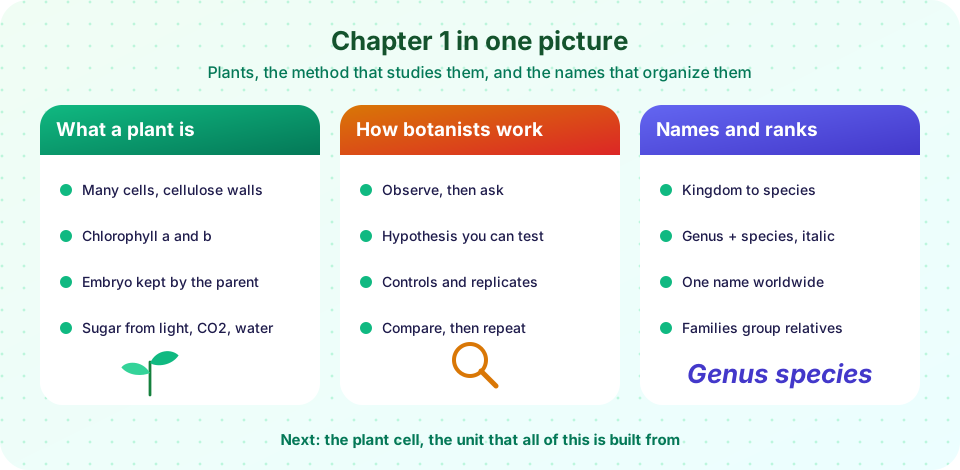
You have met the three ideas that every later chapter relies on: what counts as a plant, how plant scientists test their ideas, and how the names and groups of plants are organized. This lesson pulls them together in one picture, one table and a ten-question quiz that mixes all three lessons.
What you will learn
- Which facts from Chapter 1 are worth knowing cold.
- How the three lessons connect.
- Where your understanding still needs work, using the quiz.
Recap table
| Topic | Key facts |
|---|---|
| Plant traits | Many cells, cellulose walls, chlorophyll a and b, starch storage, protected embryo, alternation of generations |
| Relatives | Green algae are close; fungi are closer to animals; kelp is a separate lineage |
| Origin | Land plants descend from freshwater green algae, roughly 470 million years ago |
| Plant mass | Mostly from carbon dioxide and water, not soil (van Helmont, 1640s) |
| Experiments | One changed factor, a control, replicates, random placement |
| Statistics | Mean and standard deviation; a p-value asks whether chance could explain the difference |
| Tools | Hand lens, herbarium, microscope, growth chamber, spectrophotometer, DNA sequencing |
| Names | Genus (capital) + epithet (lower case), italic; one accepted name per species |
| Ranks | Kingdom, phylum, class, order, family (-aceae), genus, species |
| Classification today | DNA-based clades (APG IV for flowering plants); names and groupings can change |
How the lessons connect
The definition of a plant came from decades of comparing structures, tested and refined through experiments such as those in lesson 3. Names and ranks (lesson 4) record what those comparisons revealed about relatedness. Each lesson depends on the others: without a clear definition you cannot decide what to name, and without experiments you cannot know which traits really matter.
If you could explain these three things to a friend in one minute each, you are ready for Chapter 2: (1) why a kelp is not a plant, (2) why a plant experiment needs a control and replicates, and (3) why lycopersicum alone is not a species name.
Exam-style practice prompts
Try to answer each prompt in two or three sentences before reading on in the next chapter.
- Classify and justify. A colleague hands you a green, many-celled organism that lives in a pond, has cellulose walls and chlorophyll a and b, but no embryo and no roots. Is it a plant? Explain which trait decides the question. (It is most likely a green alga: the missing protected embryo is the key difference.)
- Design a fair test. You suspect that bean seedlings grow taller in red light than in blue light. Name the independent variable, the dependent variable, two things you would hold constant, and how many replicates you would use and why.
- Read a name. What is wrong with the label rosa Canina? Rewrite it correctly and say what the family ending -aceae tells you about the plant Rosa canina (Rosaceae).
- Spot the flaw. A student concludes that a fertilizer "works" because one treated plant grew taller than one untreated plant. List at least three problems with this conclusion.
If you can answer all four without looking back, you have the habits of mind that Chapter 2 and every chapter after it will build on.
Try it
Press Run (or Ctrl + Enter) to see the console output here.
No output.
Press Run (or Ctrl + Enter) to see the result here.
Program input · what you'd type while the program runs
Type the answers before you press Run, one per line. Each time the program reads a line (with input()), it gets the next line from this box.
Check your understanding
Quick check · 10 questions
of 10 answered You scored / 10 · perfect!
-
1. Which pair of pigments do plants use for photosynthesis?
Plants and green algae use chlorophyll a and b. -
2. Fungi differ from plants because their cell walls contain...
Fungal walls contain chitin, and fungi cannot photosynthesize. -
3. The closest living relatives of land plants are...
Charophyte green algae share pigments, walls and starch storage with plants. -
4. Van Helmont's willow experiment showed that...
The soil lost almost no mass while the tree gained about 164 pounds. -
5. In a light-and-chlorophyll experiment, chlorophyll content is the...
It is what you measure in response to the change you made. -
6. Why use random placement of pots?
Randomization spreads unseen differences evenly among the groups. -
7. If the spread within groups is large compared with the gap between group means, you should...
A large spread means that overlap between groups is likely, so the effect is uncertain. -
8. Which is a correctly written scientific name?
The genus is capitalized and the epithet is lower case. -
9. Which ending marks a plant family?
Order names end in -ales, class names in -opsida and phyla in -phyta; families end in -aceae. -
10. Why does DNA evidence sometimes change plant classification?
Similar structures can evolve independently, while DNA reveals shared ancestry.
Summary
- A plant is defined by a set of traits and by its ancestry, not by color or habitat.
- Experiments need a control, replicates and one changed factor.
- Statistics (mean, spread, p-value) help separate real effects from chance.
- One scientific name per species; ranks run from kingdom to species and family names end in -aceae.
- All of these ideas are used again in Chapter 2, which opens up the plant cell.
Track your progress
Create a free account to tick off lessons and pick up where you left off on any device.
of Botany and Plant Science lessons completed