


















Lesson 41 of 48 · Ecology, Agriculture and Biotechnology
Plant ecology and biomes
Learn how climate shapes biomes and plant productivity, how plants compete and cooperate, how succession rebuilds communities, and why plant conservation matters.
Look at a map of the world's vegetation and you can almost read a climate map beneath it. Green forests hug the wet tropics, deserts sit where air sinks and rain is scarce, grasslands fill the dry interiors of continents, and the cold north is covered by conifer forest and then tundra. Within each region, plants compete for light, share resources through fungal networks, defend themselves against grazers and slowly change the soil. After a landslide, a volcanic eruption or a farmer's abandoned field, the community rebuilds in a predictable sequence. This lesson shows how botanists describe that world with a few clear ideas: limiting factors, biomes, interactions, succession and conservation.
What you will learn
- How temperature and water limit plant growth, and how the Miami model estimates productivity.
- The main terrestrial biomes and their dominant plants.
- Competition, facilitation, defense and mutualism among plants.
- How primary and secondary succession work, and why plant conservation matters.
Key terms
Limiting factor: the resource or condition that most restricts growth.
Biome: a large-scale community defined by climate and dominant growth form.
Primary and secondary succession: community change starting from bare ground with no soil, or from a disturbed site that keeps its soil.
Pioneer species: the first colonizers of a disturbed or new site.
Mutualism: a partnership that benefits both partners.
What limits plant growth
Plants need light, water, carbon dioxide, warmth and mineral nutrients (see mineral nutrition). At any place, the resource in shortest supply limits growth, which is Liebig's law of the minimum applied to ecosystems. On a rain forest floor light is scarce, in a desert it is water, in the Arctic it is warmth and in a nutrient-poor bog it is nitrogen.
Because temperature and water are the major controls on land, net primary productivity (NPP), the dry matter plants add after their own respiration, tracks climate. The Miami model (Helmut Lieth, 1975) is a neat summary. It predicts NPP in grams of dry matter per square meter per year as the smaller of two estimates:
NPP_T = 3000 / (1 + exp(1.315 − 0.119 × T))where T is mean annual temperature in °C.NPP_P = 3000 × (1 − exp(−0.000664 × P))where P is annual precipitation in millimeters.
It is a rough statistical fit to many sites, not a physical law, but it captures the pattern: warmth and rainfall both raise productivity, with diminishing returns.
The major biomes
The map of biomes follows temperature and precipitation, as the diagram at the start of the chapter shows. In rough order from wet and warm to cold and dry:
| Biome | Climate | Dominant plants | Notes |
|---|---|---|---|
| Tropical rain forest | Warm all year, very wet | Tall evergreen trees, lianas, epiphytes | Highest plant diversity; nutrients mostly in the living biomass |
| Tropical savanna and seasonal forest | Warm, with a dry season | Grasses with scattered trees | Fire and grazing maintain open cover |
| Desert | Very dry | Succulents, shrubs, ephemerals | Water-saving adaptations: CAM, deep or wide roots |
| Temperate grassland and shrubland | Moderate rain, seasonal | Grasses, herbs, shrubs | Deep, fertile soils; many are now farmland |
| Temperate forest | Moderate rain, four seasons | Deciduous and mixed trees | Leaves drop in winter |
| Boreal forest (taiga) | Cold winters, short summers | Spruce, fir, pine, larch | The largest forest biome |
| Tundra | Very cold, short growing season | Mosses, lichens, dwarf shrubs, sedges | Permafrost; slow growth |
Climate is not the only factor. Soil, fire, grazing and altitude also matter: a single mountain can pass through several biomes from base to summit. The same biome on different continents often contains unrelated plants with similar shapes, a result of convergent evolution.
Plants interact
Competition
Neighboring plants compete for light, water and nutrients. Tall plants shade short ones; roots of one plant take water before another can. In intraspecific competition, individuals of the same species compete, which is why a thick row of seedlings must be thinned. In interspecific competition, different species compete. Two competitors with the same needs usually cannot coexist indefinitely if one does better, an idea called competitive exclusion. Coexistence happens when species use different resources or when disturbance or grazing keeps any one from winning.
Some plants release chemicals that harm neighbors (allelopathy). The black walnut's juglone is the classic example, though how strong the effect is in natural soil is debated and many "allelopathic" claims are hard to test.
Facilitation and mutualism
Plants help one another too. In deserts, "nurse plants" such as palo verde trees shelter young saguaro cacti from heat and frost. Legume roots with Rhizobium give nitrogen to the soil. Mycorrhizal fungi trade phosphate and water for sugar, and some forests are linked by shared fungal networks, though how much resource sharing happens is an active research question. Pollinators and seed dispersers are partners too.
Defense
Plants cannot run from grazers, so they use armor and chemistry: thorns, tough tissue, and a huge range of secondary metabolites such as tannins, alkaloids (nicotine, caffeine), glucosinolates (the sharp taste of mustard) and latex. Damage can trigger jasmonate signals and the release of volatile compounds that attract predators of the herbivore. Many of the compounds we use as spices and medicines evolved as defenses.
Succession: how communities rebuild
Succession is the sequence of communities that follows a disturbance.
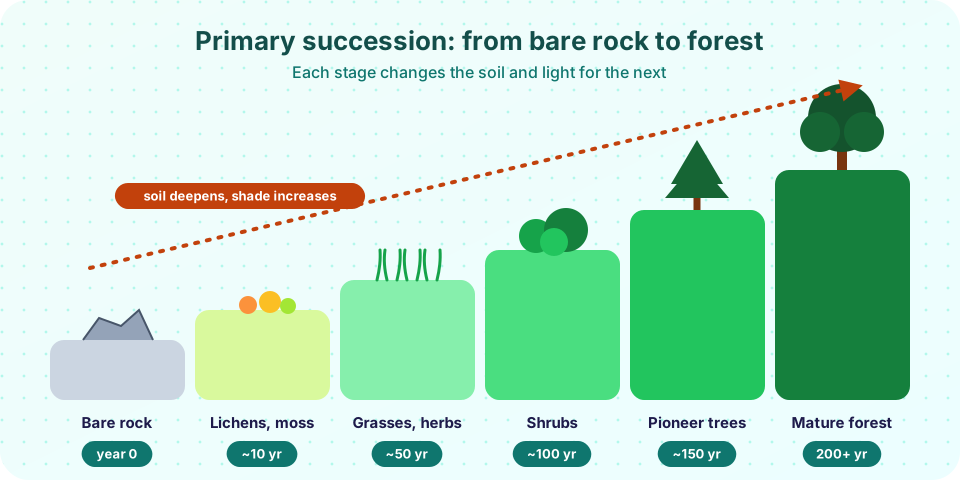
- Primary succession starts on bare rock, new volcanic land or ground exposed by a retreating glacier. There is no soil, so the first colonizers (lichens, mosses, hardy plants) are pioneers that fix nitrogen and break down rock. At Glacier Bay in Alaska, where glaciers have retreated over the last two centuries, ecologists have traced the series from bare gravel to willows and alder, then spruce and hemlock forest. After the 1883 eruption of Krakatau, plants and animals returned over decades.
- Secondary succession follows a fire, storm or an abandoned field. Soil and seeds remain, so the sequence is faster: annual weeds, then perennial grasses and herbs, then shrubs, pioneer trees (such as pine or birch) and, in time, shade-tolerant forest trees.
In 1977 Joseph Connell and Ralph Slatyer proposed three pathways. Early species may facilitate later ones by improving soil, inhibit them by competition until they die or are disturbed, or merely tolerate them. All three occur. Early views treated succession as a march to a stable "climax," but ecologists now see it as a shifting mosaic shaped by chance, disturbance and climate.
Disturbance such as fire is not always bad: many pines, grasslands and Australian eucalyptus forests depend on regular fire for seed release or clearing space.
Conservation
Plants provide food, fuel, fiber, medicine, oxygen, carbon storage and habitat. Threats include habitat loss, overharvesting, invasive species (non-native plants that spread aggressively), pollution and climate change, which is shifting flowering times (phenology) and moving species uphill and toward the poles. Assessments differ with method and year, but estimates suggest that a fifth or more of the world's plant species may be threatened with extinction.
Responses include protected areas, restoration, controlling invasive species, botanic gardens and seed banks. The Svalbard Global Seed Vault in Norway, opened in 2008, holds backup copies of seeds from gene banks around the world. Conservation works best combined with the needs of local people.
Common misconceptions
"Rain forests are the lungs of the planet." Rain forests absorb CO₂, but they also release it through respiration and decay, so their net contribution of oxygen is close to zero. Their value lies in biodiversity, carbon storage and climate regulation.
"Succession always ends in the same forest." Outcomes depend on climate, chance and disturbance, and many ecosystems never settle into a single endpoint.
"Competition is the only interaction among plants." Facilitation and mutualism are just as common, especially in harsh environments.
Try it
First, the Miami model, which shows how productivity responds to temperature and rainfall, and the NPP predicted for three example climates (rough estimates, not measurements).
Press Run (or Ctrl + Enter) to see the result here.
Program input · what you'd type while the program runs
Type the answers before you press Run, one per line. Each time the program reads a line (with input()), it gets the next line from this box.
Second, a simulation of two plant species competing, using the Lotka-Volterra competition equations. The parameters are for demonstration. Change the competition coefficients a12 and a21 and see when species coexist or one excludes the other.
Press Run (or Ctrl + Enter) to see the result here.
Program input · what you'd type while the program runs
Type the answers before you press Run, one per line. Each time the program reads a line (with input()), it gets the next line from this box.
Check your understanding
Quick check · 6 questions
of 6 answered You scored / 6 · perfect!
-
1. Net primary productivity is
NPP is gross photosynthetic production minus plant respiration, per unit area and time. -
2. Which biome has the largest forest area on land, with spruce, fir and pine in a cold climate?
The boreal forest circles the northern hemisphere and is the largest forest biome. -
3. Primary succession differs from secondary succession because it starts
Primary succession begins where no soil exists, such as lava flows or ground exposed by glaciers. -
4. A small saguaro seedling grows in the shade of a palo verde tree. This is best described as
The nurse plant improves conditions for the seedling. -
5. In the Miami model, NPP in a given climate is limited by
The smaller estimate acts as the limit, in the spirit of Liebig's law. -
6. What is an invasive plant species?
Invasive species are introduced plants that spread and cause ecological or economic harm.
Summary
- Temperature, water, light and nutrients limit plant growth; NPP follows climate, as summarized by the Miami model.
- Biomes, from rain forest to tundra, are defined by climate and dominant plant forms, and similar biomes on different continents contain unrelated plants with similar shapes.
- Plants compete, facilitate, partner with fungi and bacteria, and defend themselves chemically.
- Succession rebuilds communities after disturbance, from bare rock (primary) or from existing soil (secondary), and does not always reach one fixed end.
- Habitat loss, invasives and climate change threaten plant diversity; protected areas and seed banks help.
Next: Agriculture and crops
Track your progress
Create a free account to tick off lessons and pick up where you left off on any device.
of Botany and Plant Science lessons completed