


















Lesson 26 of 48 · Water, Nutrients and Transport
Transpiration and stomata
Follow water through a leaf, see how guard cells open and close stomata, and calculate transpiration from humidity, temperature and stomatal conductance.
On a hot afternoon a single large tree can release hundreds of liters of water vapor into the air, and a field of maize behaves like a giant humidifier. This release, called transpiration, looks wasteful, yet it is the engine behind everything else in this chapter. The same pores that let water out let carbon dioxide in, so a plant is always balancing two needs: take in carbon for photosynthesis and keep enough water to stay alive. This lesson shows where the water leaves, what controls the rate, and how a pair of tiny cells decides, moment by moment, how wide to open the door.
What you will learn
- Where in a leaf water evaporates and which route the vapor takes out.
- How guard cells open and close a stoma and which signals control them.
- How to estimate transpiration from vapor pressure deficit and conductance.
- Why plants trade water for carbon, and how different plants cope.
Key terms
Stoma (plural stomata): a pore in the leaf epidermis surrounded by two guard cells.
Guard cells: paired cells that change shape to open or close the stoma.
Cuticle: the waxy waterproof layer on the outside of the epidermis.
Vapor pressure deficit (VPD): the difference between the vapor pressure the air could hold when saturated and what it actually holds; the "drying power" of the air.
Stomatal conductance (gs): how easily gas passes through the stomata, in mol per square meter per second.
The path of a water molecule through a leaf
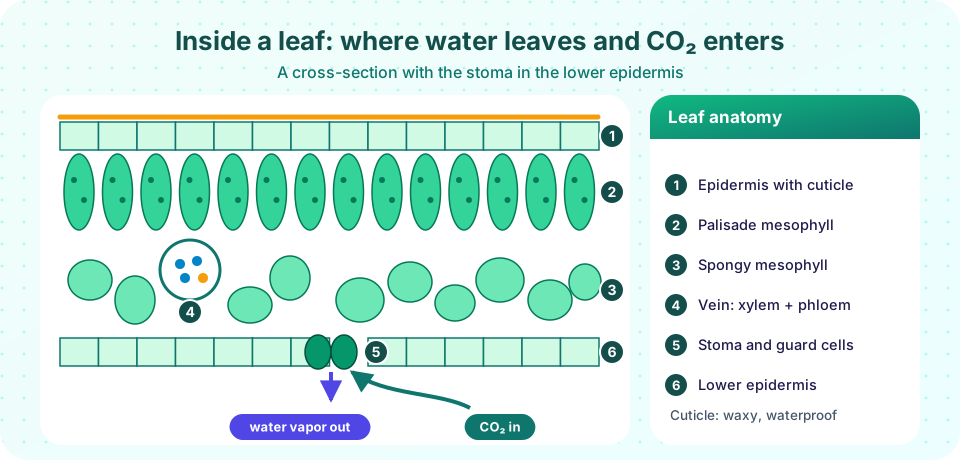
A leaf is a wet sponge wrapped in a nearly waterproof skin. Water arrives in the xylem of the veins, leaves the vein and travels through the walls of mesophyll cells. At the surface of those walls, a thin film of water evaporates into the air spaces between the cells. Because those spaces are connected, the vapor spreads through the spongy mesophyll and then escapes through the stomata into the air outside. Biologists call the first part of this path apoplastic (through cell walls) and part of it symplastic (through the cell interiors, linked by plasmodesmata), but what matters for transpiration is the evaporation at the wall surface.
The outer surface is protected. The cuticle, a layer of wax and cutin, makes the epidermis very poorly permeable to water. Only about 5% or less of a leaf's water loss normally goes through the cuticle, so around 95% leaves through stomata when they are open. When stomata close, water loss falls steeply, and this is why a plant can survive a dry afternoon.
Why transpiration happens: a gradient in water potential
Air inside a leaf is nearly saturated with water vapor, so the vapor pressure there equals the saturation value at leaf temperature. Air outside is usually drier. Water vapor therefore diffuses from the leaf to the atmosphere, down a gradient. In water-potential terms, air at 50% relative humidity and 20 °C has Ψ ≈ −94 MPa, while the leaf is at about −1 MPa. A drop that large is a very strong pull.
For a convenient estimate we use a form of Fick's law:
E = gs × VPD / P
where E is transpiration (mol m⁻² s⁻¹), gs is stomatal conductance to water vapor (mol m⁻² s⁻¹), VPD is vapor pressure deficit (kPa) and P is atmospheric pressure (about 101.3 kPa). The saturation vapor pressure at temperature T in °C can be approximated by es = 0.6108 × exp(17.27 T / (T + 237.3)) kPa (the Tetens equation), and VPD = es × (1 − RH).
Worked example: a sunny afternoon
Air at 25 °C and 50% relative humidity, gs = 0.2 mol m⁻² s⁻¹.
es = 0.6108 × exp(17.27 × 25 / 262.3) = 0.6108 × exp(1.646) ≈ 3.17 kPa.VPD = 3.17 × (1 − 0.5) ≈ 1.58 kPa.E = 0.2 × 1.58 / 101.3 ≈ 0.0031 mol m⁻² s⁻¹ = 3.1 mmol m⁻² s⁻¹.- Mass: 3.1 mmol × 18 g/mol ≈ 56 mg of water per second per square meter, about 0.2 liters per square meter of leaf per hour.
A tree crown has many square meters of leaf (leaf area index of 4 to 6 over each square meter of ground is common), which is how hundreds of liters a day add up.
Factors that change the rate
| Factor | Effect on transpiration | Why |
|---|---|---|
| Light | Increases | Opens stomata; also warms the leaf |
| Temperature | Increases | Saturation vapor pressure rises steeply with temperature, so VPD grows |
| Humidity | Decreases when high | A humid atmosphere has a smaller VPD |
| Wind | Increases | Removes the humid boundary layer clinging to the leaf |
| Soil water | Decreases when low | Stress signals close stomata |
| Leaf traits | Varies | Hairs, thick cuticle, sunken stomata and small leaves cut loss |
Temperature is the one that surprises people. Warm air can hold much more vapor: es is about 1.7 kPa at 15 °C but about 4.2 kPa at 30 °C. At the same relative humidity, the warmer day has more than twice the drying power.
How guard cells work
A stoma is a pore between two kidney-shaped guard cells (in grasses, dumbbell-shaped). The cell walls on the pore side are thicker and less elastic than the outer walls. When the guard cells fill with water and swell, the thinner outer walls bulge more than the thick inner walls, and the cells bow apart. The pore opens. When they lose water, they straighten and the pore closes.
The control mechanism is a nice example of chemistry changing pressure:
- Light (especially blue light, sensed by phototropin receptors) activates a proton pump in the guard cell membrane. The pump pushes H⁺ out of the cell.
- The resulting electrical gradient drives potassium ions (K⁺) and chloride into the guard cell. Malate is also made inside the cell.
- With more solute in the cell, Ψs falls, water enters by osmosis, turgor rises and the stoma opens.
At night or under stress, the sequence runs in reverse. The hormone abscisic acid (ABA), which roots and leaves release when water is short, triggers ion channels to open, ions leak out, water follows, and the guard cells go limp. A low internal carbon dioxide level also opens stomata, and high carbon dioxide closes them. Stomatal density also varies across species and conditions; leaves commonly have tens to a few hundred stomata per square millimeter, and many plants grown in high CO₂ develop fewer.
The big trade-off
Opening stomata gives carbon dioxide at a price. A common figure is that C₃ plants lose on the order of 300 to 500 molecules of water per molecule of CO₂ fixed. This ratio is the inverse of water-use efficiency. Plants have evolved several answers:
- C₄ plants such as maize and sorghum concentrate CO₂ around the enzyme Rubisco, so they can keep stomata partly closed and still photosynthesize; their water cost per unit of carbon is lower.
- CAM plants such as cacti and many succulents open stomata at night, fix CO₂ into organic acids, and keep stomata shut during the day.
- Xerophytes have leaf hairs, rolled leaves, thick cuticles or sunken stomata that trap a humid pocket of air.
- Deciduous trees drop leaves in dry or cold seasons, ending transpiration.
Chapter 4 covers the biochemistry behind C₃, C₄ and CAM; here, what matters is that each strategy changes the balance between carbon gain and water loss.
Wilting and the safety valve
When transpiration outruns uptake, leaf water content falls, turgor drops and the plant wilts. This is a safety response: wilted leaves present less surface to the sun and close stomata. Short-term wilting at midday is common and recovers by evening; permanent wilting happens when soil water is so low that even at night the plant cannot recover. Gardeners use this signal to decide when to irrigate.
Common misconceptions
"Transpiration is just wasted water." It cools leaves, drives mineral uptake and keeps the whole transport system running. The waste only appears when the plant is short of water.
"Stomata are mostly on the top of leaves." In most land plants they are more common on the lower surface, where it is cooler and more sheltered. Floating leaves such as water lilies are the opposite, with stomata on top.
"Plants breathe through stomata only for photosynthesis." They exchange gases for respiration, too; the stomata let in O₂ in the dark and let out CO₂.
Try it
First, a plot of how transpiration rises with temperature at three humidities, using the formulas above.
Press Run (or Ctrl + Enter) to see the result here.
Program input · what you'd type while the program runs
Type the answers before you press Run, one per line. Each time the program reads a line (with input()), it gets the next line from this box.
Second, a calculator that shows what closing the stomata saves.
Press Run (or Ctrl + Enter) to see the result here.
Program input · what you'd type while the program runs
Type the answers before you press Run, one per line. Each time the program reads a line (with input()), it gets the next line from this box.
Third, an interactive stoma. Tick the conditions and watch the guard cells respond. It is a qualitative model of the signals described above, not a measurement.
Check your understanding
Quick check · 5 questions
of 5 answered You scored / 5 · perfect!
-
1. Through which structures does most water vapor leave a leaf when the stomata are open?
Roughly 95 percent of leaf water loss goes through open stomata; the waxy cuticle is nearly waterproof. -
2. Air at 25 C and 50 percent humidity has a larger VPD than air at 15 C and 50 percent humidity. Why?
Saturation vapor pressure rises steeply with temperature, so VPD = es x (1 - RH) is larger at 25 C. -
3. What happens inside a guard cell when the stoma opens?
Proton pumping drives K+ and other solutes in, Psi_s falls, water enters by osmosis, and the bowed cells open the pore. -
4. Which hormone signals water stress and tends to close stomata?
ABA, released by roots and leaves under water shortage, makes guard cells lose ions and water. -
5. CAM plants reduce water loss mainly by
CAM plants take up CO2 at night when the air is cooler and more humid and use it during the day with stomata closed.
Summary
- Water evaporates from the wet walls of mesophyll cells and leaves mainly through open stomata; the cuticle blocks most other loss.
- Transpiration follows
E = gs × VPD / P, so it rises with warmth, dryness and wind and falls when stomata close. - Guard cells open the pore when K⁺ and other solutes pull in water; ABA and high CO₂ close it.
- Plants trade water for carbon; C₄, CAM and desert adaptations shift the balance.
- Transpiration is the engine for water flow through the plant, which the next lesson follows into the xylem.
Track your progress
Create a free account to tick off lessons and pick up where you left off on any device.
of Botany and Plant Science lessons completed