


















Lesson 21 of 48 · Photosynthesis and Plant Metabolism
C4 and CAM plants: beating heat and drought
Compare C3, C4 and CAM photosynthesis: how Kranz anatomy and PEP carboxylase concentrate CO2, how CAM plants open stomata at night, and which crops use each.
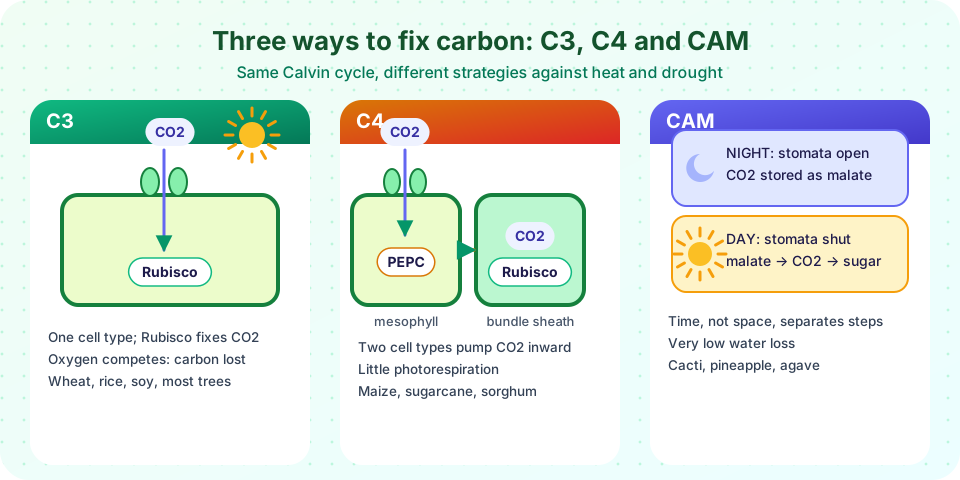
Rubisco's mistake with oxygen is costly in hot, dry, bright places, which is exactly where many plants must live. Over evolutionary time, plants have found two clever fixes. One, called C4 photosynthesis, separates the steps in space: one kind of cell captures CO2 and pumps it to a second kind of cell, where Rubisco is surrounded by a high concentration of the gas. The other, called CAM, separates the steps in time: the plant takes in CO2 at night and uses it in the day. Both solutions have appeared independently many times, which suggests that the problem is real and the solutions useful.
What you will learn
- Why C3 plants lose carbon in hot, dry conditions.
- How C4 plants use two cell types to concentrate CO2.
- How CAM plants separate fixation and the Calvin cycle in time.
- The costs and benefits of each pathway.
- Which crops and wild plants use which.
Key terms
- C3 plant: a plant whose first stable product of fixation is the 3-carbon 3-PGA, by Rubisco. Most plants.
- C4 plant: a plant that first fixes CO2 into a 4-carbon acid using the enzyme PEP carboxylase.
- CAM plant: a plant using Crassulacean Acid Metabolism, with night-time CO2 uptake.
- PEP carboxylase (PEPC): an enzyme that binds bicarbonate to phosphoenolpyruvate; it has no reaction with O2.
- Kranz anatomy: the wreath-like ring of bundle sheath cells around the veins in C4 leaves.
The problem for C3 plants
In a C3 plant, Rubisco is exposed to the CO2 that reaches the chloroplasts. On a hot, sunny day the plant faces a dilemma: opening the stomata brings in CO2 but also loses water, so it partly closes them. With stomata partly closed, CO2 inside the leaf drops while the O2 from the light reactions builds up. Rubisco then fixes more O2, and photorespiration claims a larger share of carbon, often a quarter or more at high temperatures.
C4 photosynthesis: separation in space
C4 photosynthesis was worked out in the 1960s by Marshall Hatch and Roger Slack in Australia, who found that sugarcane first labels a 4-carbon acid rather than 3-PGA. It relies on Kranz anatomy (German for wreath): the leaf's veins are surrounded by a tight ring of large bundle sheath cells, and outside that ring are the mesophyll cells.
- In the mesophyll cell: CO2 dissolves as bicarbonate (HCO3⁻) and PEP carboxylase attaches it to phosphoenolpyruvate (3 carbons), making oxaloacetate (4 carbons), which is converted to malate or aspartate. PEPC has a high affinity for bicarbonate and does not react with oxygen, so it works even when stomata are partly closed.
- The 4-carbon acid moves through plasmodesmata into a bundle sheath cell.
- In the bundle sheath cell: the acid is split, releasing CO2. The concentration of CO2 around Rubisco rises many-fold, maybe to 10 times or more than in the air. At this concentration Rubisco nearly always fixes CO2, so photorespiration is small. The 3-carbon remainder returns to the mesophyll to be reused.
- Calvin cycle runs in the bundle sheath chloroplasts as usual.
The price is energy: the CO2 pump costs about 2 extra ATP per CO2 fixed (about 5 ATP per CO2 instead of 3), so C4 is less efficient than C3 in cool, shaded places. In warm, bright conditions the saved carbon is worth much more than the cost. C4 plants also use water more efficiently because they can fix the same carbon with stomata less open.
Only about 3 percent of plant species are C4, yet they account for roughly a quarter of the photosynthesis on land because they dominate tropical grasslands and savannas. Important C4 crops include maize, sugarcane, sorghum and millet. Many weedy species are C4, as are some of the most productive wild grasses.
CAM: separation in time
CAM was first described in succulent plants of the stonecrop family (Crassulaceae), hence the name Crassulacean Acid Metabolism. It is the strategy of cacti, many succulents, pineapple, agave and many orchids.
- Night: stomata open when the air is cool and humid. PEP carboxylase fixes CO2 into oxaloacetate, which becomes malate (malic acid) and is stored in the large vacuole. The leaves become acidic by morning.
- Day: stomata stay closed, so almost no water escapes. The malate leaves the vacuole and is split to release CO2 inside the leaf, where Rubisco and the Calvin cycle use it with the light reactions' ATP and NADPH.
CAM plants can lose five to ten times less water per unit of carbon fixed than C3 plants, which lets them survive in deserts. The cost is slow growth: the vacuole can store only so much malate each night, so the daily carbon gain is small. Some plants are flexible: they use C3 when water is plentiful and switch to CAM during drought.
Comparing the three
| Feature | C3 | C4 | CAM |
|---|---|---|---|
| First product of fixation | 3-PGA (3 C) | Oxaloacetate (4 C) | Oxaloacetate/malate (4 C) |
| First enzyme | Rubisco | PEP carboxylase | PEP carboxylase (night) |
| Separation | None | In space (two cell types) | In time (night and day) |
| Photorespiration | High in heat | Very low | Very low |
| ATP per CO2 | 3 | about 5 | about 4 to 5 |
| Best conditions | Cool, moist, moderate light | Hot, bright, moderate water | Arid, very hot days |
| Water use per carbon | High | Moderate | Very low |
| Share of species | about 85 to 90 percent | about 3 percent | about 6 to 7 percent |
| Examples | Wheat, rice, soy, potato, trees | Maize, sugarcane, sorghum | Cactus, pineapple, agave |
Why this matters
Understanding these pathways explains why maize outyields wheat in hot climates and why cactus farming is an option in dry regions. It also drives some of the biggest projects in crop science: researchers are trying to introduce C4 features into rice, a C3 crop, which could raise yields in a warming world, and to cut photorespiration losses in other crops by engineering bypasses.
Common misconceptions
- "C4 and CAM plants do not use the Calvin cycle." They all use it. C4 and CAM only add a CO2-concentrating step in front of it.
- "C4 plants are better than C3 plants." C4 plants have an energy cost, so they lose to C3 plants in cool or shady conditions.
- "CAM plants never open their stomata." They open them at night.
- "Only desert plants are CAM." CAM also occurs in epiphytic orchids and in some aquatic plants.
Try it
Press Run (or Ctrl + Enter) to see the result here.
Program input · what you'd type while the program runs
Type the answers before you press Run, one per line. Each time the program reads a line (with input()), it gets the next line from this box.
Press Run (or Ctrl + Enter) to see the result here.
Program input · what you'd type while the program runs
Type the answers before you press Run, one per line. Each time the program reads a line (with input()), it gets the next line from this box.
Check your understanding
Quick check · 5 questions
of 5 answered You scored / 5 · perfect!
-
1. In a C4 plant, where is Rubisco found?
The CO2 pump delivers CO2 to bundle sheath cells, where Rubisco works at a high CO2 concentration. -
2. CAM plants open their stomata...
Night is cooler and more humid, so little water is lost. -
3. Why does PEP carboxylase help in hot conditions?
Its high affinity for bicarbonate and lack of oxygenase activity make it an efficient CO2 pump. -
4. Which pairing is correct?
Maize is a C4 crop; wheat and rice are C3; cacti are CAM. -
5. What is the main cost of C4 photosynthesis?
The CO2 pump needs about 2 extra ATP per CO2.
Summary
- C3 plants lose carbon to photorespiration in heat because Rubisco meets too much O2.
- C4 plants capture CO2 with PEP carboxylase in mesophyll cells and release it around Rubisco in bundle sheath cells (Kranz anatomy).
- CAM plants fix CO2 at night as malate and run the Calvin cycle by day with stomata closed.
- C4 and CAM cost extra energy but save carbon or water; each wins in its own climate.
- About 3 percent of species are C4, yet they carry about a quarter of land photosynthesis.
Track your progress
Create a free account to tick off lessons and pick up where you left off on any device.
of Botany and Plant Science lessons completed