


















Lesson 47 of 48 · Projects and Practice
Botany cheat sheet: chapters 5 to 8
A one-page botany cheat sheet: water potential, transpiration, transport, nutrients, hormones, light, flowers, plant groups, ecology and crops, with formulas and a code toolkit.
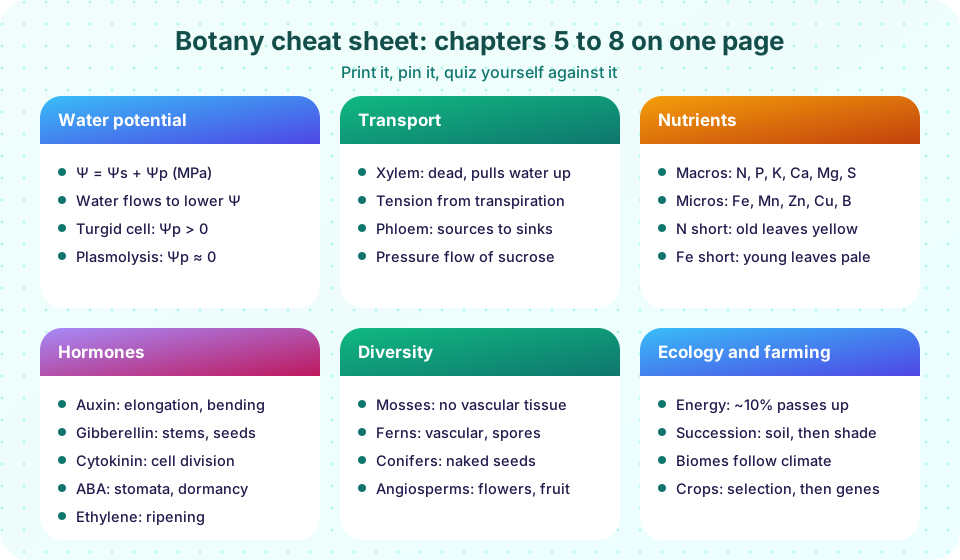
This page is the quick reference for chapters 5 to 8. Print it, pin it above your desk, or use it as a checklist before a test: if you cannot explain a line from memory, follow the link back to the lesson. The summary picture covers the six big areas, the tables give the numbers and formulas worth knowing, and a Python toolkit turns the formulas into functions you can reuse.
What you will learn
- The main formulas and numbers of chapters 5 to 8 in one place.
- How to use code to turn formulas into reusable tools.
- Where to go back for details.
Key terms
Cheat sheet: a short summary of facts and formulas for quick review.
Toolkit: a set of small functions that implement the formulas.
Formulas
| Topic | Formula | Notes |
|---|---|---|
| Water potential | Ψ = Ψs + Ψp |
MPa; water moves toward lower Ψ. See water potential |
| Solute potential | Ψs = −i C R T |
R = 0.008314 L·MPa/(mol·K); i = 1 for sucrose, about 2 for NaCl |
| Air water potential | Ψ = (R T / Vw) ln(RH) |
about −94 MPa at 20 °C, 50% RH |
| Saturation vapor pressure | es = 0.6108 exp(17.27 T / (T + 237.3)) |
kPa, T in °C (Tetens) |
| Vapor pressure deficit | VPD = es (1 − RH) |
The drying power of air |
| Transpiration | E = gs × VPD / P |
P about 101.3 kPa; see transpiration |
| Gravity cost in xylem | 0.0098 MPa per meter | Friction roughly doubles it; see xylem and phloem |
| Poiseuille flow | Q = π r⁴ ΔP / (8 η L) |
Flow scales with r⁴ |
| Capillary volume | V = π r² d |
Used in the potometer project |
| Day length | (24/π) arccos(−tan φ tan δ) |
δ = −23.44° cos(360°(N + 10)/365) |
| Molecular clock | T = d / (2 r) |
See plant evolution |
| Miami model | NPP_T = 3000/(1+exp(1.315−0.119T)), NPP_P = 3000(1−exp(−0.000664P)) |
g/m²/yr; the smaller value applies |
| Growing degree days | max(0, Tmean − Tbase) |
Maize base about 10 °C |
| Plants to grow | n = ln(1 − c) / ln(1 − p) |
At least one desired plant with confidence c |
Facts by topic
| Topic | Remember |
|---|---|
| Transport | Xylem: dead, tension, up. Phloem: living, pressure flow, source to sink (about 0.5 to 1 m/h). |
| Stomata | Open with light and K⁺ uptake; ABA closes them; roughly 95% of leaf water loss is stomatal |
| Nutrients | 17 essential elements; N, P, K, Mg are mobile (old leaves show deficiency); Ca, Fe immobile (young leaves) |
| Hormones | Auxin elongation; GA stems and germination; cytokinin division; ABA stress and dormancy; ethylene ripening |
| Light | Pr (660 nm) to Pfr (730 nm); plants measure uninterrupted night; florigen is FT protein |
| Flowers | Double fertilization: zygote 2n, endosperm 3n; ovule gives seed, ovary gives fruit |
| Plant groups | Bryophytes: no vascular tissue. Ferns: vascular, spores. Gymnosperms: naked seeds. Angiosperms: flowers, fruit |
| Dates | Land plant spores about 470 Ma; vascular about 430; forests about 385; seeds about 365; flowers about 130 |
| Ecology | Biomes follow temperature and rainfall; about 10% energy passes up each trophic level |
| Crops | Domestication syndrome; bread wheat 2n = 42 (hexaploid); Green Revolution semi-dwarfs |
| Biotechnology | Skoog and Miller ratios; T-DNA; PAM = NGG for SpCas9 |
Traps to avoid
Most lost marks in plant science come from a few repeated slips. Water moves toward lower water potential, which means more negative, not toward lower solute concentration. A short-day plant is really a long-night plant, so an interrupted night prevents flowering. Xylem and phloem are not the same pipe: xylem is dead and pulled, while phloem is alive and pushed. A mobile nutrient shows deficiency in old leaves, and an immobile nutrient shows it in young leaves. Pollination is delivery, while fertilization is fusion. Meiosis in plants makes spores, not gametes, and the leafy fern is the sporophyte. When you calculate, write the units, because MPa, kPa and mmol per square meter per second are easy to mix up. Finally, remember that rules such as the 10% energy rule and the day-length formulas are approximations, so say "about" when you quote them.
A formula toolkit in Python
The toolkit below implements the main formulas as functions and runs a demonstration of each. Copy it into your own projects and extend it.
Press Run (or Ctrl + Enter) to see the result here.
Program input · what you'd type while the program runs
Type the answers before you press Run, one per line. Each time the program reads a line (with input()), it gets the next line from this box.
How to use this sheet
- Cover and recall. Cover the right-hand column of a table and try to state the formula or fact from the left-hand label.
- Work an example. Pick one formula and use real numbers, for example the VPD on a hot day at 35 °C and 30% humidity.
- Explain it aloud. If you can explain why water moves toward lower water potential without looking, you have learned it, not memorized it.
- Return to the lesson for any row you could not explain.
Check your understanding
Quick check · 4 questions
of 4 answered You scored / 4 · perfect!
-
1. Which formula gives the solute potential of an ideal solution?
Psi_s = -iCRT: solutes always lower the potential. -
2. Which nutrients show deficiency first in old leaves?
Mobile nutrients are moved to young tissue, so old leaves show deficiency first. -
3. What is the molecular clock formula for the split time of two lineages?
Both lineages accumulate changes, so the distance d grows at 2r. -
4. About how much of the energy at one trophic level reaches the next, on average?
The 10% rule is a rough average.
Summary
- Most of chapters 5 to 8 can be summarized in about a dozen formulas and a few dozen facts.
- Water potential, vapor pressure deficit, Poiseuille flow, day length, the Miami model and the molecular clock are the quantitative tools.
- The toolkit turns the formulas into code you can reuse and extend.
- Use the sheet for active recall, and return to the lessons for any gaps.
Track your progress
Create a free account to tick off lessons and pick up where you left off on any device.
of Botany and Plant Science lessons completed