


















Lesson 17 of 48 · Anatomy and Morphology
Chapter 3 review: anatomy and morphology
Review the four plant organs: root zones and the Casparian strip, stems and tree rings, leaf layers and stomata, flowers, fruits and seeds, with a ten-question quiz.
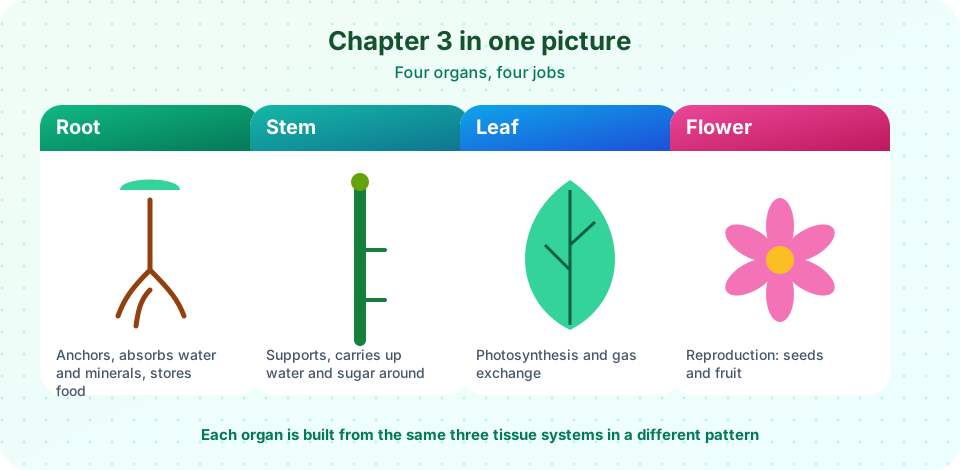
Chapter 3 covered the organs of a flowering plant. The aim now is to connect them. A root absorbs water that rises through the stem's xylem to leaves, where stomata let it escape as vapor while the mesophyll makes sugar that phloem carries to roots, flowers and fruit. Before moving on to what happens inside the leaf in Chapter 4, take stock with a picture, a table and a quiz that mixes all the lessons.
What you will learn
- The key facts of each organ at a glance.
- How the organs work together as a system.
- Which topics need a second pass, based on your quiz result.
Recap table
| Organ | Main jobs | Key structures |
|---|---|---|
| Root | Anchor, absorb, store | Taproot or fibrous; cap, meristem, elongation, maturation (root hairs); epidermis, cortex, endodermis with Casparian strip, stele |
| Stem | Support, transport, bud bearing | Nodes, internodes, terminal and axillary buds; eudicot ring or monocot scattered bundles; vascular cambium and cork cambium; rings |
| Modified stems | Storage, spreading, climbing, defense | Rhizome, stolon, tuber, bulb, corm, tendril, thorn, cladode |
| Leaf | Photosynthesis, gas exchange | Cuticle, epidermis, palisade, spongy mesophyll, veins, stomata with guard cells |
| Flower | Reproduction | Sepals, petals, stamens (anther, filament), carpel (stigma, style, ovary, ovules) |
| Fruit and seed | Protect and spread | Ovary becomes fruit; seed has embryo (radicle, plumule), cotyledons, coat |
How the organs cooperate
Follow a water molecule: it enters a root hair, crosses the cortex, passes through the endodermis and enters the xylem of the stele. It rises through the stem's vessels, enters a leaf vein and moves into the mesophyll. Most of it escapes through a stoma as vapor, but a small share is used in photosynthesis. The sugar made in the mesophyll enters the phloem and travels to wherever it is needed: a growing bud, a root, or a developing fruit. The plant is a single plumbing system, so a problem in one organ shows up in all.
Draw a whole plant from memory with the root cap, an axillary bud, a stoma and a carpel labeled. If you cannot place one of them, reread that lesson.
Exam-style practice prompts
Try to answer each one from memory, then check against the lessons.
- Trace the path. List, in order, every tissue a water molecule crosses from the soil to the xylem of a root, and say which structure forces it through a membrane.
- Identify from a clue. You find a plant with parallel leaf veins, fibrous roots, flower parts in threes and scattered vascular bundles. Which group is it likely to belong to, and which of these clues is least reliable on its own?
- Read a trunk. A cross-section shows 62 rings, with narrow rings near the 40th and 55th ring. What can you say about the tree's age and its history?
- Explain a trade-off. Why do leaves have many tiny stomata instead of a few large pores, and why are most of them on the lower surface?
Spotting which organ, tissue or cell type an observation points to is the core skill of plant anatomy, and it is the skill the next chapter assumes when it asks where photosynthesis happens.
Try it
Press Run (or Ctrl + Enter) to see the console output here.
No output.
Press Run (or Ctrl + Enter) to see the result here.
Program input · what you'd type while the program runs
Type the answers before you press Run, one per line. Each time the program reads a line (with input()), it gets the next line from this box.
Check your understanding
Quick check · 10 questions
of 10 answered You scored / 10 · perfect!
-
1. Which zone of a root tip carries root hairs?
Root hairs form where cells have matured, behind the elongation zone. -
2. The Casparian strip lies in the walls of the...
It is a suberin band in endodermal cell walls. -
3. Which structure produces wood?
The vascular cambium adds secondary xylem inward. -
4. A potato is a modified...
It is a stem tuber with nodes (eyes). -
5. Which layer of a leaf contains most chloroplasts per cell?
Palisade cells are tall and packed with chloroplasts. -
6. Guard cells open a stoma by...
Water follows the ions in, the cells bow apart and the pore opens. -
7. Parallel veins, scattered bundles and fibrous roots point to a...
These are typical monocot features. -
8. Which part of a flower contains ovules?
Ovules develop inside the ovary at the base of the carpel. -
9. Botanically, a cucumber is a...
It develops from the ovary and contains seeds. -
10. Why do leaves have air spaces in the spongy mesophyll?
Gases diffuse far faster through air than through water.
Summary
- Roots, stems, leaves and flowers are organs built from the same three tissue systems.
- Roots absorb near the tip; the Casparian strip makes water cross membranes.
- Stems carry buds, support leaves and may be modified for storage; cambia thicken woody stems.
- Leaves balance carbon dioxide gain against water loss with stomata, cuticle and air spaces.
- Flowers make seeds; the ovary becomes the fruit, and the seed packages an embryo with food.
Next: Chapter 4 overview: photosynthesis and plant metabolism
Track your progress
Create a free account to tick off lessons and pick up where you left off on any device.
of Botany and Plant Science lessons completed