


















Lesson 37 of 48 · Plant Diversity and Evolution
Seed plants: gymnosperms and flowering plants
Compare gymnosperms and angiosperms: cones and flowers, pollen and ovules, seeds and fruit, why flowering plants dominate, and how to tell monocots from eudicots.
Almost everything you eat from the ground, and nearly every tree you can name, belongs to the seed plants. They fall into two big groups: the gymnosperms, such as pines, spruces and cycads, whose seeds sit bare on the scales of a cone, and the angiosperms, the flowering plants, whose seeds are sealed inside an ovary that grows into a fruit. Seeds and pollen freed plants from the need for a film of water to reproduce and allowed them to colonize the dry interiors of continents. This lesson explains what a seed is, how the two groups differ, why one of them became overwhelmingly dominant, and how to sort the flowering plants into their two big families.
What you will learn
- What a seed is and how seed plants differ from seedless ones.
- The four groups of gymnosperms and the life cycle of a pine.
- Why angiosperms are so successful.
- How to tell monocots from eudicots by seven traits.
Key terms
Seed: a protected embryo with a food supply, enclosed in a seed coat.
Ovule: the structure in which the female gametophyte develops; it becomes the seed after fertilization.
Pollen grain: a tiny male gametophyte that carries sperm without needing water.
Cotyledon: a seed leaf of the embryo; monocots have one, eudicots two.
Heterospory: producing two kinds of spores, small male and large female.
The seed plant innovations
Seed plants share a set of inventions that built on heterospory:
- Reduced gametophytes. The female gametophyte is only a few cells and is kept inside the ovule on the parent sporophyte. The male gametophyte is a pollen grain.
- Ovules and seeds. An ovule is a megasporangium wrapped in one or two layers (integuments). After fertilization the ovule becomes a seed, with the embryo, a food reserve and a seed coat that survives drought and cold for months or years.
- Pollen. Pollen is carried by wind or animals to the ovule, and the sperm travel the last stretch inside a pollen tube or, in some groups, by swimming a short distance inside the ovule. Fertilization no longer requires a free film of water.
Seeds are not just a way to reproduce. They are a way to wait: a seed can pause its life until conditions improve, and it can be carried far from its parent.
Gymnosperms: seeds on scales
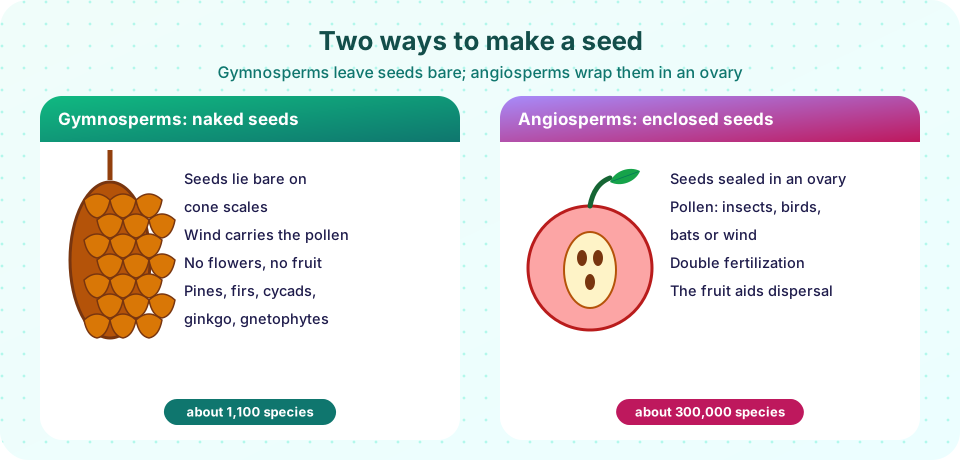
"Gymnosperm" means "naked seed". Their ovules sit exposed on cone scales, not enclosed inside an ovary. There are about 1,000 to 1,100 living species in four groups:
- Conifers (about 600 species): pines, firs, spruces, cedars, junipers and redwoods. Most are evergreen trees with needle- or scale-like leaves, resin canals and wood made of tracheids only.
- Cycads (about 300 species): palm-like plants of tropical and subtropical regions with large cones. Some have swimming sperm.
- Ginkgo (one living species, Ginkgo biloba): a fan-leaved tree that is a living fossil, with relatives in the fossil record from the Mesozoic.
- Gnetophytes (about 100 species): the odd trio of Ephedra, Gnetum and Welwitschia, the last a desert plant with just two straps of leaf that grow for centuries.
Gymnosperms include the tallest trees (coast redwood, over 115 meters), the most massive (giant sequoia) and some of the oldest non-clonal individuals (bristlecone pines, nearly 5,000 years).
The pine life cycle
A pine tree is a diploid sporophyte with two kinds of cones.
- Small pollen cones carry microsporangia. Cells undergo meiosis and make microspores, which become pollen grains with two small air sacs for wind dispersal. A pollen grain is a four-celled male gametophyte.
- Larger seed cones carry two ovules on each scale. Inside an ovule, a megaspore mother cell makes a megaspore by meiosis, which grows into a female gametophyte with egg cells. This tissue, still haploid, will become the seed's food supply.
- Wind carries pollen to the ovule, where it enters a small opening, the micropyle. The pollen tube grows very slowly: fertilization can happen more than a year after pollination. The seed cone typically takes about two years in total to mature, and each cone scale then releases winged seeds.
Notice one difference from flowering plants: the seed's food in a pine is haploid female gametophyte tissue, not triploid endosperm.
Angiosperms: flowers and fruits
"Angiosperm" means "enclosed seed". Their ovules sit inside the ovary of a carpel, which becomes a fruit. In addition to flowers and fruit, flowering plants have several other innovations:
- Double fertilization and triploid endosperm, which saves resources by feeding only fertilized ovules (see flowers, pollination and seeds).
- Vessel elements in the xylem of most species, giving fast water transport.
- Very short life cycles in many herbs. Some annual weeds go from seed to seed in weeks, while a pine needs years.
- Precise partnerships with animal pollinators and seed dispersers, which let rare plants exchange pollen across long distances.
Charles Darwin called the sudden appearance and rapid diversification of flowering plants in the Cretaceous fossil record an "abominable mystery" in a letter of 1879. Today, fossil evidence of pollen from around 134 million years ago, flower fossils of about 125 million years ago, and molecular family trees tell a story of an early origin and a very fast radiation, though the details are still debated.
The three main groups of flowering plants
- Early-diverging lineages (the ANA grade): Amborella trichopoda, a shrub that exists only in New Caledonia, the water lilies and their relatives, and Austrobaileyales (star anise). These retain features thought to be ancestral.
- Magnoliids (about 10,000 species): magnolias, laurels, black pepper, avocado.
- Monocots (roughly 60,000 to 70,000 species) and eudicots (about three quarters of all angiosperms), along with a few smaller groups. Most of the flowering plants you know fit into these two.
Monocots versus eudicots
| Trait | Monocots | Eudicots |
|---|---|---|
| Cotyledons | One | Two |
| Leaf veins | Parallel | Net-like (branching) |
| Stem vascular bundles | Scattered | In a ring |
| Roots | Fibrous | Often a taproot |
| Flower parts | In threes | In fours or fives |
| Pollen | One pore | Three pores |
| Secondary growth (wood) | Usually absent | Often present |
| Examples | Grasses, lilies, orchids, palms, onions | Roses, beans, oaks, sunflowers, tomatoes |
These traits are tendencies, not rules. Some monocots break one or two, and some eudicots have parallel veins. A good identification uses several traits at once.
Monocots include the grasses, which supply most of the world's calories (wheat, rice, maize), as well as orchids (about 28,000 species, one of the largest plant families) and the tiny duckweed Wolffia, the smallest flowering plants. Eudicots include most trees of temperate forests, most vegetables and most wildflowers.
Why flowering plants took over
No single trait explains it. Flowers made pollination more efficient, so pollen reached the right plant with less waste. Fruit made seed dispersal efficient. Vessels, and in many cases leaves that fall and regrow, allowed fast growth when conditions were good. Short life cycles let annual plants evolve quickly and colonize disturbed ground. Whole-genome duplications gave raw material for new traits. Gymnosperms are far from defeated: conifers dominate cold boreal forests, the largest forest biome, and many remain abundant in dry or nutrient-poor soils.
Common misconceptions
"Gymnosperms are always trees with cones, and flowering plants are never trees." Many flowering plants are trees (oak, maple, eucalyptus), and some gymnosperms are shrubs or palm-like plants.
"Fruits are what make a plant an angiosperm, so nuts and grains are not fruit." Nuts and grains are dry fruits; any ovary that matures around the seeds is a fruit.
"A pine cone is the pine's flower." Cones are reproductive structures, but a flower has an ovary, petals or sepals and a carpel, which cones do not.
Try it
First, a bar chart of how many species each plant group contains. The values are rounded estimates, and the scale is logarithmic because the numbers span three orders of magnitude.
Press Run (or Ctrl + Enter) to see the result here.
Program input · what you'd type while the program runs
Type the answers before you press Run, one per line. Each time the program reads a line (with input()), it gets the next line from this box.
Second, a dichotomous key written as code. It sorts a plant into a group from yes/no traits, then splits flowering plants into monocots and eudicots by majority vote. Try changing a plant's traits.
Press Run (or Ctrl + Enter) to see the result here.
Program input · what you'd type while the program runs
Type the answers before you press Run, one per line. Each time the program reads a line (with input()), it gets the next line from this box.
Check your understanding
Quick check · 6 questions
of 6 answered You scored / 6 · perfect!
-
1. What does the word gymnosperm mean?
Gymnosperm means naked seed: the ovules sit exposed on cone scales rather than in an ovary. -
2. In a pine seed, the stored food is
Triploid endosperm is a flowering-plant feature; in conifers the food comes from the haploid female gametophyte. -
3. Which set of traits describes a typical monocot?
Monocots have one cotyledon, parallel veins, scattered bundles, fibrous roots and flower parts in threes. -
4. Which innovation is unique to angiosperms?
Pollen and seeds are shared with gymnosperms, and vascular tissue is shared with ferns; double fertilization and fruit are unique to flowering plants. -
5. How long can the gap between pollination and fertilization be in a pine?
The pollen tube grows very slowly, and fertilization can occur more than a year after pollination. -
6. Roughly how many gymnosperm species are alive today?
Around a thousand species: conifers, cycads, Ginkgo and gnetophytes.
Summary
- Seed plants evolved reduced gametophytes, ovules, pollen and seeds; fertilization no longer needs a film of water.
- Gymnosperms (about 1,000 to 1,100 species: conifers, cycads, Ginkgo, gnetophytes) bear naked seeds on cone scales and use haploid female gametophyte tissue as seed food.
- Angiosperms (about 300,000 species) have flowers, double fertilization, endosperm and fruit.
- Monocots and eudicots differ in cotyledons, leaf veins, vascular bundles, roots, flower parts and pollen.
- Flowering plants dominate most land habitats, while conifers rule the cold boreal forest.
Track your progress
Create a free account to tick off lessons and pick up where you left off on any device.
of Botany and Plant Science lessons completed