


















Lesson 2 of 48 · Getting Started
What is a plant?
Learn what makes a plant a plant: cell walls, chlorophyll, embryos and life cycles, how plants differ from algae and fungi, and where they came from.
Ask ten people what a plant is and you will hear ten different answers: "something green", "something that grows in soil", "not an animal". Each answer is partly right and partly wrong. Seaweed is green and grows in water, but most of it is not a plant. A mushroom grows in soil, but it is not a plant either. A scientist needs a definition that sorts living things reliably, so this lesson builds one from observable traits and from family history.
What you will learn
- The traits that together define a plant.
- How plants differ from green algae and fungi.
- What "alternation of generations" means in one sentence.
- How and roughly when plants colonized land.
- Why plants matter to the rest of life on Earth.
Key terms
- Autotroph: an organism that makes its own food from simple inorganic substances. Plants are photoautotrophs because the energy comes from light.
- Cellulose: a long-chain sugar polymer that forms strong fibers in plant cell walls.
- Chlorophyll: the green pigment that absorbs light for photosynthesis. Plants use chlorophyll a and chlorophyll b.
- Embryophyte: a plant whose young embryo develops inside, and is nourished by, the parent plant.
- Alternation of generations: a life cycle with two multicellular stages, one making spores and one making gametes.
The defining traits
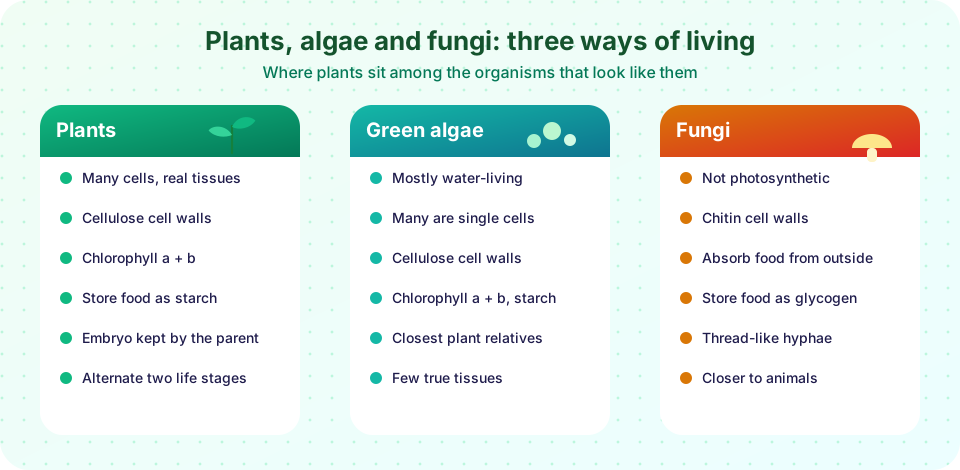
Botanists define a plant (kingdom Plantae in the usual modern sense) as an organism with these traits together.
- It is a eukaryote made of many cells. The cells have a nucleus and organelles, and they cooperate in tissues. A single-celled green alga is therefore not a plant.
- Its cells have walls made largely of cellulose. The wall is outside the cell membrane and gives the cell a fixed shape. Animal cells have no wall; fungal walls are made of chitin, the same tough material as insect shells.
- It carries out photosynthesis in chloroplasts, using chlorophyll a and b plus yellow and orange carotenoids. Photosynthesis is the process that turns carbon dioxide and water into sugar and oxygen, and you will study it in Chapter 4.
- It stores spare food as starch inside plastids (the family of organelles that includes chloroplasts). Fungi and animals store glycogen instead.
- Its embryo is protected and fed by the parent. This is why plants are called embryophytes. A seed is an embryo plus a food supply and a coat. Even in mosses, which have no seeds, the young sporophyte starts life attached to the parent.
- Its life cycle alternates between two multicellular generations. One generation, the gametophyte, makes eggs and sperm. The other, the sporophyte, makes spores. In a moss the gametophyte is the green carpet you see; in an oak, the tree is the sporophyte and the gametophyte is microscopic.
No single trait is enough. Some algae have chlorophyll b and cellulose walls. A few plants have lost chlorophyll. Together, though, the traits describe a coherent group with a common ancestor.
Plants, algae and fungi
Look at the illustration again. The green algae are the closest living relatives of plants: they share the same pigments, the same food storage and cellulose walls. Many are single cells or simple filaments living in water. The group of green algae called charophytes is thought to include the nearest relatives of the land plants.
Fungi are not close at all. They cannot photosynthesize. They grow as fine threads called hyphae and digest food outside their bodies, then absorb the results. Genetic evidence places fungi on the same branch of the tree of life as animals, not plants. They only seem plant-like because they stay in one place.
Seaweeds are a good example of why definitions matter. Green seaweeds such as sea lettuce are algae. Brown seaweeds such as kelp belong to a completely different branch, the stramenopiles, which also includes diatoms. Red seaweeds are another independent group. Calling all of them "plants" in everyday speech is fine, but scientifically they are not.
Plants are not all green and not all self-feeding
Every rule has exceptions. Dodder is a parasitic plant that coils around other plants and steals sap. The Indian pipe (Monotropa uniflora) is white and lacks chlorophyll; it feeds on fungi that are themselves attached to tree roots. Pitcher plants and Venus flytraps photosynthesize but also digest insects to obtain nitrogen that poor soil lacks. These plants are still classified as plants because their cells, walls, embryos and ancestry match the rest of the group.
Where plants came from
The fossil record and DNA agree on the outline. Plants evolved from freshwater green algae. The first land plants appeared roughly 470 million years ago, judging from fossil spores, and the first plants with true vascular tissue (a plumbing system for water, studied in Chapter 5) appeared several tens of millions of years later. Moving onto land solved a problem and created several.
The advantage was sunlight and carbon dioxide without water filtering them. The challenges were drying out, standing upright without water to hold you up, absorbing water and minerals from soil, and spreading sperm without a water current. Evolution answered with a waxy cuticle, strengthened cell walls, roots, vascular tissue, and later pollen and seeds. Chapter 7 tells that story in order.
Why plants matter
- Food. Directly or indirectly, almost every food chain on land starts with plants.
- Oxygen. Photosynthesis in plants and algae produces the oxygen in the air. Land plants and algae share the work.
- Climate. Plants remove carbon dioxide from the air and store carbon in wood and soil.
- Materials and medicine. Timber, cotton, paper, rubber and a long list of drugs come from plants.
- Biomass. Estimates of the carbon in living things suggest that plants make up roughly four-fifths of life on Earth by mass, far more than animals.
Common misconceptions
- "Plants eat soil." The Belgian physician Jan Baptist van Helmont tested this in the early 1600s. He weighed a pot of soil and a small willow tree, watered the tree for five years, and found the tree had grown by about 164 pounds (from roughly 5 to 169 pounds) while the soil had lost only a couple of ounces. He concluded the tree was made of water. The full answer is that most of a plant's dry mass comes from carbon dioxide in the air, and water supplies the hydrogen and oxygen. Soil supplies minerals, which are a tiny share of the mass.
- "Plants only respire at night." Plant cells respire all the time, day and night, to release energy from sugar. During the day photosynthesis is faster than respiration, so the plant releases net oxygen.
- "Anything green and living in water is a plant." Many are algae, and cyanobacteria (blue-green "algae") are bacteria. They contributed chloroplast ancestry, but they are not plants.
Try it
Press Run (or Ctrl + Enter) to see the result here.
Program input · what you'd type while the program runs
Type the answers before you press Run, one per line. Each time the program reads a line (with input()), it gets the next line from this box.
Check your understanding
Quick check · 5 questions
of 5 answered You scored / 5 · perfect!
-
1. Which trait is found in plants but NOT in fungi?
Fungi have walls (of chitin), eukaryotic cells and spores, but they cannot photosynthesize. -
2. What does the word embryophyte emphasize?
Embryophytes keep the young embryo attached to the parent, a feature absent in green algae. -
3. Van Helmont's willow grew by about 164 pounds while the soil lost only a few ounces. What does this show?
The mass came mostly from water and, as later work showed, from carbon dioxide in the air. -
4. Dodder has little chlorophyll and steals sap. Is it still a plant?
Classification rests on the whole set of traits and shared ancestry, not on one trait. -
5. Kelp is brown. Why is it not usually called a plant by scientists?
Brown algae evolved their large bodies independently, in a different branch of life.
Summary
- A plant is a multicellular eukaryote with cellulose walls, chlorophyll a and b, starch storage and a protected embryo, with a life cycle that alternates two generations.
- Green algae are the closest relatives of plants; fungi are far more closely related to animals.
- A few plants are parasitic, white or insect-eating, but they share the other traits and the ancestry.
- Land plants descend from freshwater green algae and appeared roughly 470 million years ago.
- Most of a plant's dry mass comes from carbon dioxide in the air, not from soil.
Next: How botanists work
Track your progress
Create a free account to tick off lessons and pick up where you left off on any device.
of Botany and Plant Science lessons completed