


















Lesson 8 of 48 · Plant Cells and Tissues
Cell walls, vacuoles and osmosis
Understand cellulose cell walls, the central vacuole, water potential and osmosis, and why plant cells become turgid, flaccid or plasmolyzed.
Leave a lettuce leaf in cold water and it turns crisp. Leave the same leaf in a bowl of salty water and it goes limp. Nothing was added or removed from the leaf except water, yet its strength changed completely. The reason lies in two features of the plant cell: a strong wall and a vacuole that fills with water. In this lesson you will learn how the wall is built, how water moves in and out by osmosis, and how to predict which way water will flow by using a number called water potential.
What you will learn
- How a plant cell wall is built from cellulose, hemicellulose, pectin and lignin.
- What osmosis is and how water potential predicts it.
- The terms turgid, flaccid, plasmolyzed and wilting.
- How to calculate water potential from solute and pressure potentials.
- Why turgor matters for growth and support.
Key terms
- Osmosis: the net movement of water across a selectively permeable membrane, from higher to lower water potential.
- Water potential (Ψ): the potential energy of water per unit volume, measured in megapascals (MPa). Pure water at atmospheric pressure is defined as 0.
- Solute potential (Ψs): the effect of dissolved solutes; always zero or negative.
- Pressure potential (Ψp): pressure on the water; turgor pressure is positive.
- Turgor pressure: the outward pressure of the cell contents against the wall.
The cell wall
A cell wall is built like reinforced concrete. Long cellulose molecules, chains of glucose joined by β-1,4 links, bundle together into microfibrils that are stronger than steel on a weight basis. These are the steel rods. A gel of hemicellulose and pectin around them is the concrete. In growing cells this thin, flexible layer is the primary wall.
- Middle lamella. A pectin-rich layer between two neighboring cells that glues them together. Cooking fruit dissolves pectin, and jam sets because pectin forms a gel.
- Primary wall. Laid down while the cell is growing. Elastic enough to stretch.
- Secondary wall. Laid down inside the primary wall after growth stops in some cells, such as wood fibers and water-conducting vessels. It is thick, rigid and often impregnated with lignin, a complex polymer that makes wood hard and waterproof.
Cellulose is made by enzyme complexes in the plasma membrane that spin out the chains and follow microtubules inside the cell. This is how the cell controls its shape: if microfibrils are wrapped around the cell like hoops on a barrel, the cell can only grow longer, not fatter. Cellulose is the most abundant organic polymer on Earth, and it is the main component of cotton, paper and wood.
Osmosis and water potential
Water molecules move by random thermal motion, and their net movement through a membrane depends on how much "free" water is on either side. Osmosis is the net movement of water across a selectively permeable membrane from the region of higher water potential to lower. Botanists measure this tendency with water potential, written Ψ (psi):
Ψ = Ψs + Ψp
- Ψs, solute potential, is negative. The more dissolved particles, the more negative it becomes. For a dilute ideal solution,
Ψs = −i × C × R × T, whereiis the number of particles per formula unit (1 for sugar, about 2 for table salt),Cis the concentration in mol/L,R = 0.00831 L·MPa/(mol·K)andTis the temperature in kelvin. - Ψp, pressure potential, is positive when the cell is pushed outward by turgor and zero in an open beaker.
Water always flows toward the more negative Ψ.
Worked example
A cell has Ψs = −0.80 MPa and Ψp = +0.50 MPa. Its water potential is Ψ = −0.80 + 0.50 = −0.30 MPa. The cell is placed in a sugar solution with Ψ = −0.60 MPa (open beaker, so Ψp = 0). Which way does water move?
The solution (−0.60) is more negative than the cell (−0.30), so water leaves the cell. As water leaves, the vacuole shrinks and Ψp falls. If the solution were weaker, say −0.10 MPa, water would enter the cell until the cell's Ψ also reached −0.10 MPa, which happens when Ψp rises to +0.70 MPa. The wall stops water from entering forever: pressure builds until the potentials are equal.
The three states of a plant cell
| Surroundings | Net water | Cell state | Appearance |
|---|---|---|---|
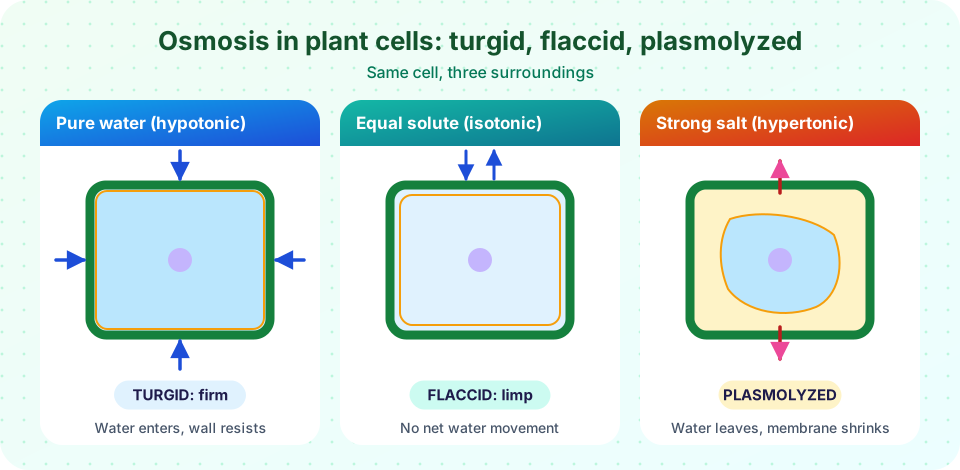
| Pure water or very dilute (hypotonic) | In | Turgid | Firm; membrane pressed against the wall; Ψp high |
| Same water potential (isotonic) | None | Flaccid | Limp; Ψp about zero |
| Stronger solution (hypertonic) | Out | Plasmolyzed | Membrane pulls away from the wall |
An animal cell in pure water swells and may burst, because it has no wall. A plant cell cannot burst: the wall balances the turgor pressure, so the cell simply becomes firm. In fact, turgor is useful. A typical turgor pressure is 0.3 to 1 MPa, similar to the air pressure in a bicycle tire, so a non-woody stem is held up by hydraulic pressure.
Wilting is what you see when many cells lose turgor at the same time: the leaves droop because their cells are flaccid. It is usually reversible when water returns. Plasmolysis is more severe; it can damage cells, and a plant that stays plasmolyzed for long may die. Road salt, over-fertilizing and a flood of seawater can cause it.
Why turgor matters
- Support. Herbs, leaves and young shoots stand up because of turgor, not a skeleton.
- Growth. A growing cell loosens its wall, and turgor pushes the wall outward as water pours into the vacuole. This is how a cell can double in size in hours (hormones in Chapter 6 control the wall loosening).
- Movement. Guard cells open and close stomata (the leaf pores) by gaining or losing turgor. A Venus flytrap and a mimosa leaf use sudden water movements to snap or fold.
Common misconceptions
- "The wall controls what moves in and out." The wall lets water and dissolved substances pass easily. The membrane does the controlling; the wall limits swelling.
- "Osmosis is movement of solute." Osmosis is the net movement of water. The solute stays on its own side of a selectively permeable membrane.
- "Water moves from low to high concentration of water." It moves from higher to lower water potential. A more concentrated solution has more negative Ψ, and the water is pulled toward it.
- "Wilted plants are dead." Most wilting is a reversible loss of turgor.
Try it
Press Run (or Ctrl + Enter) to see the result here.
Program input · what you'd type while the program runs
Type the answers before you press Run, one per line. Each time the program reads a line (with input()), it gets the next line from this box.
Press Run (or Ctrl + Enter) to see the console output here.
No output.
Check your understanding
Quick check · 5 questions
of 5 answered You scored / 5 · perfect!
-
1. Which polymer forms the strong microfibrils in plant cell walls?
Cellulose chains of β-1,4-linked glucose bundle into microfibrils. -
2. A cell has Ψs = −0.9 MPa and Ψp = +0.4 MPa. Its water potential is...
Ψ = Ψs + Ψp = −0.9 + 0.4 = −0.5 MPa. -
3. A plant cell is placed in a solution with a much more negative water potential. The cell becomes...
Water leaves, the vacuole shrinks and the membrane pulls away from the wall. -
4. Why can a plant cell not burst in pure water?
The wall's inward pressure balances turgor, and water uptake stops when the potentials are equal. -
5. Which wall layer gives wood fibers their hardness because of lignin?
Lignified secondary walls make wood fibers and vessels rigid and waterproof.
Summary
- Walls are built from cellulose microfibrils in a pectin and hemicellulose gel; secondary walls add lignin.
- Osmosis is the net movement of water down a water potential gradient; Ψ = Ψs + Ψp, and water flows toward the more negative value.
- A turgid cell is firm, a flaccid one is limp and a plasmolyzed one has lost water so far that the membrane has left the wall.
- Turgor supports soft tissue, drives cell growth and moves guard cells.
- Salty soil, road salt and drought all cause cells to lose water.
Next: Cell division in plants
Track your progress
Create a free account to tick off lessons and pick up where you left off on any device.
of Botany and Plant Science lessons completed