


















Lesson 14 of 48 · Anatomy and Morphology
Stems: support, transport and tree rings
Explore plant stems: nodes, buds and internodes, monocot and eudicot cross-sections, modified stems like tubers and rhizomes, and how wood and tree rings form.
A stem does three things: it holds leaves up to the light, it connects roots with leaves through the vascular tissue, and it carries the buds from which the plant grows. Stems vary from the green thread of a clover to the trunk of a giant sequoia, which can exceed 80 meters in height. Despite the variety, every stem follows the same plan, and understanding the plan lets you read a twig in winter or a tree trunk like a book.
What you will learn
- The parts of a stem: nodes, internodes, terminal and axillary buds.
- How bundle arrangement differs in monocots and eudicots.
- How secondary growth makes wood and bark.
- How to read a tree ring series.
- What modified stems such as tubers, rhizomes and bulbs are.
Key terms
- Node: the point on a stem where a leaf (and its axillary bud) is attached.
- Internode: the stem between two nodes.
- Axillary bud: a bud in the angle between a leaf and the stem; it can grow into a branch.
- Vascular cambium: a thin cylinder of dividing cells between xylem and phloem in woody stems.
- Secondary growth: growth in thickness by the lateral meristems.
The outside of a stem
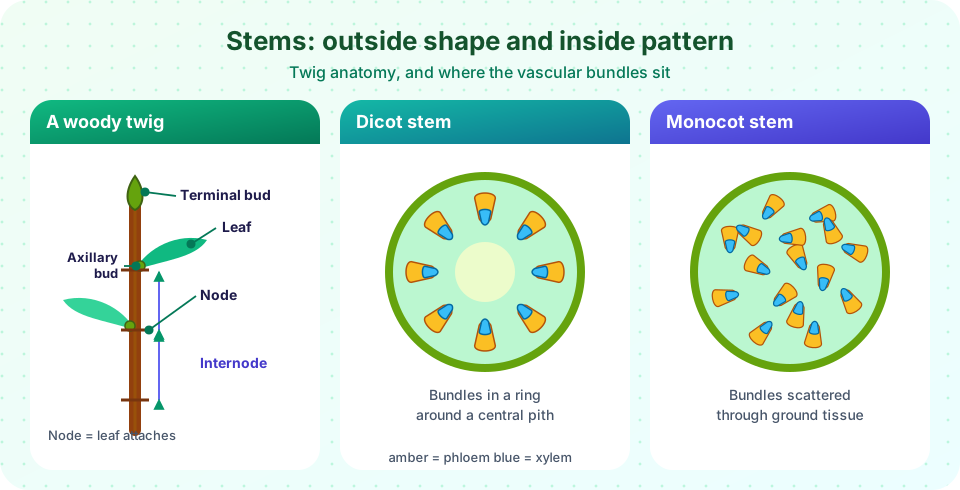
Look at a twig. The stem has swellings called nodes, and where a leaf attaches it makes an angle called the axil. The stretch between nodes is an internode. In the axil of each leaf sits an axillary bud, a tiny package of meristem and unopened leaves. At the stem's tip is the terminal bud, which produces the continued extension of the shoot.
A growing terminal bud suppresses the axillary buds below it with the hormone auxin, a pattern called apical dominance. Cut the tip off a shrub and the axillary buds wake up, which is why pruning makes a plant bushier. Chapter 6 covers the hormones in more detail.
In deciduous trees, the winter twig shows scars where leaves fell, and bud scale scars where each year's terminal bud was. The distance between two sets of scars is one year's growth, so you can read the growth history of a branch.
Inside a young stem
The cross-section of a young stem has the same three tissue systems as every other organ.
- Eudicot stem. The vascular bundles lie in a ring. Inside the ring is the pith, a store of parenchyma; outside lies the cortex, then the epidermis. Each bundle has xylem toward the pith and phloem toward the outside, with a strip of cambium between them in eudicots, which makes wood possible.
- Monocot stem. The bundles are scattered through the ground tissue, and there is no distinct ring or cortex. Each bundle is surrounded by a sheath of fibers. Monocots usually lack a vascular cambium, so grasses, bamboo and most palms do not thicken the way oaks do. A palm gets its wide trunk by early growth, then keeps that width.
Secondary growth: making wood and bark
Stems of many eudicots and conifers get thicker every year. Two lateral meristems are responsible.
- Vascular cambium. A thin cylinder of dividing cells. It adds secondary xylem toward the inside (this is wood) and secondary phloem toward the outside. Far more xylem than phloem is made, which is why the trunk is mostly wood.
- Cork cambium. Lies near the surface and produces cork cells whose walls are waterproofed with suberin. Cork plus the dead phloem outside the cambium make up the bark.
In temperate climates, growth is seasonal. In spring, when water is plentiful, the cambium makes wide, thin-walled vessels (early wood, pale). In late summer it makes narrow, thick-walled cells (late wood, dark). The sharp edge between this year's dark late wood and next spring's pale early wood is one annual ring.
Counting rings gives the tree's age at the height of the cut. Ring widths record the weather: wide rings indicate good growth years; narrow ones indicate drought or cold. Dendrochronology, the science of dating by tree rings, uses matching ring patterns to date wooden beams in old buildings and to reconstruct past climates over thousands of years.
As the tree grows, the inner xylem stops conducting water, fills with resins and tannins and becomes heartwood, dark and strong. The outer, light rings of working xylem are the sapwood.
Tropical trees often have no clear rings because they grow all year, though some produce rings in response to wet and dry seasons.
Modified stems
Many plants adapt stems to special jobs. A stem is recognized by nodes and buds, even when it looks like something else.
| Modified stem | What it does | Examples |
|---|---|---|
| Rhizome | Underground horizontal stem; stores food and spreads | Ginger, iris, bamboo, many grasses |
| Stolon (runner) | Horizontal stem above ground; makes new plants at nodes | Strawberry, spider plant |
| Tuber | Swollen tip of an underground stem; stores starch | Potato (the "eyes" are nodes with buds) |
| Bulb | Very short stem with thick, fleshy leaves | Onion, tulip, garlic |
| Corm | Short, swollen underground stem | Crocus, gladiolus |
| Tendril | Thin stem for climbing | Grape, passion flower |
| Thorn | Hard, pointed stem | Hawthorn, citrus |
| Cladode | Flat green stem that photosynthesizes | Prickly pear cactus pads |
Sharp points are not all the same thing. A thorn is a modified stem, a spine is a modified leaf (cactus), and a prickle (rose) is an outgrowth of the epidermis that you can rub off.
Common misconceptions
- "A tree grows by adding wood at the top of the trunk." New height comes from the terminal buds. A nail hammered into a trunk stays at the same height for the tree's life; the tree grows around it.
- "Bark is the tree's skin and is all dead." Part is dead cork, but the inner bark includes living phloem that carries sugar.
- "A tree ring is a year of age in every climate." In regions without a strong seasonal pause, rings may be absent or several can form in one year.
- "A bulb is a root." An onion bulb is a very short stem with swollen leaves.
Try it
Press Run (or Ctrl + Enter) to see the result here.
Program input · what you'd type while the program runs
Type the answers before you press Run, one per line. Each time the program reads a line (with input()), it gets the next line from this box.
Press Run (or Ctrl + Enter) to see the console output here.
No output.
Check your understanding
Quick check · 5 questions
of 5 answered You scored / 5 · perfect!
-
1. The point on a stem where a leaf attaches is the...
A node bears a leaf and an axillary bud. -
2. Which cells make wood?
The vascular cambium adds secondary xylem inward, which is wood. -
3. A potato is a...
Its eyes are nodes with buds. -
4. Dark late wood forms in...
Cells made late in the season are narrow and thick-walled, so they look dark. -
5. Pruning the tip of a shrub makes it bushier because...
Without auxin from the terminal bud, axillary buds can grow.
Summary
- A stem has nodes, internodes, a terminal bud and axillary buds; apical dominance suppresses side buds.
- Eudicot stems have bundles in a ring and can thicken; monocot stems have scattered bundles and usually cannot.
- The vascular cambium makes wood inward and phloem outward; cork cambium makes bark.
- Early wood and late wood form annual rings that record age and climate.
- Rhizomes, stolons, tubers, bulbs, corms, tendrils, thorns and cladodes are modified stems.
Next: Leaves
Track your progress
Create a free account to tick off lessons and pick up where you left off on any device.
of Botany and Plant Science lessons completed