


















Lesson 6 of 48 · Plant Cells and Tissues
Chapter 2 overview: plant cells and tissues
Preview Chapter 2: the plant cell and its organelles, cell walls and osmosis, how cells divide, and the tissues that cells build together.
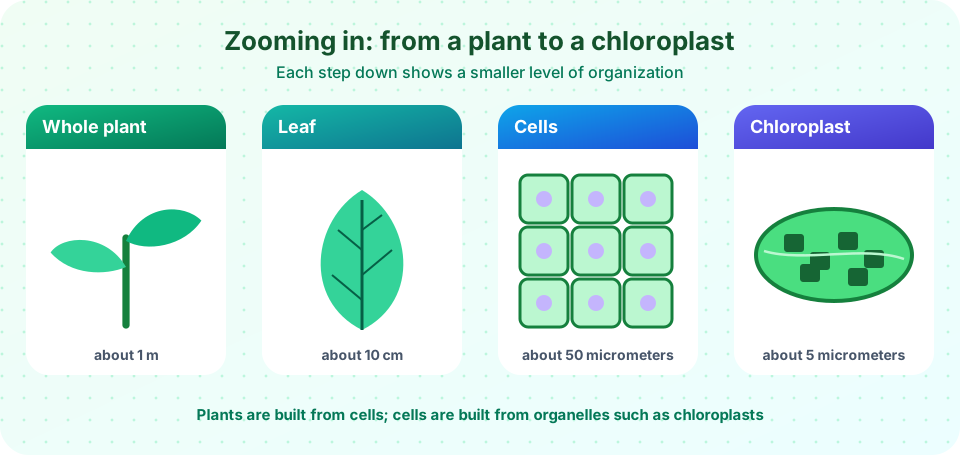
Every plant, from a moss the size of your thumbnail to a redwood taller than a 30-story building, is built from cells. A cell is the smallest unit that can carry out all the functions of life on its own, and a plant is an organized community of billions of them. This chapter opens the plant cell, explains what sets it apart from the cells of animals, and then climbs one level up to the tissues that cells form together.
What you will learn
- How this chapter builds from the single cell to tissues.
- The names and rough sizes of the structures you will meet.
- Why cell theory is the foundation of all biology.
Key terms
- Cell: the basic unit of life, bounded by a membrane.
- Organelle: a specialized structure inside a cell, such as a nucleus or a chloroplast.
- Tissue: a group of cells of similar structure that perform one function.
- Organ: a structure made of several tissues, such as a leaf or a root.
- Cell theory: all organisms are made of cells, and all cells come from existing cells.
A short history of the cell
In 1665 the English scientist Robert Hooke looked at a thin slice of cork under a simple microscope and saw rows of tiny boxes. He called them "cells" because they reminded him of the small rooms in a monastery. What he saw were the empty cell walls of dead plant cells, so the first cells ever named were plant cells. In the 1830s the botanist Matthias Schleiden and the zoologist Theodor Schwann proposed that all plants and animals are made of cells, and in 1855 Rudolf Virchow added the final piece: new cells arise only by division of existing ones. Together these ideas make up cell theory.
The chapter in three steps
Step 1: The cell
Step 2: Water and division
Step 3: Tissues
- The plant cell tours every organelle and shows how a plant cell differs from an animal cell.
- Cell walls, vacuoles and osmosis explains the wall, the central vacuole and why plants wilt.
- Cell division in plants follows mitosis and the cell plate.
- Plant tissues shows how cells combine into meristems, dermal, ground and vascular tissues.
- Chapter 2 review gives you a one-page picture and a ten-question quiz.
Sizes worth remembering
| Structure | Typical size |
|---|---|
| Plant cell | 10 to 100 micrometers (0.01 to 0.1 mm) |
| Nucleus | 5 to 10 micrometers |
| Chloroplast | 4 to 10 micrometers long |
| Mitochondrion | 1 to 2 micrometers long |
| Cell wall (primary) | well under 1 micrometer thick |
| Plasma membrane | about 7 to 10 nanometers thick |
A micrometer (µm) is one thousandth of a millimeter. A nanometer (nm) is one thousandth of a micrometer. The figures above are typical ranges; real cells vary widely.
Try it
Press Run (or Ctrl + Enter) to see the result here.
Program input · what you'd type while the program runs
Type the answers before you press Run, one per line. Each time the program reads a line (with input()), it gets the next line from this box.
Press Run (or Ctrl + Enter) to see the console output here.
No output.
Check your understanding
Quick check · 4 questions
of 4 answered You scored / 4 · perfect!
-
1. What did Robert Hooke actually see in cork in 1665?
Cork is dead tissue, so only the cell walls remained. -
2. Cell theory says that new cells come from...
Virchow's addition: omnis cellula e cellula, every cell from a cell. -
3. A typical plant cell is about...
Most are visible only with a microscope. -
4. Which is the correct order from smallest to largest?
Organelles are inside cells; cells make up tissues and organs such as leaves.
Summary
- Plants are built from cells, which are built from organelles; cells combine into tissues and organs.
- Cell theory: all organisms consist of cells, and all cells come from existing cells.
- Most plant cells are 10 to 100 micrometers wide; chloroplasts are a few micrometers.
- This chapter covers the cell, osmosis, mitosis and the tissue systems.
Next: The plant cell
Track your progress
Create a free account to tick off lessons and pick up where you left off on any device.
of Botany and Plant Science lessons completed