


















Lesson 24 of 48 · Water, Nutrients and Transport
Chapter 5 overview: Water, nutrients and transport
Preview chapter 5 of Botany: how roots take up water and minerals, how xylem and phloem move them, and why transpiration is the engine of the whole system.
A plant has no heart and no muscles, yet a tall tree lifts water more than a hundred meters into the air and moves sugar from leaves to roots every day. This chapter explains how. The answers are physical rather than mysterious: diffusion, osmosis, evaporation, pressure and a few clever tissues. Once you see them, a wilting lettuce, a ripening fruit and a growing root tip all start to make sense as parts of one plumbing system.
What you will learn
- Why plants need so much water and what happens to it.
- How the lessons of this chapter fit into a single picture of transport.
- The vocabulary you will meet: water potential, turgor, transpiration, xylem, phloem, essential element.
Key terms
Transport: movement of water, minerals and sugars through the plant body.
Water potential (Ψ): a measure of the free energy of water; water moves toward lower (more negative) values.
Transpiration: loss of water vapor, mostly through stomata.
Xylem: tissue that carries water and minerals upward.
Phloem: tissue that carries sugars and other organic solutes from sources to sinks.
Why plants are so thirsty
A leaf must keep its stomata open to let carbon dioxide in, but open stomata also let water vapor out. Air contains only about 0.04% carbon dioxide, while the air spaces inside a leaf are saturated with water vapor, so the exchange is lopsided. For every molecule of carbon dioxide a leaf captures, it commonly loses a few hundred molecules of water. Over a growing season, a field crop such as maize passes very roughly a hundred liters of water through each plant, and more than 95% of the water a plant absorbs leaves again as vapor. Only a small fraction stays in the plant as part of its cells or is used directly in photosynthesis.
This is not wasted effort. The same stream carries dissolved minerals from the soil to the leaves, cools the leaf surface as water evaporates, and keeps cells swollen with water pressure (turgor), which holds up soft stems and drives cell growth. The plant pays a price, but it gets a transport system that needs no pump of its own.
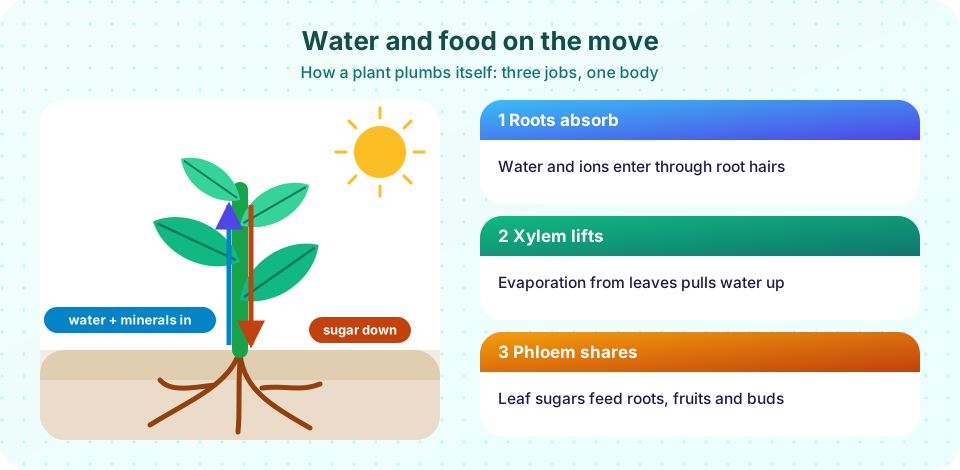
The big picture in three steps
Water enters
Uptake starts where roots meet soil
Water climbs
The sun powers the lift
Food circulates
Phloem feeds every living cell
What each lesson covers
- Water potential and osmosis introduces the quantity that predicts where water moves, with the equation Ψ = Ψs + Ψp, turgor and plasmolysis, and a calculator.
- Transpiration and stomata follows water through the leaf, explains how guard cells open and close stomata, and shows how humidity and temperature set the rate.
- Xylem and phloem transport explains the cohesion-tension theory of the xylem and the pressure-flow model of the phloem, and how tall a tree can grow.
- Mineral nutrition and soil lists the essential elements, shows how roots take them up, and teaches you to read deficiency symptoms.
- Chapter 5 review recaps the whole chapter with a picture, a table and ten questions.
How the parts connect
Everything in this chapter hangs from one idea: water and solutes move from where they have more free energy to where they have less. In roots, dissolved salts lower the water potential inside cells, so water enters. In leaves, evaporation drops the water potential to very low values, so water is pulled up through the xylem. In the phloem, sugar loading lowers the water potential at the source, water flows in, pressure rises, and sap is pushed toward sinks where sugar is removed.
Common misconceptions
"Roots suck water up like a straw." In most plants on most days, roots do not pump water up the stem. Evaporation from leaves pulls it. Root pressure exists, but it is small and works mainly at night in moist soil.
"Plants drink only through their roots, so leaves do not matter for water." Leaves are the engine of the water flow, not passengers. Close the stomata and the flow nearly stops.
Summary
- Plants lose more than 95% of the water they absorb as vapor, and the stream does useful work: minerals, cooling and turgor.
- Water moves toward lower water potential at every step, from soil to root to xylem to leaf to air.
- Xylem carries water up; phloem carries sugar from sources to sinks.
- This chapter builds the model step by step and ends with nutrition and a review.
Track your progress
Create a free account to tick off lessons and pick up where you left off on any device.
of Botany and Plant Science lessons completed