


















Lesson 33 of 48 · Growth, Hormones and Reproduction
Flowers, pollination and seeds
Learn flower anatomy, how pollination works, how double fertilization makes a seed and fruit, and how seeds disperse, stay dormant and germinate.
A flower is a plant's reproductive machine dressed up as an advertisement. The colors, scents and nectar are all aimed at a bee, a bird or a moth, while the quiet working parts in the center make and receive pollen. After a pollen grain lands on the right surface, a series of events begins that ends with a sealed, provisioned, dormant baby plant, the seed, usually carried inside a fruit. This lesson follows the whole sequence: parts of the flower, how pollen is delivered, what happens in the ovary, and what a seed needs to wake up.
What you will learn
- The parts of a flower and what each does.
- Pollination methods and how flowers match their pollinators.
- How double fertilization produces an embryo and the endosperm.
- How seeds and fruits form, disperse and germinate, and what dormancy is.
Key terms
Stamen: the male part: an anther (makes pollen) on a filament.
Carpel: the female part: stigma, style and ovary, which contains ovules.
Pollination: transfer of pollen from an anther to a stigma.
Double fertilization: one sperm fuses with the egg and the other with the central cell, giving a zygote and endosperm.
Germination: the start of growth by a seed's embryo.
Anatomy of a flower
Most flowers have four whorls of parts, from outside in:
- Sepals (together, the calyx) are usually green and protect the bud.
- Petals (the corolla) attract pollinators with color, scent and shape.
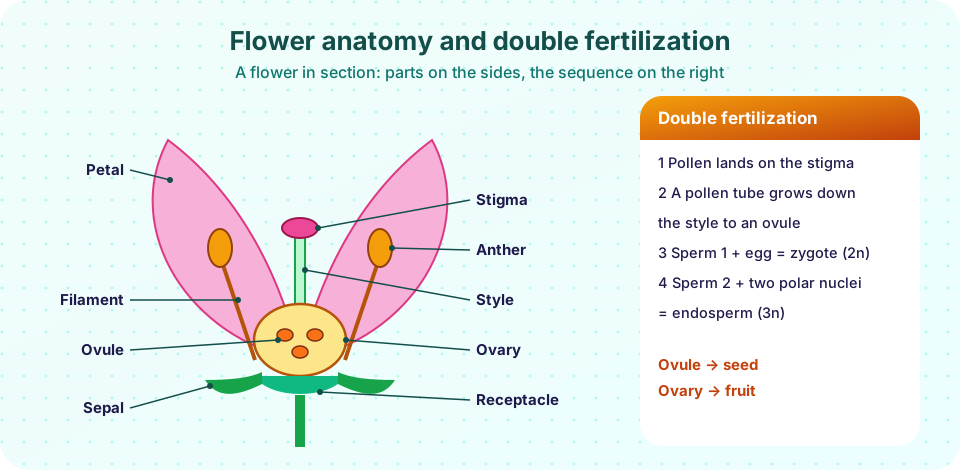
- Stamens (the androecium) are the male parts. Each is an anther carried on a filament. The anther holds pollen sacs where cells divide by meiosis to make microspores, which develop into pollen grains.
- Carpels (the gynoecium) are the female parts. A carpel has a sticky stigma to catch pollen, a style that leads down, and an ovary at the base containing one or more ovules. Each ovule contains an embryo sac with an egg cell and a large central cell with two nuclei.
Flowers vary a lot. A perfect flower has both stamens and carpels (lilies, roses). Imperfect flowers have only one kind. A plant that bears both male and female flowers is monoecious (maize: tassels are male, silks belong to female flowers), and one with separate male and female plants is dioecious (holly, willow, kiwifruit). Grasses and many trees have tiny, plain flowers; orchids and some tropical flowers are among the most elaborate structures in nature.
Pollination: getting pollen where it must go
Pollination is just delivery, not fertilization. Pollen can move by:
| Agent | Typical flower | Features |
|---|---|---|
| Wind | Grasses, birch, oak, pine | Small, dull flowers; huge amounts of light pollen; feathery stigmas |
| Bees | Sunflower, clover, apple | Bright blue, yellow or UV patterns; sweet scent; landing platform |
| Butterflies and moths | Phlox, evening primrose | Tubular, often fragrant; moth flowers open at night and are pale |
| Birds | Fuchsia, hibiscus | Red or orange, scentless, nectar-rich |
| Bats | Agave, baobab | Large, pale, musty, open at night |
| Water or self | Eelgrass, many weeds | Specialized or no external vector |
These are pollination syndromes, patterns that predict the likely pollinator, but real flowers are visited by many species. Some partnerships are almost exclusive. Fig trees and fig wasps depend on each other; many orchids trick insects with mimicry.
Self versus cross-pollination
Pollen landing on the same flower or plant is self-pollination, and from another plant of the same species is cross-pollination. Crossing mixes genes and increases variation, which helps populations adapt. Self-pollination guarantees seed when pollinators are scarce, and many crops such as wheat, rice and peas do it. Plants have many ways of avoiding selfing: stamens and carpels maturing at different times, separate male and female flowers, and self-incompatibility systems in which the stigma recognizes and rejects its own pollen by a protein-based genetic check.
Double fertilization
Once pollen lands on a compatible stigma, it hydrates and grows a pollen tube down the style, guided by chemical signals, until it reaches an ovule. Each pollen grain carries two sperm cells (no flagella; they are carried by the tube). The sperm enter the ovule and then something unique to flowering plants happens, first described by Sergei Nawaschin in 1898 and Léon Guignard in 1899 in lilies: double fertilization.
- One sperm (n) fuses with the egg (n) and forms the zygote (2n), which develops into the embryo.
- The other sperm (n) fuses with the central cell, which has two nuclei (n + n), to form a triploid (3n) endosperm, a nutritious tissue that feeds the embryo.
Why do it? A plant spends energy on food reserves only after an egg has been fertilized, so double fertilization avoids wasting resources on ovules that were never pollinated. Endosperm is also what we eat in cereals: the starchy part of a wheat or rice grain and the white inside of a coconut.
From ovule to seed and from ovary to fruit
After fertilization:
- The ovule becomes the seed. Its outer layers (integuments) harden into a seed coat (testa). Inside is the embryo, made of a radicle (embryonic root), a plumule (embryonic shoot) and one or two cotyledons (seed leaves). Cotyledons store food in many dicots (beans, peanuts) or are absorbed from endosperm in others.
- The ovary becomes the fruit. Auxin from developing seeds signals the ovary to swell, and gibberellin also helps. In botany, a fruit is any ripened ovary, so tomatoes, cucumbers, wheat grains and pea pods are all fruits.
Fruits come in many types: fleshy (berries, drupes such as peaches and cherries), dry (nuts, grains, capsules, legumes), aggregate (raspberry, from many carpels of one flower), multiple (pineapple, from many flowers), and accessory fruits where other tissue forms the flesh (apple: the core is the ovary, and the flesh is swollen receptacle tissue).
Dispersal
Fruits exist to get seeds away from the parent. Wind carries winged or plumed fruits (maple, dandelion). Animals eat fleshy fruits and pass seeds, or carry hooked burrs on fur. Water carries buoyant coconuts, and some plants fling seeds out of exploding pods. Dispersal reduces competition with the parent and helps colonize new places.
Dormancy and germination
Seed dormancy keeps seeds from sprouting at the wrong time, for example in an autumn warm spell. Dormancy can come from a hard seed coat (physical dormancy, broken by scratching or fire), from chemical inhibitors such as ABA (physiological dormancy, broken by cold, light or time), or both. Gardeners use scarification (nicking the coat) and stratification (cold, moist storage that imitates winter) to break dormancy.
Germination starts with imbibition, the uptake of water by the dry seed, which swells and cracks the coat. Water triggers the embryo to produce gibberellin, which activates enzymes that digest stored starch, protein and lipid. The radicle emerges first and anchors the seedling. Then the shoot emerges, either with cotyledons pushed above the ground (epigeal, as in beans) or left below (hypogeal, as in peas and maize). The seedling lives off reserves until its first leaves can photosynthesize.
Germination needs water, oxygen, suitable temperature and, for some species, light. Seeds can be very long-lived. A date palm seed about 2,000 years old, found at Masada in Israel, was germinated by researchers in 2005, though most seeds last only a few years.
Common misconceptions
"Pollination and fertilization are the same." Pollination is the arrival of pollen on a stigma. Fertilization is the fusion of sperm and egg, and it can happen hours or days later after the pollen tube grows.
"Fruits are sweet ones only." Botanically, any ovary that matures around seeds is a fruit, including grains, nuts, pea pods and tomatoes.
"Seeds need light to germinate." Many do not; some even germinate only in darkness under soil. A few small seeds do need light.
Try it
First, a simulation of pollen limitation: if a flower has 20 ovules and receives only a few pollen grains, how many ovules become seeds? It treats each pollen tube as picking an ovule at random, so extra tubes sometimes reach an ovule that is already taken.
Press Run (or Ctrl + Enter) to see the result here.
Program input · what you'd type while the program runs
Type the answers before you press Run, one per line. Each time the program reads a line (with input()), it gets the next line from this box.
Second, a thermal-time sketch of germination. It is an illustration of a common modelling idea: below a base temperature Tb germination stops, and above an optimum it falls again. The numbers are made up for the demonstration, not those of a real species.
Press Run (or Ctrl + Enter) to see the result here.
Program input · what you'd type while the program runs
Type the answers before you press Run, one per line. Each time the program reads a line (with input()), it gets the next line from this box.
Check your understanding
Quick check · 6 questions
of 6 answered You scored / 6 · perfect!
-
1. Which part of a carpel receives pollen?
The stigma is the sticky tip of the carpel that catches pollen; the style leads to the ovary. -
2. In double fertilization, the second sperm fuses with the central cell to form
One sperm makes the zygote; the other joins the two-nucleus central cell to form 3n endosperm. -
3. After fertilization, the ovary typically becomes
The ovule becomes the seed and the ovary wall develops into the fruit. -
4. A scientist nicks the seed coat of a hard-coated seed to help it germinate. What is this called?
Scarification breaks physical dormancy; stratification uses cold, moist storage. -
5. Which hormone from the embryo triggers the production of starch-digesting enzymes in a germinating cereal seed?
GA from the embryo induces the aleurone layer to make amylase that digests starch for the seedling. -
6. Wind-pollinated flowers usually have
Wind pollination relies on quantity and exposure, not on advertising.
Summary
- A flower has sepals, petals, stamens (anther and filament) and carpels (stigma, style, ovary with ovules).
- Pollination is delivery (wind, insects, birds, bats and others); fertilization comes later through the pollen tube.
- Double fertilization gives a diploid zygote and triploid endosperm; the ovule becomes the seed and the ovary becomes the fruit.
- Fruits help disperse seeds; dormancy delays germination until conditions are right.
- Germination begins with imbibition, then the radicle emerges, driven by gibberellin and stored reserves.
Next: Chapter 6 review
Track your progress
Create a free account to tick off lessons and pick up where you left off on any device.
of Botany and Plant Science lessons completed