


















Lesson 20 of 48 · Photosynthesis and Plant Metabolism
The Calvin cycle: how CO2 becomes sugar
Learn the three stages of the Calvin cycle, how Rubisco fixes CO2, the carbon and energy bookkeeping for one new sugar, and why photorespiration wastes carbon.
The light reactions leave the thylakoid with ATP and NADPH. The Calvin cycle, which runs in the stroma around the thylakoids, spends them to turn carbon dioxide, a gas in the air, into the solid sugar of a plant's body. It is a cycle because the molecule that captures CO2 is regenerated at the end, so the process can run again and again. Calvin, Benson and Bassham worked out its steps in the 1950s by feeding algae radioactive carbon and seeing where the label appeared first. This lesson goes through the cycle and then through the problem that makes the next lesson necessary.
What you will learn
- The three stages: fixation, reduction and regeneration.
- What Rubisco does and why it matters.
- How to count carbon atoms, ATP and NADPH for the cycle.
- Where the sugar goes: sucrose and starch.
- What photorespiration is and why it wastes energy.
Key terms
- RuBP: ribulose 1,5-bisphosphate, a 5-carbon sugar that accepts CO2.
- Rubisco: the enzyme that attaches CO2 to RuBP; its full name is ribulose-1,5-bisphosphate carboxylase/oxygenase.
- 3-PGA: 3-phosphoglycerate, the 3-carbon product of fixation.
- G3P: glyceraldehyde 3-phosphate, the 3-carbon sugar that exits the cycle.
- Photorespiration: a wasteful reaction in which Rubisco uses oxygen instead of CO2.
Stage 1: carbon fixation
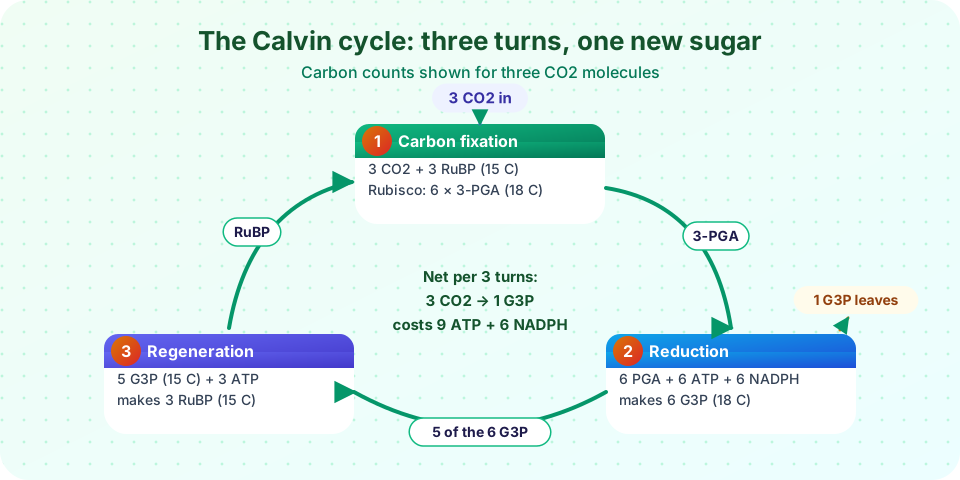
Rubisco attaches one CO2 to one RuBP (5 carbons). The 6-carbon product is unstable and splits at once into two molecules of 3-PGA (3 carbons each). This is carbon fixation: inorganic carbon is bound into an organic molecule. Calvin's labeling experiments found that 3-PGA was the first compound to carry the radioactive carbon, which gave the clue.
Rubisco is thought to be the most abundant protein on Earth, making up about half of the soluble protein in a leaf. It is also slow: a single enzyme fixes only a few CO2 molecules per second. Leaves compensate by having a huge amount of it.
Stage 2: reduction
Each 3-PGA receives a phosphate from ATP, and then electrons from NADPH, which converts it to G3P, a 3-carbon sugar phosphate. The word reduction means gaining electrons; this step is where the energy captured by the light reactions is locked into chemical bonds. Per CO2 fixed, this stage uses 2 ATP and 2 NADPH.
Stage 3: regeneration
Only one of every six G3P molecules produced in three turns leaves the cycle. The other five are rearranged through a series of sugar-interconversion reactions that use 1 ATP for each RuBP molecule made (3 ATP in total for three turns). They become three molecules of RuBP, ready to accept the next three CO2.
The bookkeeping
Count carbon atoms for three turns of the cycle (three CO2 in):
| Step | Molecules | Carbon atoms |
|---|---|---|
| Start: RuBP | 3 | 15 |
| Add CO2 | 3 | 3 |
| After fixation: 3-PGA | 6 | 18 |
| After reduction: G3P | 6 | 18 |
| One G3P leaves | 1 | 3 |
| Five G3P rebuilt to RuBP | 3 | 15 |
Carbon is conserved: 15 + 3 = 18, and 18 = 3 (exported) + 15 (recycled). Now count energy for the same three turns:
- Reduction: 6 ATP + 6 NADPH.
- Regeneration: 3 ATP.
- Total: 9 ATP and 6 NADPH for one G3P, which is the equivalent of 3 ATP and 2 NADPH per CO2 fixed.
To make a whole glucose (6 CO2), the cycle runs 6 turns and costs 18 ATP and 12 NADPH. This is why the light reactions must supply ATP and NADPH in a ratio of 3:2.
What happens to the G3P
G3P is the starting point of nearly all the plant's carbon compounds. Two G3P can be joined into a 6-carbon sugar (fructose and glucose phosphates).
- Starch is built inside the chloroplast during the day as a temporary store. At night it is broken down and exported as sugar. Many plants make starch granules that can be seen in leaves stained with iodine.
- Sucrose is built in the cytosol and loaded into the phloem for transport to the rest of the plant. Sucrose, a glucose-fructose disaccharide, is the main sugar of transport.
- Other products include cellulose for walls, amino acids, fats and many more compounds (see the lesson on metabolism).
Regulation by light
The Calvin cycle is not a "dark" reaction. Its enzymes are switched on in the light through the ferredoxin–thioredoxin system, and by the rise in stromal pH and magnesium concentration that light causes. In the dark, they shut down so the plant does not waste energy. This regulation is why net CO2 uptake ceases soon after sunset.
Rubisco's mistake: photorespiration
Rubisco evolved when the atmosphere had little oxygen and a lot of CO2. Today the air is about 21 percent oxygen and 0.04 percent CO2, and Rubisco sometimes mistakes O2 for CO2. When it fixes O2 to RuBP, the result is one 3-PGA and one 2-carbon compound (2-phosphoglycolate). The 2-carbon compound is toxic and the plant must recycle it through a long pathway in the chloroplast, peroxisome and mitochondrion that costs ATP and releases previously fixed CO2. This process is called photorespiration. It does not make ATP, unlike ordinary respiration.
Photorespiration gets worse with heat: at higher temperatures the balance shifts toward oxygen (Rubisco's affinity for CO2 falls relative to O2, and CO2 becomes less soluble than O2). In C3 plants at warm temperatures, photorespiration can claim a quarter or more of newly fixed carbon. This is the reason plants evolved C4 and CAM photosynthesis, and why crop scientists try to engineer ways around the problem.
Common misconceptions
- "The Calvin cycle makes glucose directly." It makes G3P. Glucose, sucrose and starch are built from G3P afterward.
- "The Calvin cycle only runs in the dark." It runs in the light and uses the light reactions' products.
- "Rubisco is a very fast enzyme." It is slow and also makes mistakes, which is why leaves contain so much of it.
- "Photorespiration is the same as respiration." It is a wasteful side reaction of Rubisco that releases CO2 and uses energy without making ATP.
Try it
Press Run (or Ctrl + Enter) to see the result here.
Program input · what you'd type while the program runs
Type the answers before you press Run, one per line. Each time the program reads a line (with input()), it gets the next line from this box.
Press Run (or Ctrl + Enter) to see the console output here.
No output.
Check your understanding
Quick check · 5 questions
of 5 answered You scored / 5 · perfect!
-
1. Rubisco joins CO2 to...
RuBP, a 5-carbon sugar, accepts the CO2. -
2. How many ATP and NADPH does the Calvin cycle need per CO2 fixed?
Reduction uses 2 ATP and 2 NADPH, and regeneration adds 1 ATP. -
3. Of six G3P made in three turns, how many leave the cycle?
One is exported; five are used to rebuild three RuBP. -
4. Photorespiration is caused by...
Rubisco has an oxygenase activity that produces a toxic 2-carbon compound. -
5. Why does photorespiration get worse when it is hot?
Higher temperatures favor O2 over CO2 at Rubisco's active site, and CO2 is less soluble.
Summary
- Calvin cycle: fixation (Rubisco adds CO2 to RuBP), reduction (ATP and NADPH make G3P), regeneration (RuBP rebuilt).
- Three turns: 3 CO2 in, 1 G3P out; 9 ATP and 6 NADPH.
- G3P becomes starch in the chloroplast and sucrose for export; the cycle is switched on by light.
- Rubisco sometimes fixes O2, causing photorespiration, which wastes carbon and energy and worsens in heat.
Next: C4 and CAM plants
Track your progress
Create a free account to tick off lessons and pick up where you left off on any device.
of Botany and Plant Science lessons completed