


















Lesson 10 of 48 · Plant Cells and Tissues
Plant tissues: meristems, dermal, ground and vascular
Learn the plant tissue systems: meristems that make new cells, dermal tissue, parenchyma, collenchyma, sclerenchyma, and the xylem and phloem that transport water and sugar.
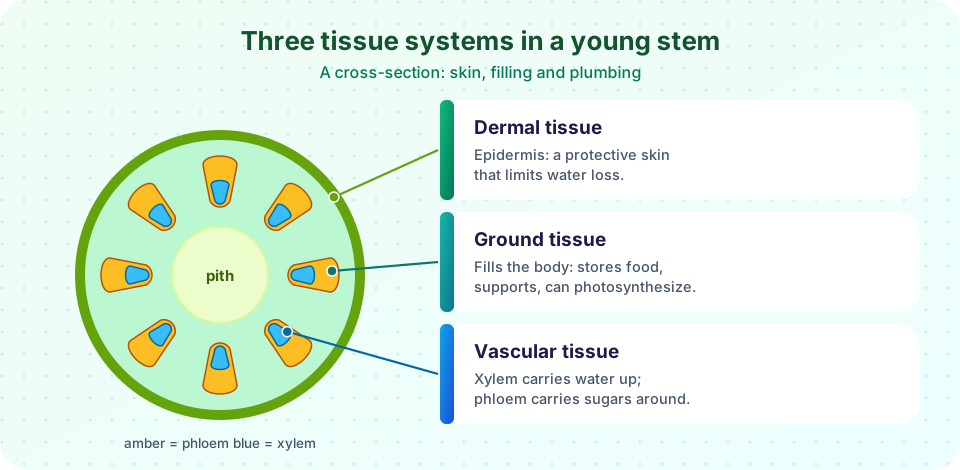
Cells rarely work alone. In a plant, groups of similar cells team up as tissues: some form a waterproof skin, some store starch, some conduct water, and some do nothing but divide. Knowing the tissues is the key to reading any plant organ. A root, a stem and a leaf look very different, but each one is made from the same small set of tissues arranged in different patterns. This lesson sorts those tissues into a simple system you can use in Chapter 3.
What you will learn
- The difference between meristematic and permanent tissue.
- The three permanent tissue systems and their cell types.
- How xylem and phloem differ in structure and in what they carry.
- How to recognize a tissue from its cell features.
Key terms
- Meristem: a region of unspecialized cells that keep dividing.
- Parenchyma: thin-walled living cells that do most of the plant's basic work.
- Xylem: vascular tissue that carries water and minerals upward.
- Phloem: vascular tissue that carries sugars and other organic molecules.
- Stoma (plural stomata): a pore in the epidermis, controlled by two guard cells, for gas exchange.
Meristematic tissue: the source of new cells
New cells come from meristems. Their cells are small, thin-walled, packed densely, have a large nucleus and small vacuoles, and keep dividing.
- Apical meristems sit at the tips of roots and shoots and make the plant longer (primary growth).
- Lateral meristems form a cylinder inside woody stems and roots and make them thicker (secondary growth). The vascular cambium adds xylem and phloem; the cork cambium adds bark.
- Intercalary meristems sit at the base of leaves and stem nodes in grasses. This is why a lawn mower does not kill grass: the growth point is below the cut.
Daughter cells leaving the meristem enlarge and differentiate, taking on the shape and chemistry of their final job. Differentiation is not always permanent, though: plant cells can often change their mind. A piece of carrot root grown in a nutrient jelly with the right hormones can regrow into a whole plant. This ability of plant cells to restore the whole organism is called totipotency, and it is the basis of tissue culture and cloning in horticulture.
Dermal tissue: the skin
The epidermis is usually one cell layer that covers young plant parts. Its cells are flat and fit together tightly. On the surface of leaves and stems it secretes a waxy cuticle that cuts water loss. Special features:
- Stomata. Pairs of bean-shaped guard cells surround a pore. When the guard cells fill with water and become turgid, the pore opens to let carbon dioxide in and water vapor out; when they lose water, it closes.
- Trichomes. Outgrowths from epidermal cells, called hairs. They reflect light, trap moisture, deter insects or secrete oils (the smell of mint comes from trichome glands).
- Root hairs. Long extensions of root epidermal cells that increase the surface for absorption (Chapter 3).
In older woody stems and roots, the epidermis splits and is replaced by periderm, which is the bark's outer layers of dead, waterproof cork cells.
Ground tissue: the filling
Ground tissue makes up most of a young plant. It has three cell types, differing in their walls.
| Type | Wall | Alive at maturity? | Job | Example |
|---|---|---|---|---|
| Parenchyma | Thin, flexible | Yes | Photosynthesis, storage, healing wounds | Leaf mesophyll, potato flesh |
| Collenchyma | Unevenly thickened with extra cellulose and pectin | Yes | Flexible support for growing parts | Celery "strings", petioles |
| Sclerenchyma | Thick, lignified | Usually dead | Rigid strength | Fibers in flax and hemp; stone cells (gritty bits) in pears |
Parenchyma is the all-purpose cell. In leaves it is called mesophyll and contains many chloroplasts. In roots and tubers it stores starch. Because its cells are alive and can divide, parenchyma also repairs damage.
Collenchyma works like a stretchy support: it cannot be too rigid, because it supports organs that are still growing. Pull the strings off a stick of celery; they are collenchyma strands.
Sclerenchyma comes in two forms: long fibers (used for rope and textile) and short, irregular sclereids (stone cells, which give nutshells and pear flesh their hardness). Their walls are so heavy that the cell dies once the wall is complete, leaving only a hollow, strong frame.
Vascular tissue: the plumbing
Vascular tissue is a continuous network of tubes running from the root tip to the leaves. It consists of two tissues that are usually found together in vascular bundles.
Xylem: water upward
- Tracheids are long, narrow, tapered dead cells with thick lignified walls and small holes called pits. Water passes from one tracheid to the next through the pits. All vascular plants have them.
- Vessel elements are shorter and wider cells found in flowering plants and a few others. They are stacked end to end with open ends (perforation plates), forming a continuous tube called a vessel, which carries water faster.
- Fibers give strength and parenchyma stores food.
The conducting cells of xylem are dead when functional: an empty hollow tube has no cytoplasm in the way. The walls are strengthened with lignin in rings, spirals or networks, which keeps the tubes from collapsing when water is pulled up under tension (Chapter 5).
Phloem: sugars around
- Sieve tube elements are living cells joined end to end into tubes. The end walls, called sieve plates, are perforated like a colander. Mature sieve tube elements lose their nucleus and most organelles to make room for flow.
- Companion cells sit beside each sieve tube element, are connected to it by plasmodesmata and keep it alive: they have the nucleus and the machinery for loading sugar.
- Fibers and parenchyma support and store.
Phloem carries sap rich in sucrose, along with amino acids, hormones and some RNA. Xylem sap is a dilute solution of water and minerals.
| Feature | Xylem | Phloem |
|---|---|---|
| Carries | Water and minerals | Sugars and other organic molecules |
| Direction | Mostly up | Source to sink, up or down |
| Conducting cells | Dead (tracheids, vessels) | Living (sieve tubes) |
| Cell walls | Thick, lignified | Thin, cellulose |
| Position in a stem bundle | Inner side | Outer side |
In a woody stem, you can see the difference in a tree trunk: the wood is old xylem; the thin living layer just inside the bark is phloem and cambium. Ring a tree by cutting around the trunk through the phloem, and the roots starve while the leaves still get water, which is why girdling kills trees.
Common misconceptions
- "Xylem carries water up and phloem carries it down." Phloem carries sugars from where they are made (sources, such as mature leaves) to where they are used or stored (sinks, such as roots, fruits and growing tips), which can be up or down.
- "All cells in xylem are alive." The conducting cells (tracheids and vessel elements) are dead and hollow when they work.
- "A plant cell that has become specialized is stuck that way." Many can dedifferentiate, which is why cuttings root and wounds heal.
- "Wood is the same thing as bark." Wood is xylem. Bark is everything outside the cambium: phloem, cork cambium and cork.
Try it
Press Run (or Ctrl + Enter) to see the result here.
Program input · what you'd type while the program runs
Type the answers before you press Run, one per line. Each time the program reads a line (with input()), it gets the next line from this box.
Check your understanding
Quick check · 5 questions
of 5 answered You scored / 5 · perfect!
-
1. Where does primary growth (growth in length) occur?
Apical meristems at root and shoot tips add length; lateral meristems add width. -
2. Which ground tissue provides flexible support in celery strings?
Collenchyma has unevenly thickened walls and is alive, so it supports growing parts without being brittle. -
3. Which cells carry water in xylem and are dead when working?
The empty, lignified tubes offer no cytoplasm to slow the flow. -
4. What is the job of a companion cell?
Sieve tube elements lose their nuclei, so companion cells supply the machinery. -
5. Why does girdling (cutting a ring through the bark) kill a tree?
Roots starve because phloem flow from the leaves is cut; the xylem stays intact at first.
Summary
- Meristems make new cells; apical meristems lengthen, lateral meristems thicken, intercalary meristems regrow grass.
- Dermal tissue (epidermis, cuticle, stomata, trichomes) forms the skin; periderm replaces it in woody plants.
- Ground tissue: parenchyma (living, general), collenchyma (flexible support), sclerenchyma (rigid, dead).
- Vascular tissue: xylem (dead tubes, water and minerals up) and phloem (living sieve tubes, sugars source to sink).
- Plant cells can often dedifferentiate, which is the basis of cuttings and tissue culture.
Next: Chapter 2 review
Track your progress
Create a free account to tick off lessons and pick up where you left off on any device.
of Botany and Plant Science lessons completed