


















Lesson 11 of 47 · Transmission Lines
Chapter 3 Overview: Transmission Lines
Preview chapter 3 on transmission lines: overhead lines, cables and HVDC, the physical parts of a line, conductor sag, and how R, L and C enter the models.
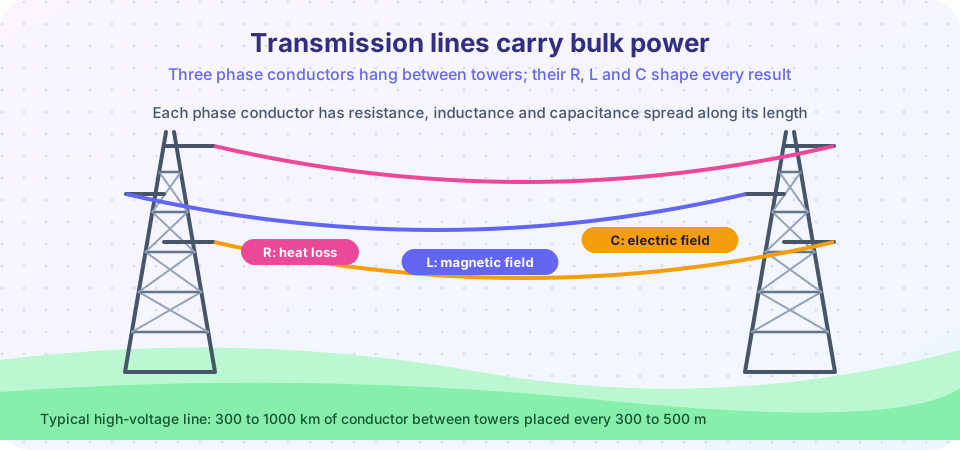
A transmission line looks like three wires on a tower, but to the circuit it is a long, thin component with resistance, inductance and capacitance spread along its length. These three properties decide how much power a line can carry, how much voltage it loses, and how much reactive power it absorbs or produces. Chapter 3 shows you how to calculate them and how to model a line at the right level of detail.
What you will learn
- The physical parts of an overhead line and their purpose.
- When to use overhead lines, underground cables or HVDC.
- How the sag of a conductor depends on span, weight and tension.
- How the lessons in this chapter fit together.
Key terms
- Conductor: the wire that carries current, often aluminum strands around a steel core (ACSR).
- Insulator: a string of porcelain, glass or polymer discs that holds the conductor away from the tower.
- Span: the horizontal distance between two adjacent towers.
- Sag: the vertical drop of the conductor below the line joining its two supports.
- Right-of-way: the strip of land reserved for the line.
The parts of an overhead line
Conductors. Aluminum is light and cheap, but weak; steel is strong but a poor conductor. Aluminum conductor steel-reinforced (ACSR) wraps aluminum strands around a steel core so the steel carries the weight and the aluminum carries the current. High-voltage phases are often split into bundles of two to four conductors, which reduces the electric field at the surface (less corona loss and radio noise) and lowers the line inductance.
Insulators. Air is the main insulation, but the conductor must be attached to a grounded steel tower. Strings of insulator discs provide the required distance; higher voltages need longer strings.
Towers. Lattice steel towers, tubular poles and wood or concrete poles hold the line. Tower heights and spans are chosen so that conductors stay safely above the ground and above each other in wind and heat.
Shield wires. One or two grounded wires run above the phase conductors. They catch lightning strikes and divert them to ground.
Overhead, underground or HVDC?
Overhead AC is the default because it is cheapest. Its limits are visual impact and land use, and the capacitance and inductance that limit long-distance AC.
Underground cables avoid the visual impact but have much more capacitance (conductors are close to ground), so they generate large charging current. AC cables become impractical beyond a few tens of kilometers without compensation. They also cost several times more per kilometer than overhead lines.
HVDC (high-voltage direct current) links use converters at each end and two conductors (or one with a return path). There is no reactive power and no stability limit related to distance, so HVDC beats AC for very long overhead routes (several hundred kilometers and up), for long submarine cables, and for linking grids with different frequencies. The converter stations are the cost.
A first look at sag
A conductor hangs in a curve called a catenary. For ordinary spans it is well approximated by a parabola, and the sag at midspan is
D = w L² / (8 T)
where w is the weight per unit length (N/m), L the span (m) and T the horizontal tension (N). A heavier or longer span sags more; more tension gives less sag. On a hot day the metal expands, the tension falls and the sag grows, which is why line capacity is limited by the minimum clearance to the ground.
Three constants shape every line
Series R and L, shunt C.
Pick the model by length
Longer lines need more detail.
Loading limits
The binding limit changes with length.
The lessons in this chapter
- Line Parameters derives R, L and C from conductor geometry.
- Short and Medium Lines builds the series and nominal-π models, with ABCD parameters and voltage regulation.
- Long Lines and Surge Impedance Loading introduces distributed parameters, the characteristic impedance and the Ferranti effect.
- Chapter 3 Review summarizes the chapter and tests you.
Common misconceptions
- "A longer line just has more resistance." Resistance grows with length, but inductive and capacitive effects often matter more at high voltage.
- "Cables are better because you cannot see them." AC cables charge up so much that long ones need reactors; they also cost more and are slower to repair.
- "Sag is a defect." Sag is essential: a perfectly straight wire would need infinite tension. Engineers choose it to balance tension, clearance and cost.
Try it
First, compare a parabola to the true catenary for a 400 m span and see how little they differ. The weight and tension are illustrative, not data for a real conductor.
Press Run (or Ctrl + Enter) to see the result here.
Program input · what you'd type while the program runs
Type the answers before you press Run, one per line. Each time the program reads a line (with input()), it gets the next line from this box.
Second, a rule-of-thumb chooser. Enter a route length and the type of route to get a first guess for the technology. The thresholds are rough guidelines, not design rules: real choices depend on cost studies.
Check your understanding
Quick check · 5 questions
of 5 answered You scored / 5 · perfect!
-
1. What is the main purpose of the steel core in an ACSR conductor?
Steel provides strength; aluminum, which is a good conductor, carries the current. -
2. A span is 300 m, the conductor weighs 15 N/m and the horizontal tension is 27 kN. What is the approximate sag?
D = w L² / (8 T) = 15 × 90,000 / (8 × 27,000) = 6.25 m. -
3. Why do long AC cables often need shunt reactors?
The capacitance of a cable is much larger than that of an overhead line, and the charging current limits its length. -
4. Which situation most clearly favors HVDC?
HVDC converters allow power exchange between asynchronous grids. -
5. What do shield wires do?
They are grounded wires above the phase conductors that take lightning strikes.
Summary
- An overhead line has conductors, insulators, towers and shield wires; bundled phase conductors cut corona and inductance.
- Overhead AC is cheapest; cables avoid visual impact but charge heavily; HVDC suits very long routes and asynchronous links.
- Sag
D = w L² / (8 T); heat reduces tension and increases sag. - R, L and C are the three line constants; the model detail depends on line length.
Next: Line Parameters
Track your progress
Create a free account to tick off lessons and pick up where you left off on any device.
of Electric Power Systems lessons completed