


















Lesson 41 of 47 · Projects and Practice
Chapter 9 overview: projects and practice
A guide to the final chapter: how to structure an engineering calculation, which checks catch mistakes, typical numbers for plausibility, and what each project and practice set covers.
Eight chapters have given you tools: phasors and per-unit systems, load flow, fault calculation, relays, stability equations, renewable and storage models, dispatch and markets. Real engineering problems do not arrive labeled by chapter. A utility asks whether a new wind farm will overload a breaker; a hospital asks how much battery it needs; an operator asks why the frequency dipped. Answering means choosing the right tools, applying them in the right order and, above all, checking that the answer makes sense.
This chapter has two projects, a set of twelve practice problems, a glossary, a one-page cheat sheet and a guide to further study. Work through the projects by running and changing the code; do the problems by hand before you look at the answers.
What you will learn
- Apply a four-step workflow to any power-system calculation.
- Use quick plausibility checks to catch errors.
- Convert between per-unit bases without mistakes.
- Know what each project and practice lesson contains.
Key terms
Base quantity: a reference value (Sbase, Vbase) used to express quantities in per unit.
Sanity check: a quick estimate that tells you whether a result is in the right range.
Sensitivity: how much a result changes when an input changes; it shows which inputs matter.
Scenario: one set of assumptions, for example "peak load with one line out".
Margin: the difference between a computed value and its limit.
A four-step workflow
Four steps
Usual suspects
- Define. State the question and what would count as an answer: a number with a unit, a yes/no against a limit, a design choice. List the data you have and the data you must assume. Write the limits (breaker rating, voltage band, battery capacity) next to the question.
- Model. Pick the simplest model that captures what matters. A bolted three-phase fault needs only the positive-sequence network; a frequency dip needs the aggregated swing equation, not every generator. Add detail only when a sensitivity check says it changes the answer.
- Verify. Check units, check limiting cases (what happens with zero load? with infinite grid strength?), compare with a rough hand estimate, and confirm that the result lies within typical ranges.
- Interpret. Give the margin, name the assumption that most affects the result, and say what you would study next.
Plausibility ranges
Having a feel for typical numbers is the fastest error detector. A few that this course has used:
| Quantity | Typical range |
|---|---|
| Fault current compared with full-load current | 5 to 50 times |
Transmission line X/R ratio |
5 to 20 |
| Fault clearing time (transmission) | 2 to 6 cycles |
| Inertia constant of a large generator | 2 to 9 s |
| Nominal system inertia | 3 to 6 s |
| Governor droop | 4 to 5 % |
| Frequency deviation in normal operation (50 Hz grids) | within ± 50 mHz |
| Transmission network voltage band | about ± 5 % |
| PV capacity factor | 15 to 30 % |
| Onshore wind capacity factor | 25 to 45 % |
| Li-ion round-trip efficiency | 85 to 90 % |
| Transmission losses | 2 to 6 % of energy |
If a fault current comes out at 0.3 times the load current, or a PV capacity factor at 60 %, stop and look for the mistake.
Changing the base
A very common error is mixing per-unit values on different bases. To convert an impedance from an old base to a new one:
Z_pu,new = Z_pu,old × (S_base,new / S_base,old) × (V_base,old / V_base,new)²
For example, a transformer reactance of 0.08 pu on 50 MVA becomes 0.08 × 100/50 = 0.16 pu on 100 MVA at the same voltage base. Base current is Ibase = Sbase / (√3·Vbase).
What is in the chapter
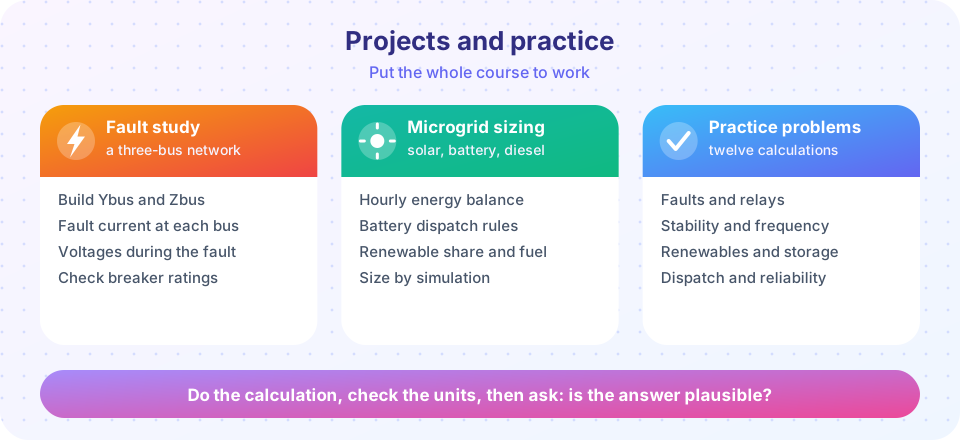
- Project 1: fault study of a three-bus system: build the bus impedance matrix and compute fault currents and voltages.
- Project 2: sizing a solar-battery-diesel microgrid: simulate a day, sweep sizes and estimate cost and renewable share.
- Practice problems: twelve problems across chapters 5 to 8, with a solution calculator.
- Glossary: the key terms of chapters 5 to 8.
- Cheat sheet: one page of formulas, constants and typical numbers.
- Further study: where to go next and how this course connects to the rest of the site.
Common misconceptions
"If the code runs and gives a number, it is right." Programs execute mistakes just as faithfully as correct models. Always compare with a hand estimate.
"More detail means more accuracy." Extra detail with uncertain data adds false precision. A simple model with the right assumptions beats a detailed one with wrong ones.
"The answer is the number." In engineering the answer is the number with its margin and its assumptions.
Try it
The first example is a small toolkit of sanity-check functions: base current, base impedance, base change and an instant fault-level estimate from a short-circuit MVA. Use it whenever you start a calculation.
Press Run (or Ctrl + Enter) to see the result here.
Program input · what you'd type while the program runs
Type the answers before you press Run, one per line. Each time the program reads a line (with input()), it gets the next line from this box.
The second example is a base-current calculator: set the MVA and kV bases and read Ibase and Zbase.
Check your understanding
Quick check · 4 questions
of 4 answered You scored / 4 · perfect!
-
1. A reactance of 0.12 pu is given on a 25 MVA base at 11 kV. What is it on a 100 MVA base at the same voltage?
Z_new = 0.12 x 100/25 = 0.48 pu. -
2. What is the base current for 100 MVA at 33 kV?
Ibase = 100e6 / (sqrt(3) x 33e3) = 1,750 A. -
3. A computed PV capacity factor is 62 %. What should you do first?
A value far outside typical ranges signals a mistake or a very special case that needs explanation. -
4. Which is the last step of the four-step workflow?
After defining, modeling and verifying, you interpret the result: margins, assumptions and next steps.
Summary
- A reliable calculation follows four steps: define, model, verify, interpret.
- Plausibility ranges catch errors early; knowing typical numbers is part of the skill.
- When changing a per-unit base use
Z_new = Z_old·(S_new/S_old)·(V_old/V_new)². - The chapter offers two projects, a practice set, a glossary, a cheat sheet and a guide to further study.
Track your progress
Create a free account to tick off lessons and pick up where you left off on any device.
of Electric Power Systems lessons completed