


















Lesson 10 of 47 · Generation and the Grid
Chapter 2 Review: Generation and the Grid
Review synchronous generators, load curves, capacity factor, merit order and transformers with a one-page poster, recap table, flash cards and a ten-question quiz.
Chapter 2 opened the boxes in the grid diagram: the machine that makes the power, the curve that tells you how much is wanted, and the device that moves it between voltage levels. Use this page to check that the ideas have stuck.
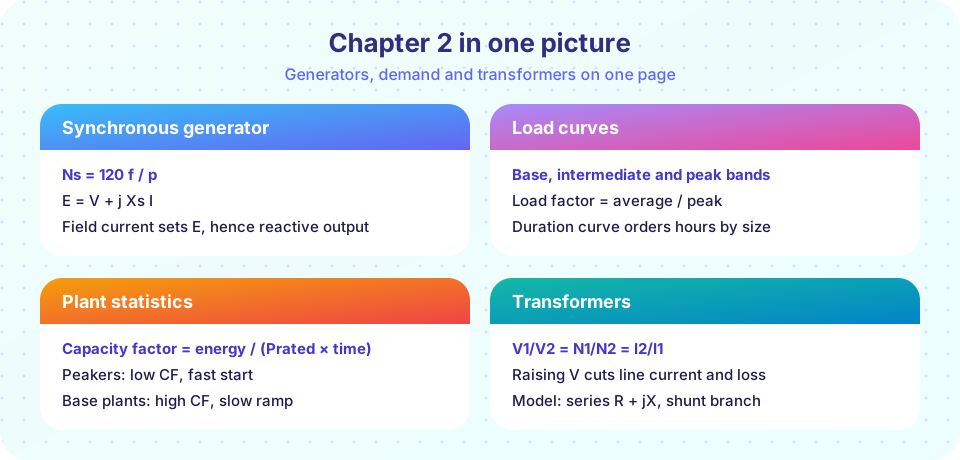
What you will review
- Speed, excitation, the phasor model and the power angle of a synchronous generator.
- Load factor, capacity factor, duration curves and merit order.
- Turns ratio, impedance reflection, regulation and efficiency of transformers.
Recap table
| Topic | Key relations | Lesson |
|---|---|---|
| Generator speed | Ns = 120 f / p |
Synchronous Generators |
| Generator model | E = V + j Xs I; P = 3 E V sin δ / Xs |
Synchronous Generators |
| Excitation | High E: supplies Q. Low E: absorbs Q |
Synchronous Generators |
| Load factor | average / peak | Load Curves and Power Plants |
| Capacity factor | E / (Prated × T) |
Load Curves and Power Plants |
| Merit order | cheapest first; last unit sets the price | Load Curves and Power Plants |
| Transformer | V1/V2 = N1/N2, Z' = a² Z |
Transformers |
| Regulation, efficiency | Req + jXeq; best efficiency when copper loss = core loss |
Transformers |
Worked review example
A 30 MW baseload plant ran at full output for 7000 hours in a year and was off for the rest. Its generator step-up transformer is rated 40 MVA, 13.8 kV / 230 kV (delta-wye).
- Energy
= 30 × 7000 = 210,000 MWh. - Capacity factor
= 210,000 / (30 × 8760) = 79.9%. - Line voltage ratio
= 230 / 13.8 = 16.67. With the wye on the high side, the phase turns ratio isNd / Ny = 13.8 / (230 / √3) = 0.104. - Rated high-side current
= 40×10⁶ / (√3 × 230,000) = 100.4 A, and low-side current= 40×10⁶ / (√3 × 13,800) = 1673 A.
The generator side carries 16.7 times the current. That is why the generator's bus ducts are massive and the transmission line's conductors are slender.
Common misconceptions
- "Capacity factor and load factor mean the same thing." One describes a plant's output against its rating, the other the customers' demand against its own peak.
- "The marginal plant is the most expensive plant in the system." It is the most expensive plant that is running at that moment, which depends on demand.
- "Excitation sets real power." It sets internal voltage and, through it, reactive power; the turbine sets real power.
Try it
First, a calculator that chains the three lessons: a generator's internal voltage and angle, a plant's load factor and capacity factor, and a transformer's currents. Change the numbers at the top.
Press Run (or Ctrl + Enter) to see the result here.
Program input · what you'd type while the program runs
Type the answers before you press Run, one per line. Each time the program reads a line (with input()), it gets the next line from this box.
Second, flash cards. Click a card to flip it, then move to the next one. Say the answer out loud before you flip.
Check your understanding
Quick check · 9 questions
of 9 answered You scored / 9 · perfect!
-
1. A 2-pole generator on a 60 Hz grid runs at:
Ns = 120 × 60 / 2 = 3600 rpm. -
2. A generator on a strong grid is under-excited. It is:
A low internal voltage E makes the machine draw reactive power. -
3. Per phase V = 6 kV, E = 9 kV, Xs = 1.5 Ω. What is the maximum three-phase power?
Pmax = 3 E V / Xs = 3 × 9000 × 6000 / 1.5 = 108 MW. -
4. A system has a peak of 500 MW and an average of 350 MW. Its load factor is:
350 / 500 = 0.70. -
5. A plant of 100 MW produced 438,000 MWh in a year. What is its capacity factor?
438,000 / (100 × 8760) = 0.5. -
6. In merit-order dispatch the plant that is marginal is:
The marginal unit is the last one called on; its cost often sets the market price. -
7. A transformer has a = 8. A 5 Ω load on the secondary looks like what to the primary?
Z' = a² ZL = 64 × 5 = 320 Ω. -
8. A transformer's core loss is 1 kW and its copper loss at full load is 4 kW. Peak efficiency occurs at what load fraction?
Set x² × 4 = 1, so x = 0.5. -
9. Which statement about inertia is correct?
The kinetic energy of rotating machines slows frequency changes. Inverter-based sources have none unless it is emulated.
Summary
- Generators:
Ns = 120 f / p,E = V + j Xs I,P = 3 E V sin δ / Xs; excitation controls reactive power. - Demand: load curve, duration curve, load factor, capacity factor; plants are matched to the curve by cost and ramp speed.
- Merit order dispatches the cheapest plants first; the marginal unit sets the price.
- Transformers: ratio,
a²impedance reflection, regulation, best efficiency when copper loss equals core loss. - Chapter 3 moves to the lines that connect plants to loads.
Track your progress
Create a free account to tick off lessons and pick up where you left off on any device.
of Electric Power Systems lessons completed