


















Lesson 27 of 47 · Stability and Control
The swing equation and the equal-area criterion
Derive the swing equation, plot the power-angle curve, apply the equal-area criterion to find the critical clearing angle and time, and compute the natural swing frequency.
A synchronous generator is a heavy spinning mass joined to the grid by an electrical coupling. In steady state the turbine's mechanical power equals the electrical power sent into the grid and the rotor turns at exactly synchronous speed. Any imbalance between the two powers accelerates or decelerates the rotor, and the rotor angle (its position relative to a reference spinning at synchronous speed) changes. Understanding that motion is the whole of transient stability.
Two tools do the job. The swing equation describes how the angle moves; the equal-area criterion tells you, without integrating anything, whether the swing will stop or run away.
What you will learn
- Write the swing equation in per-unit and define the inertia constant
H. - Sketch the power-angle curve and find the steady-state operating angle.
- Apply the equal-area criterion to find the critical clearing angle and time.
- Estimate the natural frequency of small oscillations.
Key terms
Rotor angle (δ): the angle between the machine's internal emf and a reference rotating at synchronous speed.
Swing equation: the equation of motion of the rotor, (2H/ωs)·d²δ/dt² = Pm − Pe.
Power-angle curve: Pe = Pmax·sin δ, the electrical power as a function of angle.
Critical clearing angle / time: the largest angle (time) at which a fault can be cleared with the machine still stable.
Steady-state stability limit: the maximum power, reached at δ = 90°.
The swing equation
Newton's law for rotation says J·dωm/dt = Tm − Te. Multiplying by the speed and dividing by the machine's rating S gives, in per unit,
(2H / ωs) · d²δ/dt² = Pm − Pe (δ in electrical radians, t in seconds)
where ωs = 2π·f is the synchronous speed (314.16 rad/s at 50 Hz, 377 at 60 Hz) and the inertia constant
H = (½·J·ωm²) / S [MJ/MVA = seconds]
is the kinetic energy stored at rated speed divided by the rating. It is the number of seconds the machine could supply its rated power from stored rotational energy alone. Large steam turbo-generators have H of about 2 to 9 s, hydro units 2 to 4 s, and a typical system averages 3 to 6 s. A machine with larger H accelerates more slowly for the same power imbalance, so it has more time before the fault must be cleared.
Several machines swinging together can be represented as one equivalent machine with Heq = Σ(Hi·Si)/Sbase. Machines in the same plant swing in a coherent group.
The power-angle curve
If the generator's internal emf E is joined to an infinite bus of voltage V through a total reactance X, the power delivered is
Pe = (E·V / X) · sin δ = Pmax · sin δ
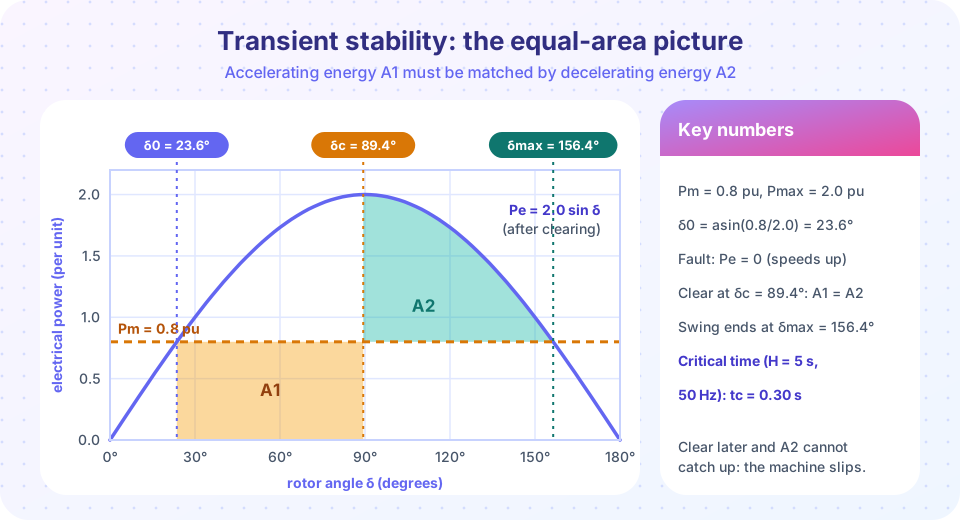
Steady operation is where Pe = Pm, giving δ0 = asin(Pm/Pmax). For Pm = 0.8 and Pmax = 2.0 per unit, δ0 = 23.6°. The curve has two intersections with the line Pm: at δ0 and at 180° − δ0 = 156.4°. Only the first is stable: a small increase in angle makes Pe exceed Pm, which brings the rotor back. At the second the opposite occurs. The maximum power the machine can deliver, at δ = 90°, is the steady-state stability limit.
The equal-area criterion
Multiply the swing equation by dδ/dt: the left side becomes the derivative of the kinetic energy of the speed deviation, the right side is (Pm − Pe)·dδ/dt. Integrating gives a statement about energy:
∫ (Pm − Pe) dδ from δ0 to δ = (H/ωs)·(dδ/dt)²
The rotor stops swinging (its speed deviation returns to zero) when the integral is zero: the area gained while Pm > Pe (acceleration) is cancelled by the area lost while Pm < Pe (deceleration). In the figure:
- Before the fault the machine sits at
δ0. - The fault at the terminals drops
Peto zero, so the rotor accelerates through the angle fromδ0to the clearing angleδc; the gained kinetic energy is the rectangle A1 = Pm·(δc − δ0). - After clearing,
Pefollows the curve again and exceedsPm, decelerating the rotor: the area A2 between the curve and thePmline, fromδcup to the angle where the rotor stops. - The machine is stable if A2 can grow to equal A1 before the angle reaches
δmax = 180° − δ0. Beyondδmaxthe electrical power falls belowPmagain and the rotor accelerates once more.
Setting A1 = A2 for a terminal fault with the same Pmax before and after gives the critical clearing angle:
cos δc = (Pm / Pmax)·(δmax − δ0) + cos δmax (angles in radians in the first term)
With the example numbers: δ0 = 0.4115 rad, δmax = 2.7301 rad, so cos δc = 0.4 × 2.3186 + (−0.9165) = 0.0109 and δc = 89.4°. During the fault Pe = 0, so the acceleration is constant, α = ωs·Pm/(2H) = 314.16 × 0.8 / 10 = 25.1 rad/s², and the critical clearing time is tc = √(2(δc − δ0)/α) = √(2 × 1.148 / 25.1) = 0.30 s. In practice faults are cleared in 4 to 6 cycles (about 0.1 s), well inside the limit.
If the fault is not at the terminals, the machine can still deliver a reduced P1 = r1·Pmax during the fault, and P2 = r2·Pmax after the faulted line is removed. The general formula is
cos δc = [ Pm·(δmax − δ0) + P2·cos δmax − P1·cos δ0 ] / (P2 − P1), δmax = π − asin(Pm/P2)
How to improve stability
Anything that lowers the area A1 or enlarges A2 helps: faster fault clearing, a higher Pmax (lower X through series capacitors or parallel lines; higher voltage), a larger H, high-speed excitation systems that raise E after the fault, braking resistors that absorb power during the fault, and generation or load shedding that reduces Pm. Single-pole reclosing, which opens only the faulted phase, keeps part of the transfer capability during the fault.
Small oscillations
Linearizing around δ0, a small disturbance Δδ obeys (2H/ωs)·Δδ'' + Pmax·cos δ0·Δδ = 0, a harmonic oscillator with
ωn = √( ωs · Pmax · cos δ0 / (2H) )
For the example ωn = √(314.16 × 2.0 × 0.916 / 10) = 7.6 rad/s, or 1.21 Hz, which is why electromechanical oscillations of single machines against the grid lie around 1 to 2 Hz. Inter-area oscillations between large groups of machines are slower (0.1 to 0.8 Hz). The oscillation is damped by damper windings and by power system stabilizers; with negative damping it grows, the small-signal instability that grid operators monitor.
The equal-area criterion works exactly only for a one-machine-infinite-bus system and a constant E. For real networks engineers run time-domain simulations of all machines, but they still use the equal-area picture to understand why a case is unstable.
Common misconceptions
"The machine is unstable if the angle exceeds 90°." It can swing past 90° and return: the limit is δmax (156° in the example), and it depends on the post-fault network.
"A stable steady state implies transient stability." A system can be perfectly stable at its operating point yet lose synchronism after a large fault, if clearing is too slow.
"Larger inertia always helps." It slows the acceleration, but a very large H also makes oscillations slower and does nothing for voltage stability.
Try it
The first example finds the critical clearing time numerically by simulating the swing equation and bisecting on the clearing time. It compares it with the analytical result and shows how a fault that leaves some transfer capability (P1 > 0) lengthens it.
Press Run (or Ctrl + Enter) to see the result here.
Program input · what you'd type while the program runs
Type the answers before you press Run, one per line. Each time the program reads a line (with input()), it gets the next line from this box.
The second example is an equal-area explorer. Drag the clearing angle δc. The bars compare the accelerating area A1 with the maximum available decelerating area A2; the verdict updates.
The third example checks the small-oscillation frequency. It nudges the rotor by 5° from δ0 and simulates a lightly damped machine. The measured frequency is compared with ωn/2π.
Press Run (or Ctrl + Enter) to see the result here.
Program input · what you'd type while the program runs
Type the answers before you press Run, one per line. Each time the program reads a line (with input()), it gets the next line from this box.
Check your understanding
Quick check · 5 questions
of 5 answered You scored / 5 · perfect!
-
1. A machine delivers Pm = 1.0 pu and has Pmax = 2.5 pu. What is its steady-state rotor angle?
delta0 = asin(1.0/2.5) = asin(0.4) = 23.6 degrees. -
2. What does the inertia constant H represent?
H = (1/2) J wm^2 / S, in MJ/MVA, equivalent to seconds. -
3. In the equal-area criterion, area A1 represents
While the fault reduces Pe below Pm, the surplus power accelerates the rotor; the area is the kinetic energy it gains. -
4. Which change increases the critical clearing time?
Larger H slows the acceleration, so the machine tolerates a longer fault. -
5. A small-signal oscillation of a single machine against the grid is typically at
The natural frequency sqrt(ws Pmax cos(delta0)/(2H))/(2 pi) is usually between 1 and 2 Hz for a machine against a strong grid.
Summary
- Swing equation:
(2H/ωs)·d²δ/dt² = Pm − Pe;His stored energy per rating in seconds. - Power-angle curve:
Pe = Pmax·sin δ; stable operating point atδ0 = asin(Pm/Pmax)below 90°. - Equal-area criterion: stable if the decelerating area can equal the accelerating area before
δmax; this yields the critical clearing angle and time. - Faster clearing, higher
Pmax, largerHand braking resistors improve transient stability. - Small oscillations have a natural frequency
ωn = √(ωs·Pmax·cos δ0/(2H)), about 1 to 2 Hz for a machine against a grid.
Next: Frequency control
Track your progress
Create a free account to tick off lessons and pick up where you left off on any device.
of Electric Power Systems lessons completed